Akai GX-F31: The Precision-Built Audiophile Reel-to-Reel from Japan’s Golden Age
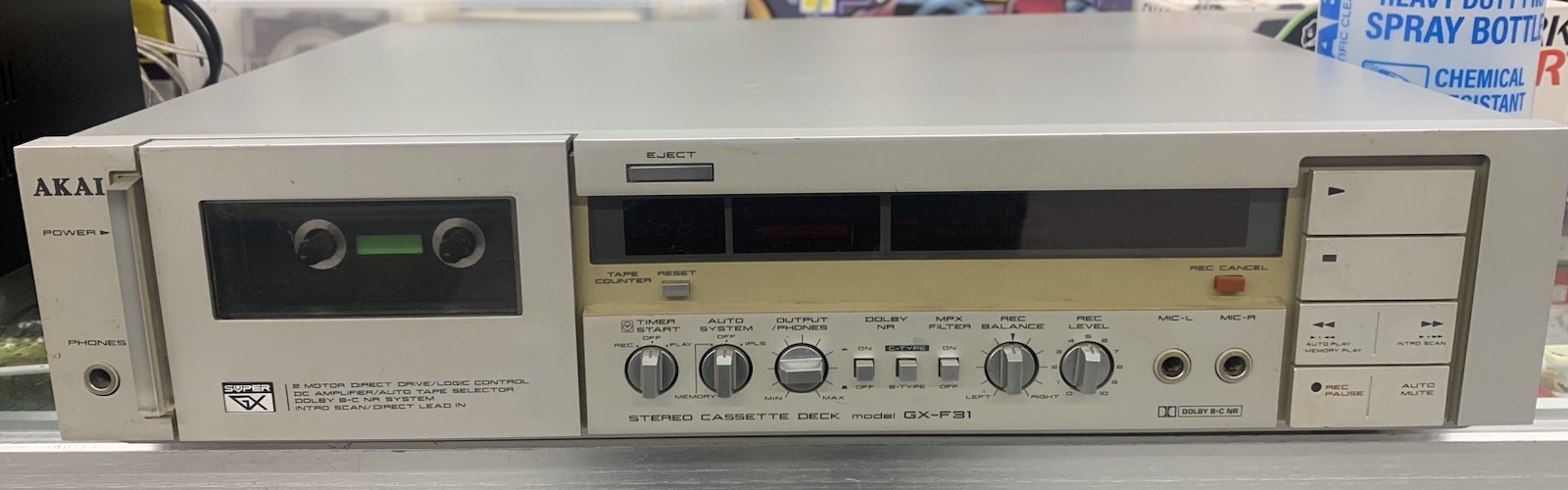
In the late 1970s, Japanese audio engineering reached a peak of innovation, craftsmanship, and sonic fidelity. Among the standout manufacturers of that era, Akai stood apart—not just for its prolific output, but for its commitment to building professional-grade, yet accessible, reel-to-reel tape recorders for serious home audiophiles. The Akai GX-F31, introduced in 1979, represents one of the company’s most refined consumer-oriented open-reel machines, blending studio-level performance with elegant design and user-friendly operation.
Though not as widely recognized today as some of its contemporaries from TEAC, Sony, or Revox, the GX-F31 holds a quiet reverence among reel-to-reel enthusiasts. It embodies the precision, mechanical excellence, and sonic transparency that defined the best of Japanese analog engineering during the final golden years of magnetic tape.
Technical Specifications
The GX-F31 was engineered to deliver high-fidelity performance across multiple tape speeds and formats, supporting both stereo and mono playback and recording. Built with a dual-capstan, three-motor transport system, it ensured exceptional tape stability and minimal wow and flutter—critical for maintaining audio integrity.
| Specification | Detail |
| Model | Akai GX-F31 |
| Year Introduced | 1979 |
| Format | 1/4" Open-Reel (2-track stereo or 4-track mono) |
| Tape Speeds | 7.5 ips, 15 ips (selectable) |
| Heads | Separate record, playback, and erase heads |
| Motor System | Three-motor, dual-capstan transport |
| Wow and Flutter | < 0.15% (15 ips, RMS) |
| Frequency Response | 30Hz – 20kHz (±3dB, 15 ips, normal bias) |
| Signal-to-Noise Ratio | > 60 dB (Dolby B compatible) |
| Input/Output | Line In/Out (RCA), Mic In (¼"), Phones Out |
| Equalization | 120µs / 70µs (switchable for different tapes) |
| Bias Adjustment | Manual front-panel control |
| Recording Modes | Full-track stereo, half-track stereo, 4-track mono |
| Power Requirements | 120V AC, 60Hz (NTSC region version) |
| Dimensions | 440 mm (W) × 145 mm (H) × 350 mm (D) |
| Weight | 12.5 kg (approx. 27.5 lbs) |
The machine supported both standard IEC (normal) and Type IV (metal) tapes when used with appropriate bias and EQ settings, though most users paired it with high-quality ferric or chrome formulations for optimal results. Its modular head stack allowed for easy alignment and maintenance—a hallmark of Akai’s professional design philosophy.
Sound Characteristics and Performance
The GX-F31 delivers a warm, detailed, and dynamically rich sound signature that many describe as “effortless” and “organic.” Its separate playback and record heads ensure that playback fidelity is not compromised by record circuitry, a feature typically found in higher-end studio decks.
At 15 ips, the GX-F31 reveals its full potential: deep bass extension, crystalline highs, and a wide, stable stereo image. The dual-capstan system virtually eliminates tape slippage and speed instability, resulting in a remarkably tight and rhythmically accurate presentation. Whether playing back self-recorded master tapes or vintage commercial reel-to-reel releases, the GX-F31 renders music with a lifelike presence that modern digital formats often struggle to replicate.
Its manual bias and equalization controls allow experienced users to fine-tune the sound for different tape types, enabling optimization for brightness, saturation, or dynamic range. When paired with Dolby B noise reduction (via external processor or compatible tapes), the GX-F31 achieves a signal-to-noise ratio that rivals early digital recordings—without sacrificing analog warmth.
Notable Features and Innovations
Akai equipped the GX-F31 with several thoughtful features that elevated it above typical consumer tape recorders:
- Dual-Capstan Transport: Unlike single-capstan designs that rely on the take-up reel for tension, the GX-F31 uses two capstans—one before and one after the head stack—to maintain constant tape-to-head contact. This drastically reduces wow, flutter, and azimuth errors.
- Three-Motor System: Dedicated motors for capstans and reel tables ensure smooth, independent operation, minimizing crosstalk and mechanical vibration.
- Front-Panel Calibration Controls: Rare in consumer decks, the GX-F31 includes accessible bias and level adjustments, allowing users to calibrate the machine for different tape brands and formulations.
- Selectable Equalization: Switchable between 120µs (for normal bias tapes) and 70µs (for high-output tapes), enhancing compatibility and fidelity.
- 4-Track Mono Capability: A nod to professional and broadcast use, this mode allows recording two programs on a single tape (each track recorded in both directions), doubling storage capacity.
- Solid Build Quality: The chassis features a rigid steel frame with rubber-damped feet, while the front panel combines brushed aluminum and high-quality plastics, exuding a sense of durability and refinement.
Common Issues and Maintenance
Like all vintage reel-to-reel machines, the GX-F31 requires regular maintenance to perform at its best. Over time, rubber components such as drive belts and idler tires can harden or crack, leading to speed inconsistencies or transport failure. These are replaceable with modern equivalents, though sourcing original parts may require specialty suppliers.
The tape heads and guides should be cleaned regularly with isopropyl alcohol and non-abrasive swabs. Misalignment—especially of the azimuth—can degrade high-frequency response and stereo imaging, so periodic head alignment by a qualified technician is recommended.
Another common issue is dried lubricant in the transport mechanism, which can cause sluggish operation or binding. A full mechanical service, including degreasing and re-lubrication of gears and bearings, is advisable for units that have been in long-term storage.
Electrolytic capacitors in the power supply and audio circuits may also need replacement after 40+ years, particularly if the unit exhibits hum, low output, or power instability.
Current Market Value and Collectibility
The Akai GX-F31 remains a somewhat under-the-radar gem in the vintage audio market. Unlike more famous models such as the TEAC A-3340S or Revox B77, it doesn’t command sky-high prices—yet. Well-maintained units typically sell between $400 and $700, depending on condition, completeness (including original manuals and boxes), and performance.
Its value is steadily rising among analog purists and reel-to-reel collectors who appreciate its build quality, sonic performance, and mechanical sophistication. Machines with documented service history or upgraded components (such as recapped power supplies or new belts) often fetch premiums.
Because Akai produced fewer GX-F31 units compared to mass-market models, finding a fully functional example can take time. However, for those seeking a high-performance, no-compromise reel-to-reel experience without the premium price tag of Swiss or German counterparts, the GX-F31 offers exceptional value.
Conclusion and Legacy
The Akai GX-F31 stands as a testament to Japan’s analog audio mastery in the late 1970s. It bridges the gap between professional studio recorders and high-end consumer gear, offering audiophiles a machine capable of near-broadcast-quality recordings and playback.
While it may not have achieved the fame of some of its peers, the GX-F31 earns its place in the pantheon of great reel-to-reel decks through sheer engineering integrity and musicality. For collectors, restorers, and analog enthusiasts, it represents a rewarding project and a sublime listening experience.
In an age where music is increasingly ephemeral and compressed, the GX-F31 reminds us of the tactile joy and sonic richness of analog tape. It’s not just a recorder—it’s a portal to a golden era of audio, where every turn of the reel carried the weight of craftsmanship and the warmth of real sound.
eBay Listings



As an eBay Partner, we earn from qualifying purchases. This helps support our independent vintage technology research.
Service Manuals & Schematics
- Service Manual — archive.org
- Service Manual — archive.org
Related Models
- Akai AM-2850 (1975)
- Akai AP-206 (1975)
- Akai AM-2450 (1978)
- Akai CS-M40R (1983)
- Akai GX-F66RC (1981)
- Nakamichi BX-1 (1985)
- Acoustic Research research-ar-17 (1978)
- Acoustic Research AR-19 (1994)
- Acoustic Research AR-1W (1954)
- Acoustic Research AR-28S (1992)