Akai GX-73: The Pinnacle of Japanese Reel-to-Reel Engineering
In the early 1970s, Japanese audio manufacturers were rapidly gaining global recognition for their precision engineering, innovative design, and commitment to high-fidelity sound. Among these, Akai stood out—not just for producing affordable consumer gear, but for pushing the boundaries of what open-reel tape recorders could achieve. The Akai GX-73, introduced in 1973, emerged as one of the company’s most sophisticated and revered machines, bridging the gap between professional studio equipment and high-end home audiophile use.
Though not as widely documented as some of its contemporaries from Sony or TEAC, the GX-73 has earned a cult following among reel-to-reel enthusiasts for its build quality, sonic transparency, and elegant design. It represents the culmination of Akai’s expertise in tape transport mechanics and audio circuitry, and remains a sought-after piece for collectors and analog purists today.
Technical Specifications
The GX-73 was engineered to deliver studio-grade performance in a compact, user-friendly package. It supported multiple tape speeds and boasted a robust transport system designed for minimal wow and flutter—critical for faithful audio reproduction.
| Specification | Detail |
| Model | Akai GX-73 |
| Year Introduced | 1973 |
| Format | 1/4" Open-Reel Tape |
| Tape Speeds | 7.5, 15, 30 ips (ips = inches per second) |
| Tracks | 4-track, 2-channel stereo (full-track or half-track at 7.5/15 ips) |
| Heads | Separate record, playback, and erase heads (all permalloy) |
| Motor System | Dual capstan drive with DC servo control |
| Wow and Flutter | < 0.15% (WRMS at 3.15 kHz, 15 ips) |
| Frequency Response | 30 Hz – 20 kHz (+/- 3 dB, 15 ips, reference tape) |
| Signal-to-Noise Ratio | > 60 dB (Dolby B optional) |
| Input/Output | Line in/out (RCA), mic in (¼" and RCA), headphone out |
| Equalization Settings | 120 µs / 70 µs (switchable for different tape types) |
| Power Requirement | 120V AC, 60 Hz (region-specific variants exist) |
| Dimensions | 440 mm (W) × 145 mm (H) × 350 mm (D) |
| Weight | 14.5 kg (approx. 32 lbs) |
| Special Features | Auto-reverse (on select configurations), VU meters, bias/tone controls |
Note: Some GX-73 units may vary slightly in configuration depending on regional market (e.g., UK, US, or Japanese domestic models), particularly in power supply and labeling.
Sound Characteristics and Performance
The Akai GX-73 is often praised for its clean, detailed, and dynamically expressive sound. Unlike some reel-to-reel decks that lean toward a warm or colored sonic signature, the GX-73 aims for neutrality and accuracy—making it ideal for critical listening and archival transfers.
At 15 ips, the machine delivers a wide frequency response and low distortion, capturing the full breadth of acoustic instruments and vocal nuance. The separate playback and record heads allow for precise calibration, enabling users to optimize playback fidelity independently of recording settings. This is particularly valuable when playing back tapes recorded on other machines.
The dual capstan transport system ensures exceptional tape stability, minimizing speed fluctuations that can degrade sound quality. Combined with low wow and flutter, the GX-73 reproduces music with remarkable timing and clarity—qualities that modern digital formats often struggle to replicate in the same analog context.
When paired with high-quality tape (such as Ampex 406/407 or modern RTM SM900), the GX-73 can produce results that rival professional studio recorders of its era. Its optional Dolby B noise reduction (on later production runs) further enhances its ability to deliver high-fidelity playback with reduced tape hiss.
Notable Features and Innovations
The GX-73 was packed with advanced features for its time:
- Three-Motor, Three-Head Design: Independent motors for capstan, reel drive, and brake systems ensure smooth, jitter-free operation. The separate heads allow for accurate monitoring during recording.
- Precision VU Meters: Large, centrally mounted VU meters provide real-time level monitoring with excellent visibility.
- Adjustable Bias and Equalization: Audiophiles and technicians can fine-tune recording performance for different tape formulations, maximizing fidelity.
- Servo-Controlled Capstan: Ensures consistent tape speed across all modes, critical for maintaining pitch accuracy and low distortion.
- Modular Construction: Internal layout is clean and service-friendly, with easy access to heads, pinch rollers, and electronics—ideal for maintenance and alignment.
- Optional Auto-Reverse: While not standard on all units, some GX-73 models included auto-reverse functionality, a rarity in high-end reel-to-reel decks.
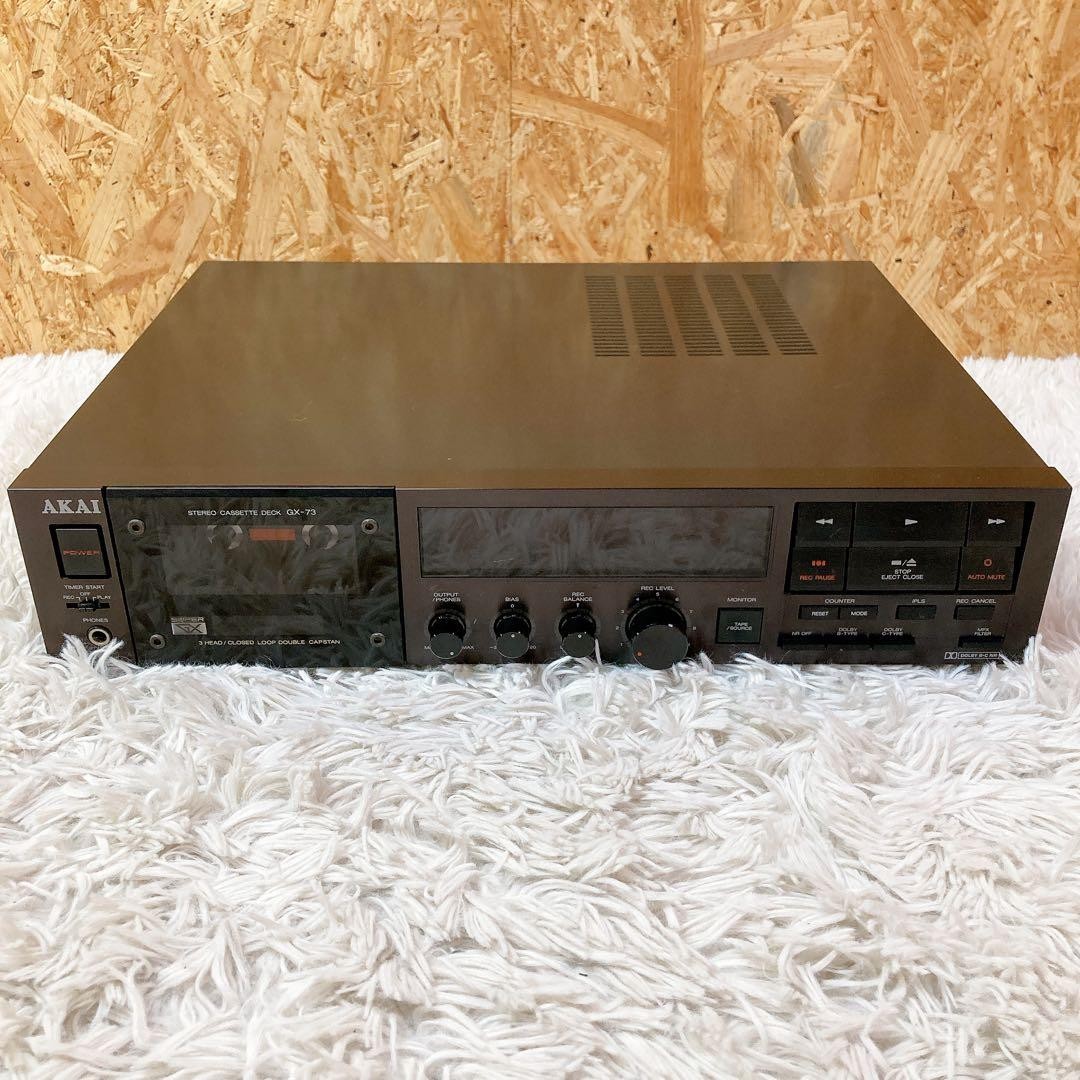
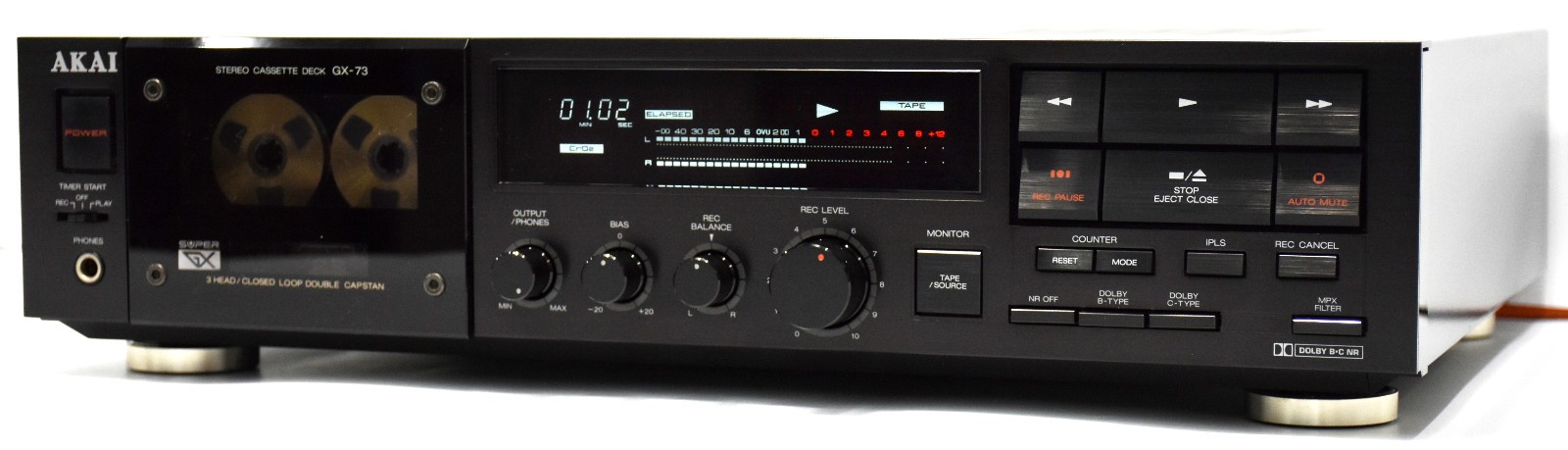
The front panel blends functionality with elegance: brushed aluminum finish, large rotary controls, and a minimalist layout reflect the design ethos of early 1970s Japanese hi-fi. It’s a machine that looks as good as it performs.
Common Issues and Maintenance
Like all vintage reel-to-reel recorders, the GX-73 requires regular maintenance to perform at its best. Common issues include:
- Deteriorated Rubber Parts: Pinch rollers, idler tires, and belts can harden or crack over time. Replacement with modern equivalents is essential.
- Dirty or Worn Heads: Tape heads should be cleaned with isopropyl alcohol and demagnetized regularly. Over time, heads may wear and require resurfacing or replacement.
- Capstan Shaft Oxidation: If the machine has been stored improperly, the capstan shaft may develop rust or residue, affecting speed stability.
- Capacitor Aging: Electrolytic capacitors in the power supply and audio circuits may dry out, leading to hum, distortion, or failure. A full recapping is recommended for units that haven’t been serviced in decades.
- Lubrication Needs: Gears and transport mechanisms require periodic lubrication with appropriate synthetic grease.
For best results, a full alignment by a qualified technician—including azimuth, bias, and frequency response calibration—is highly recommended before serious use.
Current Market Value and Collectibility
The Akai GX-73 is not as common as models from TEAC, Tandberg, or Revox, which contributes to its appeal among collectors. Well-maintained units in good cosmetic and working condition typically sell for $600 to $1,200, depending on accessories, original packaging, and regional demand.
Units with rare features—such as auto-reverse or factory-installed Dolby—can command higher prices, especially if they come with original manuals and calibration tools. Machines that have been professionally restored often attract audiophiles looking for plug-and-play performance.
While not a mainstream collectible, the GX-73 is increasingly recognized in reel-to-reel circles as a sleeper classic—a machine that delivers near-professional performance with the convenience of home use.
Conclusion and Legacy
The Akai GX-73 stands as a testament to the golden age of analog tape recording. It embodies the ambition of Japanese engineers in the 1970s to create affordable yet uncompromising audio equipment that could satisfy both serious hobbyists and semi-professional users.
Though overshadowed in popularity by more mass-market brands, the GX-73 delivers a listening experience that remains deeply rewarding. Its combination of precision mechanics, transparent sound, and elegant design makes it a crown jewel in any vintage audio collection.
For those who appreciate the tactile ritual of threading tape, the warmth of analog, and the pursuit of sonic truth, the Akai GX-73 is more than a machine—it’s a gateway to the soul of recorded music.
eBay Listings


As an eBay Partner, we earn from qualifying purchases. This helps support our independent vintage technology research.
Related Models
- Akai AM-2850 (1975)
- Akai AP-206 (1975)
- Akai AM-2450 (1978)
- Akai CS-M40R (1983)
- Akai GX-F66RC (1981)
- Nakamichi BX-1 (1985)
- Acoustic Research research-ar-17 (1978)
- Acoustic Research AR-19 (1994)
- Acoustic Research AR-1W (1954)
- Acoustic Research AR-28S (1992)