Akai GX-65: The Precision-Built Workhorse of the Reel-to-Reel Era
In the golden age of analog audio, when fidelity was measured in tape hiss and wow & flutter, few names carried the weight of Akai in the world of open-reel tape recorders. The Akai GX-65, introduced in 1975, stands as one of the company’s most respected professional-grade consumer reel-to-reel machines. Designed for audiophiles, broadcasters, and semi-professional studios, the GX-65 combined Japanese engineering rigor with a no-nonsense aesthetic, delivering performance that rivaled far more expensive studio decks.
At a time when cassette recorders were gaining popularity for convenience, Akai doubled down on the open-reel format, believing—correctly, as it turned out—that serious listeners and recording enthusiasts still demanded the superior dynamic range, frequency response, and low distortion that only 1/4-inch tape at 7.5 or 15 inches per second (ips) could provide. The GX-65 was not just another player in Akai’s lineup; it was a statement of intent: high fidelity, mechanical precision, and long-term reliability.
Technical Specifications
The GX-65 was engineered to meet the demands of critical listening and multi-track recording, offering dual-speed operation, full track switching capabilities, and a robust transport system. Below are its key specifications:
| Feature | Specification |
| Format | 1/4-inch open-reel tape |
| Tape Speeds | 7.5 ips, 15 ips (switchable) |
| Tracks | 4-track / 2-channel stereo or 2-track mono |
| Head Configuration | 3-head system (erase, record, playback) |
| Recording Modes | Full-track mono, half-track stereo |
| Frequency Response | 30Hz – 20kHz (±3dB) at 15 ips |
| Wow & Flutter | < 0.15% (weighted) |
| Signal-to-Noise Ratio | > 60 dB (Dolby B optional) |
| Input/Output | Line in/out (RCA), mic in (RCA), headphone out |
| Equalization | 120µs (15 ips), 180µs (7.5 ips) |
| Motors | Dual capstan servo-controlled DC motors |
| Power Supply | 110–120V or 220–240V AC (region-specific) |
| Dimensions | 440 mm (W) × 155 mm (H) × 355 mm (D) |
| Weight | 12.5 kg (27.5 lbs) |
The 3-head design was a hallmark of high-end decks of the era, allowing for precise monitoring of the recorded signal in real time—a critical feature for both music enthusiasts and recording engineers. The servo-controlled capstan ensured stable tape speed with minimal variation, contributing to the deck’s excellent wow and flutter performance.
Sound Characteristics and Performance
The Akai GX-65 is widely praised for its neutral, transparent sound signature—a rarity among reel-to-reel decks, many of which leaned toward warmth at the expense of accuracy. Thanks to its precision tape path and high-quality heads (typically made by TDK or Akai’s own magnetics division), the GX-65 delivered a wide frequency response with tight bass, clear mids, and extended highs.
At 15 ips, recordings exhibited a studio-like clarity, with excellent stereo imaging and depth. The deck’s ability to handle high signal levels without distortion made it ideal for recording dynamic music such as classical or jazz. When used with low-noise tape (like Ampex 456 or BASF SM911), the GX-65 could achieve a signal-to-noise ratio that rivaled early digital recordings.
Even at 7.5 ips, the GX-65 performed admirably, making it a practical choice for long-duration recording—such as live concerts or radio broadcasts—without a significant drop in fidelity.
Notable Features and Innovations
The GX-65 was packed with features that set it apart from both consumer and prosumer competitors:
- 3-Head Configuration: Enabled real-time monitoring during recording, a must for critical applications.
- Dual-Speed Operation: 7.5 and 15 ips speeds offered flexibility between runtime and fidelity.
- Solid Mechanical Transport: The full metal chassis, rubberized pinch roller, and precision capstan minimized tape slippage and ensured consistent tension.
- Track Select Switching: Easy toggling between full-track mono and half-track stereo recording/playback.
- Dolby B Noise Reduction: Optional circuitry (on later models or via external units) helped reduce tape hiss, especially at lower speeds.
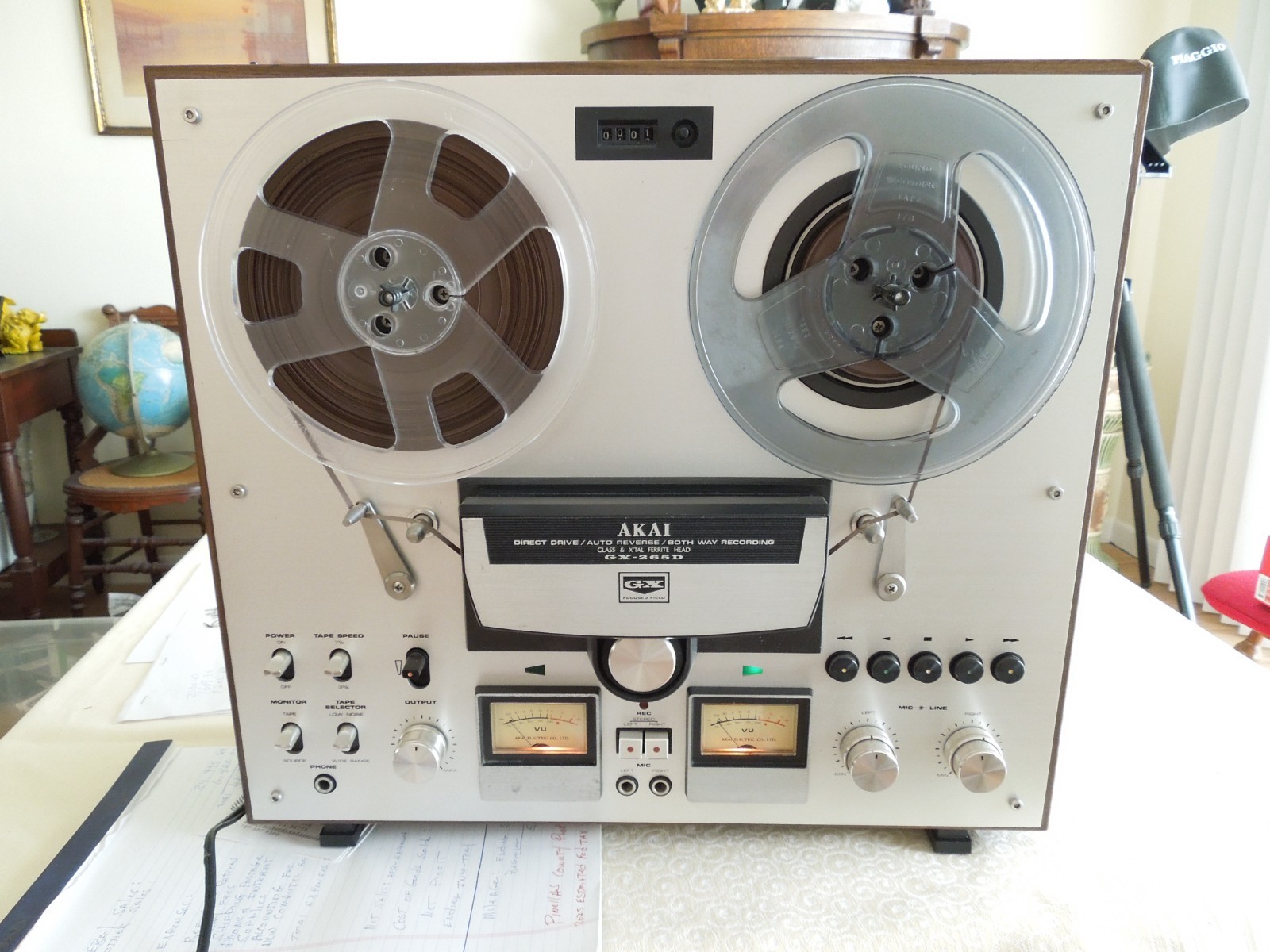
- Front-Panel Metering: Large VU meters provided accurate level monitoring, essential for avoiding distortion.
- Direct Drive Capstan Motors: Servo-controlled motors ensured speed stability and reduced mechanical wear.
One of the most appreciated aspects of the GX-65’s design is its user-friendly layout. All controls are logically arranged, with clearly labeled switches and large, responsive transport buttons. The tape counter, while not programmable, is reliable and useful for cueing.
Common Issues and Maintenance
Like all vintage reel-to-reel machines, the Akai GX-65 requires regular maintenance to perform at its best. After 40+ years, common issues include:
- Deteriorated Rubber Components: The pinch roller, idler tires, and drive belts can harden or crack over time. Replacement with modern equivalents is essential.
- Dirty or Worn Heads: Tape heads should be cleaned with isopropyl alcohol and demagnetized regularly. Worn heads may need resurfacing or replacement.
- Capstan Bearing Dryness: The capstan shaft can dry out, leading to speed instability. Light lubrication with synthetic oil is recommended.
- Capacitor Aging: Electrolytic capacitors in the power supply and audio circuits may leak or lose capacitance, potentially causing hum or failure. A full recap is advisable for long-term reliability.
- Tape Path Misalignment: Over time, guides can shift, affecting azimuth and tracking. Professional alignment ensures optimal playback.
Despite these age-related concerns, the GX-65 is known for its mechanical durability. Its all-metal construction and high-quality components mean that, with proper care, it can still operate flawlessly decades after manufacture.
Current Market Value and Collectibility
The Akai GX-65 has seen a resurgence in interest among analog audio enthusiasts, particularly those restoring vintage studios or building high-end tape playback systems. While not as rare as some Japanese competitors like the Sony TC-800B or TEAC A-3340S, the GX-65 is highly regarded for its balance of performance, build quality, and value.
As of 2024, a fully serviced GX-65 in good cosmetic condition typically sells for $400–$700, depending on region and included accessories (such as original reels or remote controls). Units that have been professionally aligned and recapped command a premium. Unrestored models may go for $200–$300 but require investment in maintenance.
Collectors value the GX-65 not just for its sound, but as a representative of Akai’s engineering legacy. While Akai is better known today for its cassette decks and later digital gear, the GX-65 reminds us that the company was once a serious contender in the professional analog space.
Conclusion and Legacy
The Akai GX-65 is more than just a reel-to-reel tape recorder—it’s a testament to an era when audio fidelity was pursued with mechanical precision and analog passion. Its combination of professional features, robust construction, and transparent sound makes it a standout in Akai’s catalog and a favorite among vintage tape enthusiasts.
While it may lack the name recognition of some high-end TEAC or Revox models, the GX-65 delivers comparable performance at a more accessible price point. For those seeking to experience music as it was recorded on analog tape—warm, dynamic, and alive—the GX-65 remains a compelling choice.
Whether you're archiving vinyl, recording live music, or simply indulging in the tactile joy of threading tape, the Akai GX-65 offers a bridge between the golden age of analog and today’s high-resolution audio world. With care and maintenance, it’s a machine that can continue spinning tape for decades to come—proving that true quality never goes out of style.
eBay Listings


As an eBay Partner, we earn from qualifying purchases. This helps support our independent vintage technology research.
Service Manuals & Schematics
- Manual — archive.org
Related Models
- Akai AM-2850 (1975)
- Akai AP-206 (1975)
- Akai AM-2450 (1978)
- Akai CS-M40R (1983)
- Akai GX-F66RC (1981)
- Nakamichi BX-1 (1985)
- Acoustic Research research-ar-17 (1978)
- Acoustic Research AR-19 (1994)
- Acoustic Research AR-1W (1954)
- Acoustic Research AR-28S (1992)