Akai GX-636: The Pinnacle of Japanese Reel-to-Reel Engineering
In the golden era of analog audio, few machines captured the imagination of audiophiles and recording enthusiasts quite like the Akai GX-636. Released in 1979 at the height of Japan’s dominance in high-fidelity consumer audio, the GX-636 stood as a flagship open-reel tape deck that combined professional-grade engineering with refined home audio elegance. Though often overshadowed by more widely marketed brands like Sony or TEAC, Akai’s GX-636 remains a cult favorite among reel-to-reel aficionados for its precision mechanics, warm sonic character, and exceptional build quality.
Part of Akai’s revered GX series—known for pushing the boundaries of what consumer tape decks could achieve—the GX-636 was designed for serious listeners and semi-professional users who demanded accuracy, reliability, and musicality. With its triple-motor direct-drive transport, three-head configuration, and comprehensive calibration features, the GX-636 wasn’t just a playback machine—it was a statement of analog excellence.
Technical Specifications
The GX-636 was engineered with meticulous attention to detail, offering specifications that rivaled or exceeded many professional studio decks of its time.
| Specification | Detail |
| Format | 1/4" 2-track stereo or 4-track mono |
| Tape Speeds | 7.5, 15 ips (standard); 3.75 ips (optional) |
| Heads | 3-head system (erase, record, playback) |
| Motor System | Triple direct-drive motors |
| Transport Control | Full logic control with microprocessor |
| Frequency Response | 30Hz – 20kHz @ 15 ips (±3dB) |
| Signal-to-Noise Ratio | >68 dB (Dolby B/C compatible) |
| Wow and Flutter | <0.07% (weighted, RMS) |
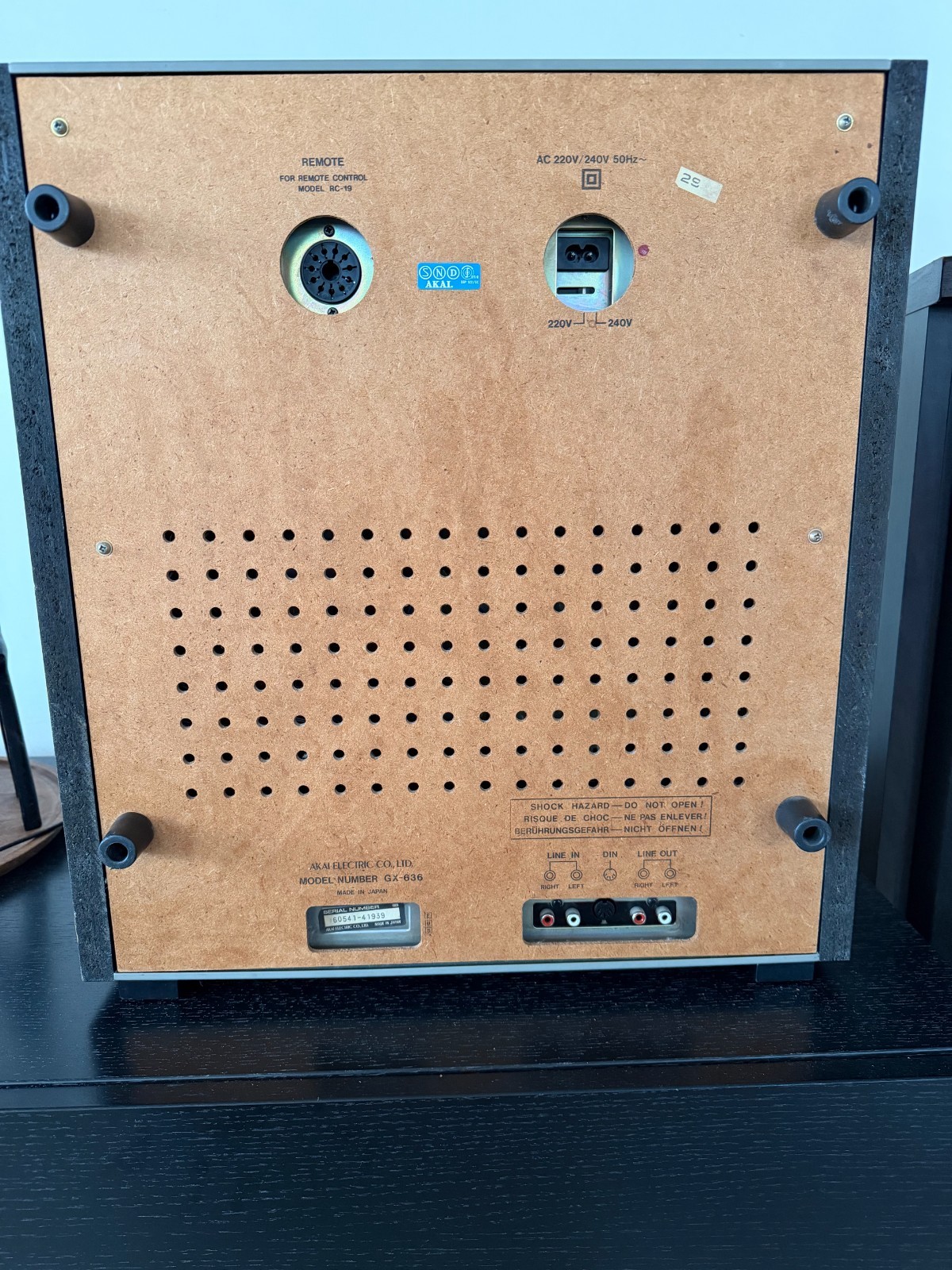
| Input/Output | Line in/out (RCA), mic in (¼"), headphone out |
| Equalization | 120µs / 70µs switchable (for different tape types) |
| Recording Bias | Adjustable front-panel trim pots |
| Dimensions | 470 mm × 155 mm × 380 mm (W×H×D) |
| Weight | 16.5 kg (36.4 lbs) |
| Power Requirement | 110–120V or 220–240V AC, 50/60 Hz |
One of the GX-636’s most impressive engineering feats was its three-motor direct-drive system. Unlike belt-driven transports that could suffer from slippage and wear, the GX-636 used separate, precision motors for the capstan, supply, and take-up reels. This ensured rock-solid speed stability and minimized mechanical noise transmission—critical for high-fidelity recording and playback.
The three-head configuration allowed for true separate record and playback monitoring, meaning users could record a track and immediately play it back with the dedicated playback head, ensuring accurate real-time monitoring without relying on the record head’s compromised frequency response. The heads themselves were high-permeability ferrite types, known for their durability and clarity.
Sound Characteristics and Performance
The Akai GX-636 delivers a sound signature that many describe as rich, detailed, and effortlessly musical. When properly calibrated and paired with high-quality tape (such as Ampex 456 or BASF SM-911), the GX-636 reveals a wide soundstage, deep bass response, and smooth, extended highs. Its ability to capture the dynamic range and spatial depth of live performances made it a favorite among classical and jazz enthusiasts.
At 15 inches per second (ips), the GX-636 achieves near-studio-quality fidelity, with a frequency response that extends cleanly to 20kHz and a signal-to-noise ratio that holds up even on dynamic recordings. The inclusion of Dolby B and C noise reduction (switchable via front panel) further enhanced its ability to deliver quiet, high-resolution playback.
What truly sets the GX-636 apart is its analog warmth. Unlike some of the more clinical-sounding decks of the era, the GX-636 imparts a subtle harmonic richness that many listeners find emotionally engaging. This isn’t a sterile machine—it’s one that breathes life into recordings, whether you’re playing vintage master tapes or making your own high-speed dubs.
Notable Features and Innovations
The GX-636 was packed with features that reflected Akai’s commitment to both usability and performance:
- Microprocessor-controlled logic transport: Ensured precise, repeatable operation with auto-stop at tape ends and smooth, jerk-free winding.
- Front-panel bias and equalization calibration: Rare in consumer decks, this allowed users to fine-tune recording performance for different tape formulations.
- Dual VU meters with peak hold: Large, easy-to-read analog meters provided real-time level monitoring with peak memory for capturing transient spikes.
- 4-track/2-track switchable mode: Offered flexibility for both stereo and mono recording, appealing to archivists and hobbyists.
- High-torque direct-drive reels: Enabled fast, controlled tape handling and reduced tape stretch during start-up.
- Heavy-duty chassis with anti-vibration damping: Minimized external resonance and ensured stable head-to-tape contact.
The front panel, with its brushed aluminum finish, large rotary controls, and intuitive layout, exudes a professional aesthetic. Every switch and knob feels substantial, reflecting Akai’s reputation for building equipment that was as durable as it was sonically capable.
Common Issues and Maintenance
Like all vintage reel-to-reel decks, the GX-636 requires regular maintenance to perform at its best. While built to last, aging components can present challenges:
- Capstan belt and idler tires: Though the capstan is direct-drive, some damping components may degrade. However, the absence of belts in the main drive system reduces long-term maintenance compared to belt-driven decks.
- Head alignment and wear: Over time, playback and record heads can become misaligned or worn. Professional demagnetization and azimuth adjustment are recommended every few hundred hours of use.
- Dried lubricants: The reel table bearings and guide posts may require relubrication with synthetic grease to ensure smooth operation.
- Capacitor aging: The internal power supply and signal path use electrolytic capacitors that may need replacement after 40+ years to prevent noise or channel imbalance.
- Tape path debris: Accumulated oxide buildup can affect sound quality and tape tracking—regular cleaning with isopropyl alcohol and cueing tape is essential.
Finding replacement heads or rare ICs can be challenging, but the GX-636’s modular design makes repairs more manageable than some contemporaries. A well-serviced GX-636 can operate reliably for decades.
Current Market Value and Collectibility
Today, the Akai GX-636 is a sought-after machine among analog enthusiasts and reel-to-reel collectors. While not as ubiquitous as TEAC or Denon decks, its reputation for quality ensures steady demand.
In working condition, a GX-636 typically sells for $600–$1,000, depending on cosmetic condition, included accessories (such as original remote or calibration tools), and full functionality. Fully restored units with new capacitors, cleaned heads, and calibrated bias can command higher prices, especially if paired with rare wood side panels or factory accessories.
Its collectibility is bolstered by its relative scarcity outside Japan and its appeal to users seeking a no-compromise analog recording experience. As interest in analog tape grows—fueled by musicians, archivists, and vinyl lovers—the GX-636 continues to appreciate in both value and esteem.
Conclusion and Legacy
The Akai GX-636 stands as a testament to the art of analog tape engineering. In an era when Japanese manufacturers were redefining high-fidelity audio, Akai delivered a machine that balanced precision, performance, and passion. More than just a tape deck, the GX-636 is an instrument—an invitation to engage deeply with the music, to slow down and savor the process of recording and playback.
While digital formats dominate today, the GX-636 reminds us of the tactile joy and sonic beauty of analog. For those willing to maintain and master it, the GX-636 offers a listening experience that is not just technically impressive, but profoundly moving. In the world of vintage audio, it remains a quiet giant—deserving of its place among the greats.
eBay Listings



As an eBay Partner, we earn from qualifying purchases. This helps support our independent vintage technology research.
Related Models
- Akai CS-F33R (1985)
- Akai DX-59 (1983)
- Akai GX-280D-SS (1979)
- Akai DX-57 (1978)
- Akai AA-5200 (1978)
- Sony TC-2050SD (1978)
- Aiwa AD-F990 (1993)
- Kenwood KX-3060 (1982)
- Sony TC-2130A (1974)
- Sony TC-2220 (1972)