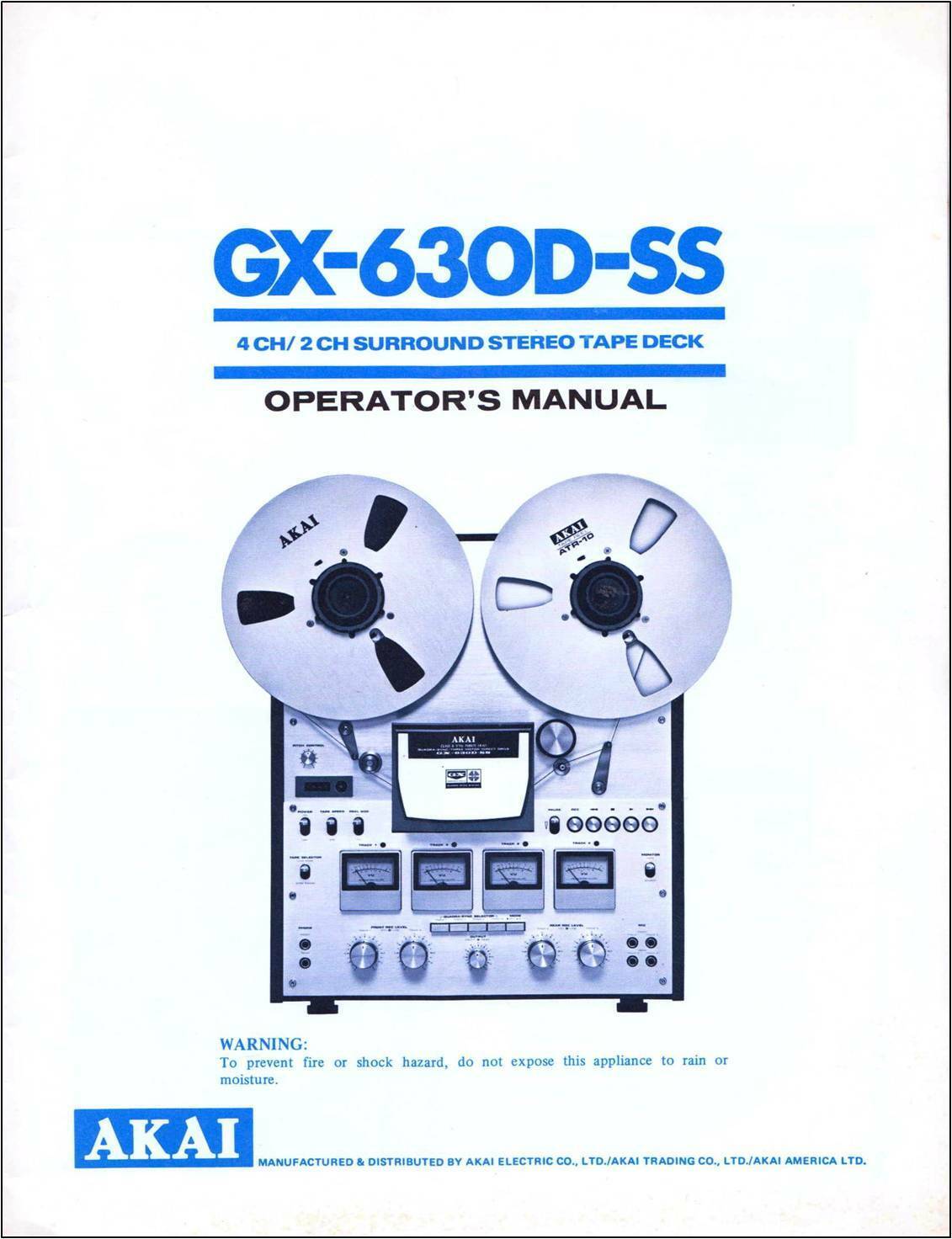
Akai GX-630D-SS: The Precision-Built Cassette Deck from Akai’s Golden Era
In the late 1970s, Japanese audio manufacturers were locked in a fierce battle to dominate the high-fidelity cassette deck market. While names like Nakamichi, Sony, and TEAC often dominate the conversation, Akai quietly carved out a niche with its GX series—machines that blended professional-grade engineering with audiophile sensibilities. Among these, the Akai GX-630D-SS stands as a lesser-known but highly respected dual-capstan cassette deck that exemplifies Akai’s commitment to precision, durability, and sonic excellence.
Introduced in 1977, the GX-630D-SS arrived during the golden age of analog tape, when cassette decks were rapidly evolving from portable convenience devices into serious components in high-end audio systems. Akai, already renowned for its reel-to-reel recorders, brought that same engineering rigor to the compact cassette format. The GX-630D-SS was not just another deck—it was a statement of intent: that cassette audio could rival open-reel performance with the right design.
Technical Specifications
| Specification | Detail |
| Model | GX-630D-SS |
| Year Introduced | 1977 |
| Format | 4-Track, 2-Channel Stereo (Compact Cassette) |
| Tape Speed | 1⅞ ips (4.76 cm/s) |
| Heads | Separate Record/Playback, Ferrite |
| Motor System | Dual DC Servo Motors (Dual Capstan) |
| Wow and Flutter | < 0.07% (WRMS) |
| Frequency Response | 30Hz – 18kHz (Type I tape) |
| Signal-to-Noise Ratio | 66 dB (Dolby B) |
| Total Harmonic Distortion | < 1.5% |
| Input/Output | Line In/Out (RCA), Mic In (3.5mm) |
| Recording Modes | Manual Bias & EQ Selection (Type I/II) |
| Dimensions | 440 mm × 140 mm × 320 mm (W×H×D) |
| Weight | 11.5 kg (25.3 lbs) |
| Power Requirement | 110–120V AC, 60 Hz (North America) |
Sound Characteristics and Performance
The GX-630D-SS was engineered for accuracy and transparency, prioritizing faithful tape reproduction over coloration. Its dual-capstan transport system—featuring two precision-ground capstans and rubber drive wheels—ensured exceptional tape-to-head contact and minimized speed fluctuations. This contributed to its remarkably low wow and flutter, a critical factor in maintaining pitch stability and rhythmic integrity.
Sonically, the GX-630D-SS delivers a balanced, open soundstage with strong midrange clarity and extended highs. Bass response is tight and well-controlled, thanks in part to Akai’s meticulous head alignment and tape tensioning system. When paired with quality Type II (chrome) tapes and Dolby B noise reduction, the deck achieves a signal-to-noise ratio that rivals many of its contemporaries.
One of the hallmarks of Akai’s GX series is their neutral tonal balance. Unlike some decks that impart a warm or bright character, the GX-630D-SS aims for fidelity—making it a favorite among users who value accuracy over sonic embellishment. Whether recording live music, duplicating master tapes, or playing back pre-recorded cassettes, the GX-630D-SS handles a wide dynamic range with composure.
Notable Features and Innovations
The GX-630D-SS was packed with features that set it apart in its era:
- Dual Capstan Transport: A rare feature in consumer decks, this system uses two capstans (one at the supply side, one at the take-up) to maintain constant tape tension across the head. This reduces tape flutter and wear, enhancing both recording and playback fidelity.
- Separate Record and Playback Heads: Unlike most cassette decks that use a combined head, the GX-630D-SS employs physically separate heads for recording and playback. This allows each head to be optimized for its specific task, improving high-frequency response and reducing crosstalk.
- Manual Tape Type Selection: The deck allows manual selection of bias and equalization settings for Type I (ferric) and Type II (chrome) tapes. This gives advanced users greater control over recording optimization, a feature typically found in professional machines.
- Solid Mechanical Construction: Housed in a heavy-gauge steel chassis with a brushed aluminum front panel, the GX-630D-SS exudes durability. The large, rubberized transport controls are tactile and responsive, while the tape counter (mechanical, not digital) is precise and reliable.
- Direct Drive Capstans: The capstans are driven directly by precision DC servo motors, eliminating belts that can stretch or degrade over time. This contributes to long-term speed stability and reduced maintenance.
Common Issues and Maintenance
While the GX-630D-SS is built to last, age has introduced some common concerns:
- Rubber Components Deterioration: The pinch rollers and drive belts (if present in auxiliary mechanisms) can harden or crack over time. Replacement with modern silicone-based rollers is recommended during servicing.
- Head Alignment Drift: Though robust, the heads may require realignment after decades of use, especially if the deck has been moved frequently or subjected to physical shock.
- Capstan Shaft Lubrication: The dual capstan shafts may need cleaning and light lubrication to ensure smooth operation and prevent tape drag.
- Capacitor Aging: The internal power supply and signal path use electrolytic capacitors that may dry out over time. A full recapping by a qualified technician is advisable for optimal performance and reliability.
Regular cleaning of the heads, capstans, and tape path with isopropyl alcohol and lint-free swabs is essential. Using demagnetizing tools on the heads and metal tape guides is also recommended every few dozen hours of use to prevent signal loss and distortion.
Current Market Value and Collectibility
The Akai GX-630D-SS remains a sleeper classic in the vintage audio world. While not as widely recognized as the Nakamichi 1000 or the Revox B77, it has a loyal following among tape enthusiasts and restoration hobbyists. Its dual-capstan design and separate heads make it a compelling alternative for those seeking high-end cassette performance without the premium price tag.
In today’s market (2024), a fully serviced GX-630D-SS typically sells for $300–$500, depending on condition and provenance. Units with original packaging, manuals, or rare finishes (such as the "SS" brushed steel variant) may command higher prices. However, untested or non-functional units often sell for under $150, reflecting the need for professional servicing.
Its collectibility is growing, particularly among users building analog recording setups or restoring vintage audio chains. The GX-630D-SS is also popular in Japan and Europe, where Akai’s reputation for engineering excellence remains strong.
Conclusion and Legacy
The Akai GX-630D-SS is a testament to a time when cassette decks were engineered with the same care as turntables and amplifiers. It bridges the gap between consumer and professional audio, offering features and performance that were exceptional for its time—and still impressive today.
While overshadowed by flashier competitors, the GX-630D-SS rewards patient users with reliability, precision, and honest sound reproduction. For the vintage audio enthusiast, restorer, or analog recording artist, it represents a smart investment and a piece of engineering history.
In an era increasingly fascinated by analog warmth and mechanical authenticity, the Akai GX-630D-SS deserves greater recognition—not as a legend, but as a quiet master of its craft.
eBay Listings



As an eBay Partner, we earn from qualifying purchases. This helps support our independent vintage technology research.
Service Manuals & Schematics
- Catalog — archive.org
Related Models
- Akai CS-F33R (1985)
- Akai DX-59 (1983)
- Akai GX-280D-SS (1979)
- Akai DX-57 (1978)
- Akai AA-5200 (1978)
- Sony TC-2050SD (1978)
- Aiwa AD-F990 (1993)
- Kenwood KX-3060 (1982)
- Sony TC-2130A (1974)
- Sony TC-2220 (1972)