Akai GX-630D: The Precision-Built Reel-to-Reel Workhorse
In the golden era of analog audio, few formats captured the imagination of audiophiles and recording enthusiasts quite like the reel-to-reel tape deck. Among the many high-fidelity machines produced in the 1970s, the Akai GX-630D stands out as a testament to Japanese engineering excellence and a commitment to sonic purity. Released in 1978, this 1/4-inch stereo open-reel tape deck was designed for both serious home tapers and semi-professional users who demanded reliability, precision, and audiophile-grade sound.
Though not as widely discussed today as some of its contemporaries from brands like Sony, Tandberg, or Revox, the Akai GX-630D earned a quiet reputation among those in the know for its rugged construction, thoughtful design, and outstanding performance—especially considering its place in the market. It represented the pinnacle of Akai’s consumer/prosumer reel-to-reel lineup and showcased the company’s deep understanding of analog tape mechanics and signal path integrity.
Technical Specifications
The GX-630D was engineered with meticulous attention to mechanical and electrical detail. It supported standard tape speeds of 7.5 and 15 inches per second (ips), allowing users to balance recording time and audio fidelity. With its three-head configuration (separate record, playback, and erase heads), the deck offered precise monitoring of recorded material—a critical feature for accurate overdubbing and editing.
| Specification | Detail |
| Format | 1/4-inch stereo, 2-track |
| Tape Speeds | 7.5 ips, 15 ips |
| Heads | 3-motor, 3-head (erase, record, playback) |
| Motor System | Dual capstan with DC servo control |
| Frequency Response | 30Hz – 20kHz (15 ips, ±3dB) |
| Signal-to-Noise Ratio | >60 dB (Dolby B), >68 dB (with Dolby C) |
| Total Harmonic Distortion | <0.5% (15 ips) |
| Wow and Flutter | <0.15% (WRMS) |
| Input/Output | Line in/out (RCA), mic in (RCA), headphone |
| Recording Modes | Stereo, monophonic |
| Noise Reduction | Dolby B and Dolby C compatible |
| Power Requirements | 120V AC, 60Hz (varies by region) |
| Dimensions | 440 mm × 145 mm × 355 mm (W×H×D) |
| Weight | 12.5 kg (approx. 27.5 lbs) |
| Years Produced | 1975-1979 |
The dual-capstan transport system—driven by precision DC servo motors—was one of the GX-630D’s standout engineering feats. This design minimized tape slippage and ensured consistent tape-to-head contact, critical for maintaining frequency response and dynamic range. The die-cast chassis and heavy-duty metal construction further reduced vibration and external resonance, contributing to the deck’s stable, low-noise performance.
Sound Characteristics and Performance
The Akai GX-630D delivers a warm, natural, and highly detailed sound signature that many analog enthusiasts still praise today. At 15 ips, the frequency response extends cleanly to 20 kHz, capturing the full breadth of the audible spectrum with minimal roll-off. The deck’s low wow and flutter measurements translate into a rock-solid pitch stability, making it ideal for both music playback and critical recording applications.
Thanks to its high-quality playback head and well-tuned electronics, the GX-630D excels in midrange clarity—vocals and acoustic instruments are rendered with lifelike presence and texture. Bass response is tight and well-controlled, avoiding the flabbiness that sometimes plagues lesser tape decks. The inclusion of Dolby B and C noise reduction significantly reduces tape hiss, especially on lower-grade tapes or at 7.5 ips, allowing for cleaner, more transparent listening.
One of the joys of using a machine like the GX-630D is the immediacy of the analog experience. There’s a richness and three-dimensionality to the soundstage that digital formats often struggle to replicate. Whether playing back vintage master tapes or making your own recordings, the GX-630D delivers a deeply satisfying, immersive listening experience.
Notable Features and Innovations
Akai packed the GX-630D with features that were advanced for its time:
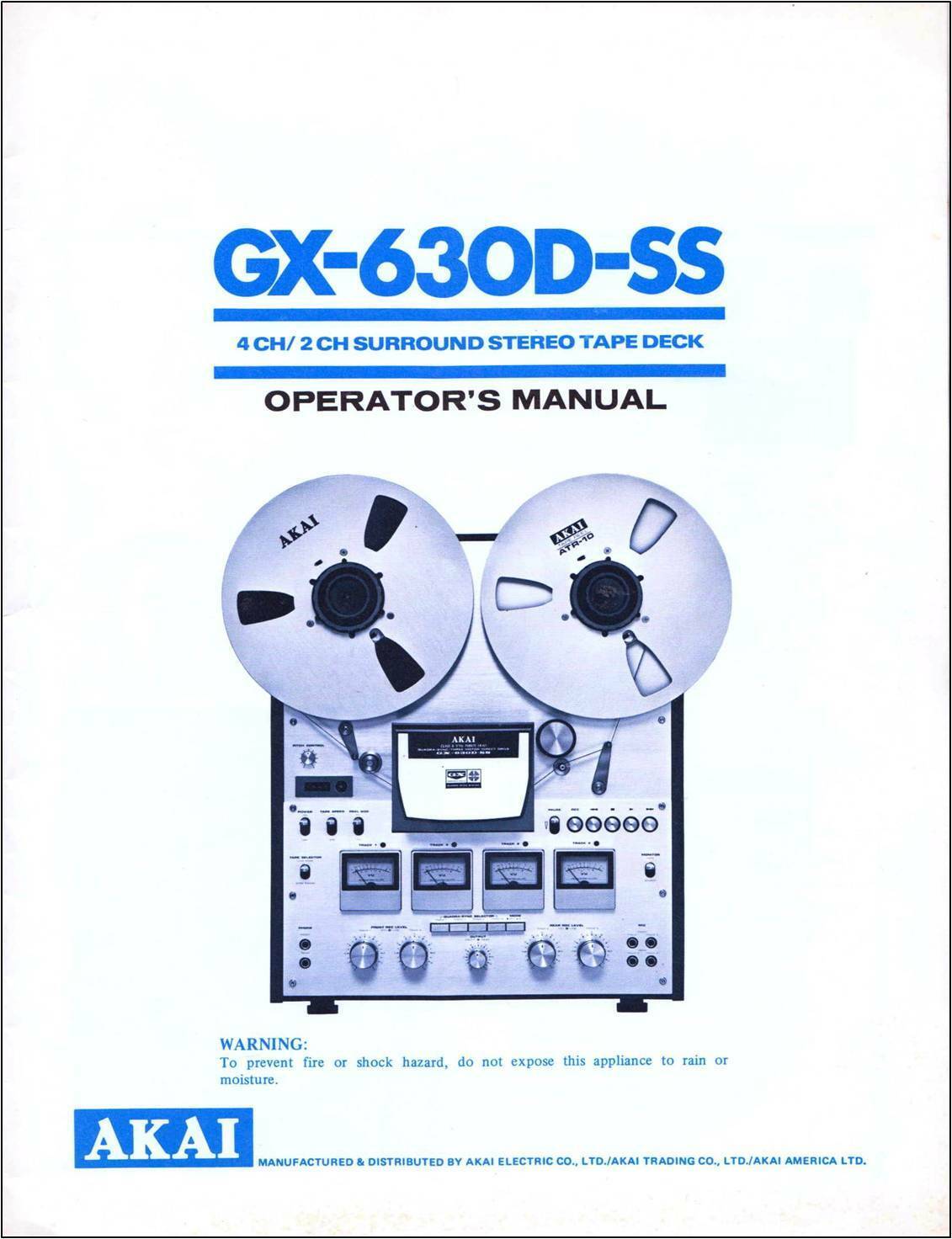
- Three-Head Configuration: Unlike simpler two-head decks, the GX-630D allows for post-record playback monitoring, essential for verifying recording levels and edits in real time.
- Dolby C Compatibility: While Dolby B was standard on many high-end decks, Dolby C support was less common in consumer models. This gave the GX-630D an edge in noise reduction performance, especially on high-frequency content.
- Manual Tape Selector: The front panel includes a manual tape type selector (normal, chrome, metal), allowing users to optimize bias and equalization for different tape formulations—crucial for achieving the best possible recording quality.
- Large VU Meters: Prominent, centrally located VU meters provide accurate visual feedback of recording levels, helping prevent distortion and under-modulation.
- Direct Drive Capstan Motors: The servo-controlled DC motors ensure precise speed control and excellent long-term reliability.
- Headphone Monitoring with Level Control: A dedicated headphone output with volume knob allows for private listening and monitoring during recording or editing.
The user interface is clean and intuitive, with clearly labeled controls and a logical layout. The transport buttons are tactile and responsive, and the overall build quality feels robust and enduring.
Common Issues and Maintenance
Like all vintage reel-to-reel decks, the Akai GX-630D requires regular maintenance to perform at its best. Over time, rubber parts such as drive belts, pinch rollers, and idler tires can harden or crack, leading to speed instability or transport failure. These should be inspected and replaced as needed—ideally by a technician experienced with analog tape equipment.
The tape heads and guides should be cleaned regularly with isopropyl alcohol and a swab to prevent oxide buildup, which can degrade sound quality and cause dropouts. Demagnetizing the heads and tape path every few months is also recommended to maintain optimal frequency response and reduce noise.
Another potential issue is dried-up lubricant in the capstan shafts and transport mechanisms. If the deck feels sluggish or makes grinding noises, a full mechanical servicing—including cleaning, relubrication, and alignment—is necessary. Head alignment should also be checked periodically, especially if the deck is used frequently or has been moved.
Despite these maintenance needs, the GX-630D is generally reliable when properly cared for. Its modular design makes repairs more accessible than on some integrated units, and many parts are still available through vintage audio specialists.
Current Market Value and Collectibility
The Akai GX-630D is not as widely collected as some of the more iconic European or high-end Japanese decks, but it has a loyal following among reel-to-reel enthusiasts and analog purists. In today’s market, a fully functional, well-maintained GX-630D typically sells for $400 to $700, depending on condition, included accessories, and regional demand.
Units that have been professionally serviced or come with original manuals and packaging can command higher prices. While not yet a “blue chip” collector’s item, the GX-630D’s reputation for durability and sound quality suggests its value may appreciate as interest in analog formats continues to grow.
Conclusion and Legacy
The Akai GX-630D may not have the name recognition of a Revox B77 or a Tandberg 3014, but it stands shoulder-to-shoulder with them in terms of engineering and performance. It represents the best of Akai’s reel-to-reel philosophy: no-nonsense reliability, excellent sound, and thoughtful design.
For the modern audiophile, the GX-630D offers a gateway into the world of analog tape—whether for playing vintage recordings, archiving vinyl, or creating new music with a classic touch. It’s a machine that rewards care and attention, delivering a listening experience that is both technically impressive and emotionally engaging.
In an age of digital perfection, the Akai GX-630D reminds us that sometimes, the most faithful reproduction of music isn’t just about specs—it’s about soul. And on that front, this vintage workhorse delivers in spades.
eBay Listings



As an eBay Partner, we earn from qualifying purchases. This helps support our independent vintage technology research.
Service Manuals & Schematics
- Service Manual — archive.org
- Catalog — archive.org
- Catalog — archive.org
Related Models
- Akai CS-F33R (1985)
- Akai DX-59 (1983)
- Akai GX-280D-SS (1979)
- Akai DX-57 (1978)
- Akai AA-5200 (1978)
- Sony TC-2050SD (1978)
- Aiwa AD-F990 (1993)
- Kenwood KX-3060 (1982)
- Sony TC-2130A (1974)
- Sony TC-2220 (1972)