Akai GX-400D: The Precision-Built Workhorse of Reel-to-Reel Enthusiasts
In the late 1970s, when audiophiles and recording engineers alike sought fidelity beyond the limitations of cassette tapes and early digital formats, open-reel tape decks stood at the pinnacle of analog sound reproduction. Among the most respected names in this domain was Akai, a Japanese manufacturer renowned for building robust, high-performance reel-to-reel recorders that bridged the gap between professional studio gear and high-end consumer equipment. The Akai GX-400D, introduced in 1978, emerged as one of the brand’s standout models—a machine engineered for accuracy, durability, and sonic excellence.
Though not as widely publicized as some of its contemporaries from Sony or TEAC, the GX-400D carved out a loyal following among serious tape enthusiasts and semi-professional users who valued its meticulous build quality and transparent audio performance. It represented the culmination of Akai’s decades-long expertise in tape transport design and analog signal path optimization.
Technical Specifications
The GX-400D was designed as a dual-capstan, three-head open-reel recorder capable of handling both 7.5 and 15 inches per second (ips), with optional 3.75 ips support via pulley change—typical of high-fidelity machines of its era. Its construction emphasized mechanical stability and low wow and flutter, critical for maintaining pitch integrity and dynamic clarity.
| Specification | Detail |
| Format | 1/4" open-reel (2-track, 4-channel mono/stereo) |
| Tape Speeds | 15 ips, 7.5 ips (3.75 ips with pulley change) |
| Heads | Separate record, playback, erase heads |
| Motor System | Dual capstan direct-drive with servo control |
| Wow and Flutter | < 0.15% (weighted, RMS) |
| Frequency Response | 30Hz – 20kHz (+/-2dB at 15 ips) |
| Signal-to-Noise Ratio | > 65dB (Dolby B/C compatible) |
| Total Harmonic Distortion | < 1.5% (at 0dB) |
| Input/Output | Line in/out (RCA), mic in (RCA), headphone out |
| Equalization Settings | 120μs / 70μs (for different tape types) |
| Power Requirements | 110-120V AC, 60Hz (or 220-240V variants) |
| Dimensions | 440mm (W) × 145mm (H) × 350mm (D) |
| Weight | 14.5 kg (approx. 32 lbs) |
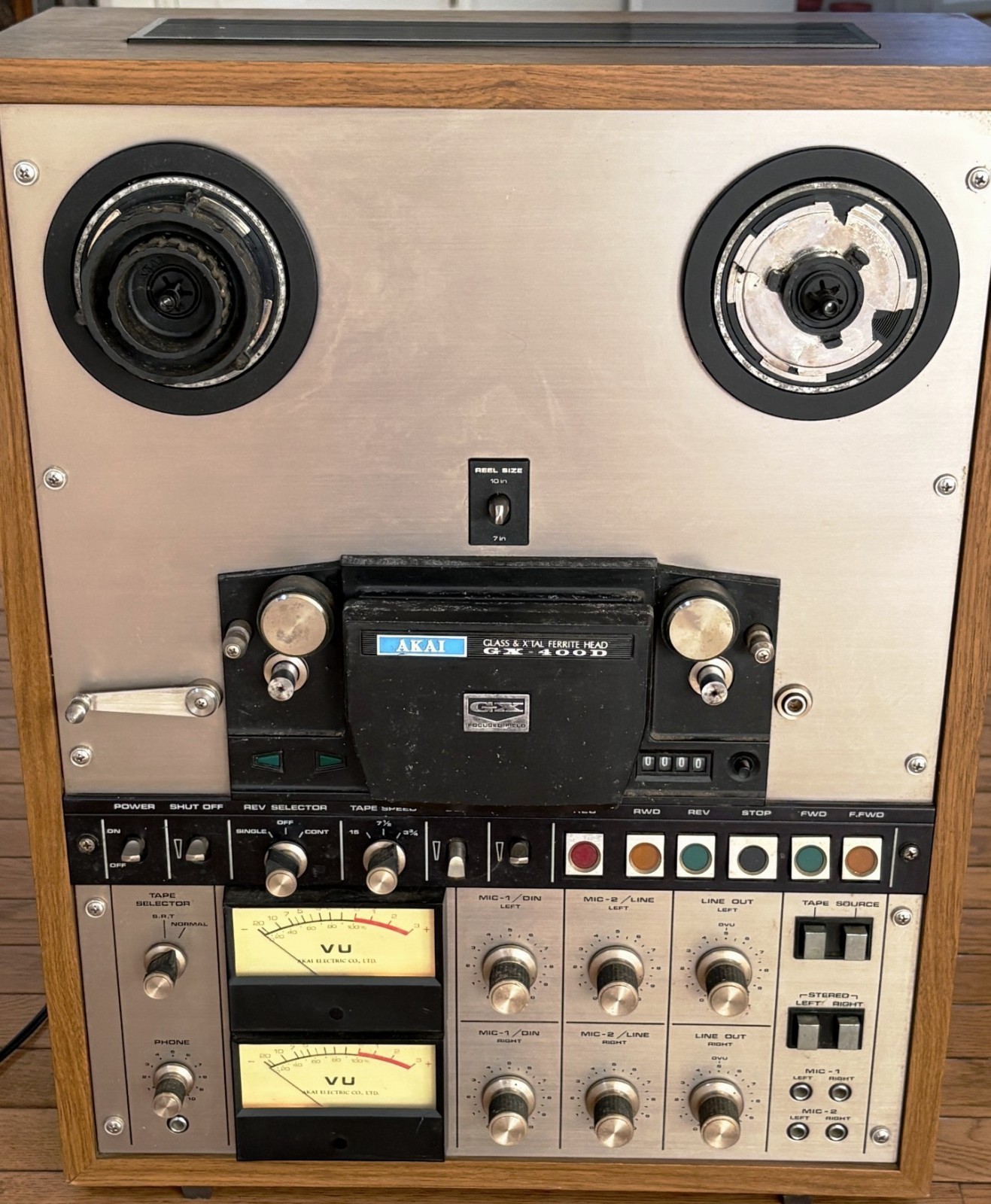
Built with a rigid steel chassis and a die-cast aluminum tape deck frame, the GX-400D minimized vibration and ensured long-term alignment stability. The front panel featured large, easy-to-read VU meters, precise mechanical tape counters, and clearly labeled controls for record, play, rewind, and fast-forward—each operated via individual buttons with mechanical latching.
Sound Characteristics and Performance
The GX-400D delivered a sound signature that many describe as clean, detailed, and dynamically expressive. Unlike some reel-to-reel decks that leaned toward a "warm" or colored tonality, the GX-400D aimed for neutrality, making it ideal for accurate monitoring and archival transfers. At 15 ips, the frequency response extended smoothly into the upper treble, with excellent transient response and minimal phase distortion.
Its three-head configuration allowed for true post-record monitoring, enabling users to verify recordings immediately after laying them down—a feature prized by home recordists and small studios. The separate playback and record heads also contributed to improved channel separation and reduced crosstalk.
With optional Dolby B and C noise reduction (depending on firmware version and region), the GX-400D could achieve a remarkably quiet background, especially when using high-bias tapes like chrome or metal formulations. When paired with quality source material—such as broadcast feeds, live recordings, or master tapes—the GX-400D revealed subtle spatial cues and a wide soundstage that few cassette decks could match.
Notable Features and Innovations
Several design elements set the GX-400D apart from its peers:
- Dual Capstan Transport: This minimized tape slippage and provided exceptional speed stability, crucial for maintaining pitch accuracy over long durations.
- Servo-Controlled Motors: Ensured consistent tape speed regardless of load or temperature fluctuations.
- Three-Head Configuration: Enabled non-destructive monitoring and improved editing capabilities.
- Selectable Equalization: Allowed users to optimize playback for different tape types (normal, high-bias, metal), enhancing fidelity across media.
- Direct Drive System: Reduced mechanical wear and improved responsiveness compared to belt-driven mechanisms.
- Professional Build Quality: All-metal construction, precision-machined head blocks, and high-grade electronics made the GX-400D a long-lasting machine.
Additionally, the GX-400D featured a logic-controlled transport with soft-touch buttons—an advanced feature for its time—offering reliable operation and reduced mechanical failure compared to older cam-based systems.
Common Issues and Maintenance
Like all vintage reel-to-reel decks, the GX-400D requires regular maintenance to perform at its best. Over time, rubber components such as idler tires and pressure pads can harden or crack, leading to inconsistent tape tension or poor head-to-tape contact. These should be replaced with modern equivalents during restoration.
The capstan shafts and pinch rollers require periodic cleaning to prevent oxide buildup, which can degrade sound quality and cause speed irregularities. Similarly, the tape heads should be demagnetized regularly using a quality tape head demagnetizer to avoid dull, thin sound.
Another potential issue is dried-up lubricant in the transport mechanism, which may cause sluggish operation or binding. A full mechanical service—including cleaning, lubrication, and belt/idler replacement—is recommended for any GX-400D that has been in storage for years.
Electrolytic capacitors in the power supply and audio circuits may also need replacement, particularly if the unit exhibits hum, low output, or power instability. Given the age of these machines, proactive recapping is a wise investment in longevity.
Current Market Value and Collectibility
The Akai GX-400D is not as commonly encountered on the vintage market as models from TEAC, Revox, or Sony, but it holds a quiet reputation among reel-to-reel aficionados. Well-maintained units typically sell in the $400–$700 range, depending on condition, included accessories, and provenance.
Fully serviced examples with upgraded capacitors, new rubber parts, and calibrated heads command premium prices, especially when bundled with original manuals and boxes. Machines in original, unmodified condition are increasingly sought after by collectors who appreciate period-correct engineering.
While not yet a "blue chip" collectible like the Revox A77 or Studer B67, the GX-400D is gaining recognition as a sleeper classic—a high-performance deck that offers professional-level results at a fraction of the cost of more famous European counterparts.
Conclusion and Legacy
The Akai GX-400D stands as a testament to Japan’s golden age of analog audio engineering. It combines precision mechanics, thoughtful design, and audiophile-grade sound in a package that was accessible to serious hobbyists and small studios alike. Though overshadowed in marketing by more prominent brands, the GX-400D delivered performance that could rival—and sometimes surpass—machines costing twice as much.
Today, it remains a favorite among reel-to-reel purists who value reliability, clarity, and the tactile joy of working with quarter-inch tape. Whether used for digitizing vintage recordings, creating new analog masters, or simply enjoying music in its most organic form, the GX-400D continues to earn respect more than four decades after its debut.
For those exploring the world of open-reel audio, the Akai GX-400D is not just a machine—it’s a gateway to the golden era of high-fidelity sound.
eBay Listings


As an eBay Partner, we earn from qualifying purchases. This helps support our independent vintage technology research.
Service Manuals & Schematics
- Catalog — archive.org
Related Models
- Akai CS-F33R (1985)
- Akai DX-59 (1983)
- Akai GX-280D-SS (1979)
- Akai DX-57 (1978)
- Akai AA-5200 (1978)
- Sony TC-2050SD (1978)
- Aiwa AD-F990 (1993)
- Kenwood KX-3060 (1982)
- Sony TC-2130A (1974)
- Sony TC-2220 (1972)