Akai CS-M40R: A Compact Classic from the Early 1980s
In the early 1980s, the personal audio market was booming. As cassette tapes replaced vinyl for portable and bedroom listening, Japanese electronics manufacturers like Akai, Sony, and Panasonic introduced a wave of compact, all-in-one audio systems designed for convenience, style, and affordability. Among these was the Akai CS-M40R, a sleek personal stereo system that blended AM/FM radio, cassette playback, and dual speakers into a single, space-saving unit. While not a high-fidelity powerhouse, the CS-M40R captured the spirit of its era—a time when music was becoming more personal, portable, and accessible than ever before.
Though not widely documented in enthusiast circles today, the Akai CS-M40R represents an important chapter in the democratization of home audio. It was aimed at younger listeners, students, and urban dwellers with limited space but a desire for a self-contained music experience. Its design prioritized usability and aesthetic appeal, making it a common sight in dorm rooms, bedrooms, and small apartments throughout the early to mid-1980s.
Technical Specifications
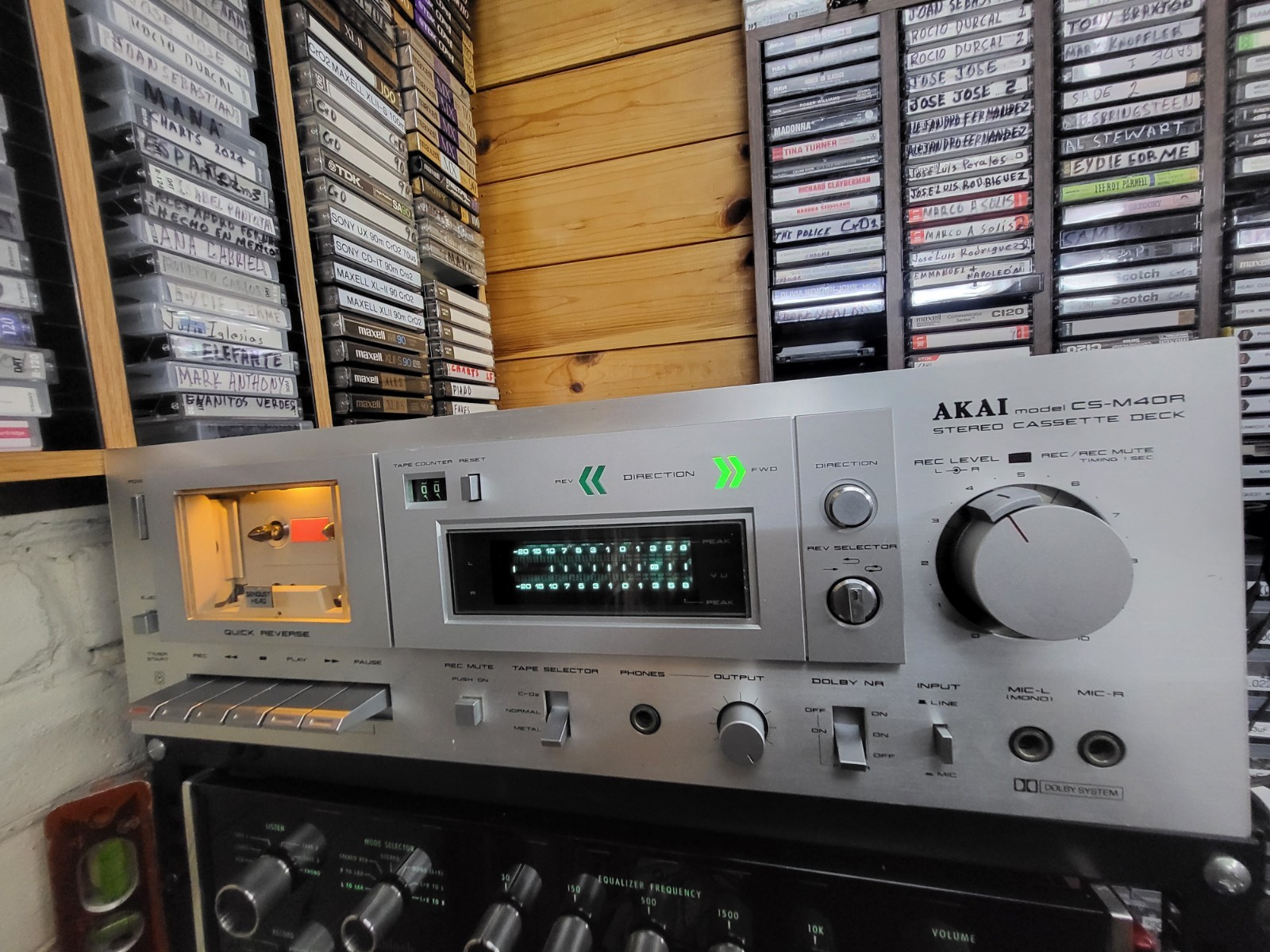
The Akai CS-M40R was designed as a self-contained personal audio solution. It featured a dual-speaker enclosure with a central control panel, integrating all essential functions into a compact footprint. While detailed service manuals are scarce, surviving units and user reports confirm the following specifications:
| Feature | Specification |
| Model | CS-M40R |
| Manufacturer | Akai Corporation, Japan |
| Year Introduced | 1980 |
| Category | Personal Stereo System |
| Tuner | AM/FM with analog tuning dial |
| Tuner Bands | FM (87.5–108 MHz), AM (530–1600 kHz) |
| Cassette Function | Playback and recording capability (1 x record/playback head, 1 x erase head) |
| Speakers | Dual integrated full-range drivers |
| Amplification | Built-in low-power amplifier (mono or stereo) |
| Output Power | Estimated 1–2W per channel (not officially rated) |
| Inputs/Outputs | Line input, 2 microphone inputs, headphone jack (3.5mm) |
| Power Source | AC adapter (12V DC, center-negative) |
| Dimensions (approx.) | 44 cm (W) × 15 cm (H) × 29 cm (D) |
| Weight | 8 kg |
| Finish | Black plastic with silver trim and fabric grilles |
The CS-M40R used a simple analog radio tuner with a large, easy-to-turn knob, typical of budget-friendly systems of the era. The cassette deck was front-loading with basic transport controls: play, stop, and eject. No record function was included, which was common for entry-level personal systems aimed at casual listeners.
Sound Characteristics and Performance
The Akai CS-M40R was never intended to compete with component stereos or high-end receivers. Its sound signature reflects its compact design and modest power output. The integrated full-range speakers deliver clear midrange and decent vocal reproduction, making it well-suited for pop, rock, and spoken word content. Bass response is limited due to the small speaker enclosures and lack of a dedicated subwoofer or ported design, but it remains surprisingly balanced for its size.
Treble is present but not overly bright, avoiding harshness on lower-quality cassette recordings—a thoughtful touch for a system likely to play pre-recorded tapes or mix tapes from the era. The overall tonality leans warm and mellow, which can be pleasing for extended listening sessions.
Stereo separation is modest, as the speakers are mounted close together in a single cabinet. However, the system does support true stereo playback when using the headphone output, offering a more immersive experience for private listening.
Despite its limitations, the CS-M40R delivers a nostalgic charm. For many, the slightly compressed, "radio-like" sound is part of its appeal—an authentic snapshot of how people actually listened to music in the early 1980s.
Notable Features and Design
The CS-M40R stands out for its clean, minimalist design. The black plastic cabinet is accented with silver trim and a brushed metal front panel, giving it a modern (for the time) appearance. The large tuning dial and prominent cassette well make operation intuitive, even for younger users.
One of its most user-friendly features is the 3.5mm headphone jack, allowing for private listening—a crucial feature for students or apartment dwellers. The inclusion of both AM and FM bands ensured access to a wide variety of content, from music stations to news and talk radio.
The system’s compact size and integrated design made it highly portable. Unlike component systems requiring separate receivers, turntables, and speakers, the CS-M40R was truly plug-and-play. Just connect the AC adapter, insert a cassette or tune a station, and you were ready to go.
While lacking advanced features like auto-reverse, Dolby noise reduction, or digital tuning, the CS-M40R excelled in simplicity and reliability—hallmarks of Akai’s approach to consumer electronics during this period.
Common Issues and Maintenance
Like many electronics from the 1980s, the Akai CS-M40R can suffer from age-related wear. The most common issues include:
- Worn cassette belts: Though the CS-M40R is playback-only, it still uses rubber drive belts that can dry out and crack over time. If the tape doesn’t spin or plays at incorrect speed, belt replacement is likely needed.
- Sticky transport mechanism: Dust and old lubricant can cause the play and stop buttons to stick. Cleaning and relubrication with appropriate grease can restore smooth operation.
- Failing electrolytic capacitors: The internal power regulation circuitry may contain aging capacitors that can leak or lose capacitance, leading to power issues or audio distortion.
- Loose headphone jack: The 3.5mm jack can become intermittent due to worn contacts or broken solder joints.
- Tuner misalignment: Over decades, the FM/AM tuner may drift out of alignment, resulting in weak reception or difficulty tuning stations.
Maintenance is relatively straightforward for those with basic electronics skills. Replacement belts and capacitors are readily available from vintage audio suppliers. Cleaning the tape head with isopropyl alcohol and a cotton swab is recommended for optimal playback quality.
Current Market Value and Collectibility
The Akai CS-M40R is not a high-demand collector’s item, but it holds niche appeal among enthusiasts of 1980s design, retro audio, and Japanese consumer electronics. Units in working condition with original finish and accessories (such as the AC adapter) typically sell for $40–$80 on auction and resale sites.
Fully restored models or those with rare color variants (if any existed) may command slightly higher prices, but the CS-M40R remains an affordable entry point into vintage personal audio systems. Its value lies more in nostalgia and aesthetic charm than in technical performance.
It’s particularly sought after by collectors of "retro bedroom setups" or those recreating period-accurate 1980s interiors. Its compact size also makes it ideal for display in offices, studios, or media rooms.
Conclusion and Legacy
The Akai CS-M40R may not have been a technical marvel, but it was a product of its time—designed for convenience, affordability, and everyday enjoyment. In an era when music was transitioning from shared living-room listening to personal, on-demand experiences, systems like the CS-M40R played a quiet but important role.
Today, it stands as a charming artifact of early 1980s consumer electronics. While overshadowed by more famous brands and models, the CS-M40R embodies the ingenuity and accessibility that defined Akai’s approach to audio for the masses. For vintage audio enthusiasts, it’s a delightful reminder that great sound doesn’t always come from high-end gear—sometimes, it comes from a simple cassette, a pair of small speakers, and the joy of listening.
eBay Listings


As an eBay Partner, we earn from qualifying purchases. This helps support our independent vintage technology research.
Related Models
- Akai AM-2850 (1975)
- Akai AP-206 (1975)
- Akai AM-2450 (1978)
- Akai GX-F66RC (1981)
- Akai AM-A-200 (1979)
- Nakamichi BX-1 (1985)
- Acoustic Research research-ar-17 (1978)
- Acoustic Research AR-19 (1994)
- Acoustic Research AR-1W (1954)
- Acoustic Research AR-28S (1992)