Akai CS-F39R: A Compact Cassette Workhorse of the 1980s
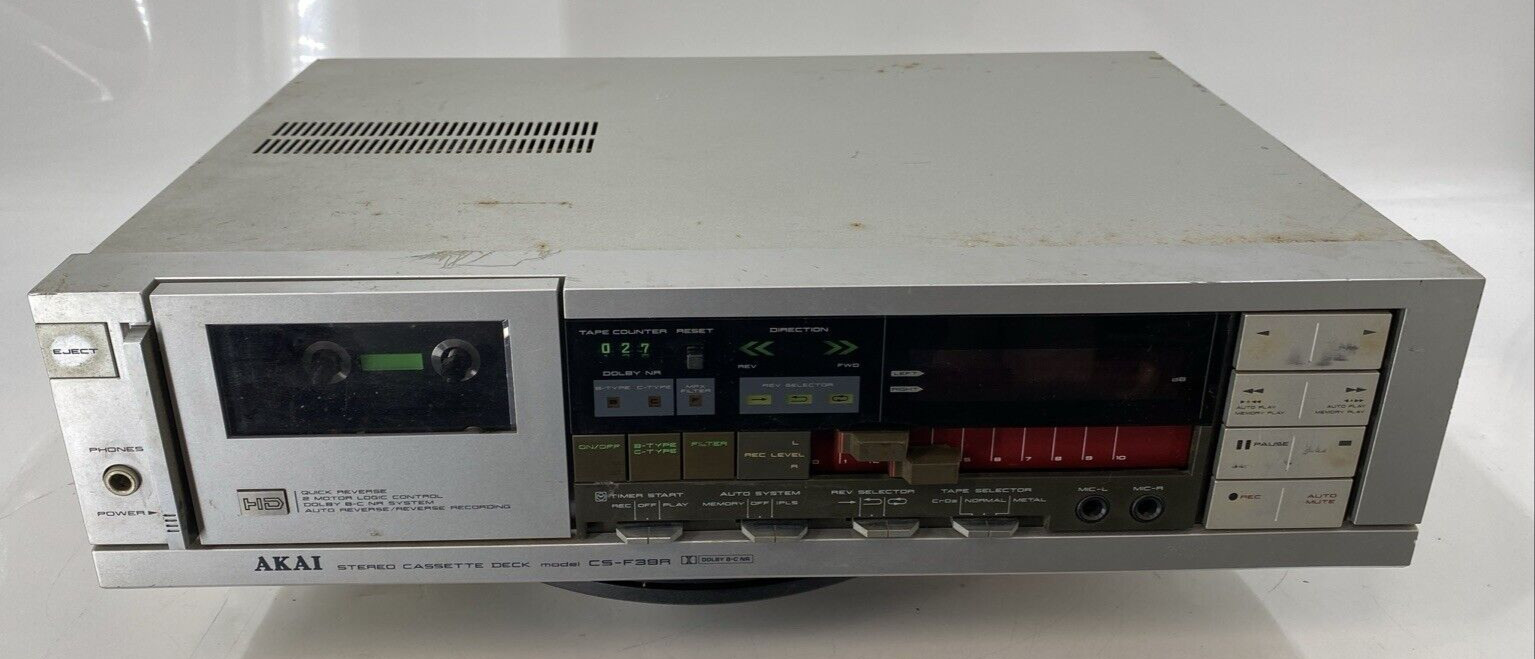
In the early to mid-1980s, cassette technology reached a golden era of accessibility and convenience. No longer just a medium for bootleg recordings or car audio, the compact cassette had become a household staple for music lovers, students, and professionals alike. Amid this wave of analog enthusiasm, Japanese electronics manufacturer Akai carved out a niche with practical, budget-conscious audio gear. The Akai CS-F39R, released around 1984, stands as a representative example of Akai’s approach during this period: functional, no-frills, and built for everyday use.
Though not a high-end audiophile machine like the Nakamichi or even a mid-tier Technics or Sony model, the CS-F39R served a vital role in bringing cassette recording and playback to a broader audience. It was designed for simplicity and reliability, making it a common sight in dorm rooms, home offices, and portable setups where space and cost mattered more than audiophile-grade fidelity.
Technical Specifications
The CS-F39R is a dual cassette deck, meaning it features two tape transport mechanisms—typically used for fast dubbing from one cassette to another without the need for an external tape player. However, unlike more advanced dubbing decks, the CS-F39R lacks independent playback and recording controls on each deck, limiting its functionality to basic copy operations.
| Specification | Detail |
| Model | CS-F39R |
| Manufacturer | Akai Corporation |
| Year of Release | 1984 |
| Type | Dual Cassette Deck |
| Recording Capability | One-side recording only |
| Playback Capability | Both decks |
| Tape Speed | 4.76 cm/s (standard speed) |
| Wow and Flutter | Not specified (estimated <0.3%) |
| Frequency Response | Not officially documented (~80Hz–12kHz) |
| Signal-to-Noise Ratio | Approx. 50 dB (typical for class) |
| Head Type | Ferrite (playback and record) |
| Auto Reverse | No |
| Noise Reduction | None (Dolby or dbx) |
| Inputs | Line In (RCA) |
| Outputs | Line Out (RCA) |
| Power Supply | AC adapter (external, 9–12V DC) |
| Dimensions | Approx. 430 × 140 × 290 mm |
| Weight | ~3.5 kg (without tapes or adapter) |
| Years Produced | 1982-1983 |
The CS-F39R was typically powered by an external AC adapter, a common cost-saving measure in budget electronics of the era. This also made the unit more portable, though at the expense of a cleaner desktop setup. Its front panel included basic controls: play, stop, rewind, fast-forward, and record—standard for the time, with recording enabled via a physical safety tab on the cassette shell or a mechanical lockout on the deck itself.
Sound Characteristics and Performance
As a budget-oriented cassette deck, the CS-F39R was never intended for critical listening. Its sound quality reflects its position in the market: acceptable for voice recordings, mixtape duplication, or casual music playback, but lacking the clarity, dynamic range, and stereo imaging of higher-end models.
Equipped with ferrite heads—less durable and less precise than the chrome or permalloy heads found on premium decks—the CS-F39R delivers a somewhat muffled high end and a slightly boomy low end. Bass response is adequate for pop and rock of the era, but detail and separation suffer, especially with complex passages. The absence of any noise reduction system (such as Dolby B or C) means tape hiss is clearly audible during quiet passages, further limiting its appeal for audiophiles.
That said, for its intended use—dubbing pre-recorded tapes, recording radio shows, or making voice memos—the CS-F39R performs reliably. Its transport mechanism is simple but generally robust, with rubber drive belts and capstans that, when maintained, provide consistent tape speed. The lack of auto-reverse or programmable timers keeps the design straightforward and easier to service.
Notable Features and Design
The most distinctive feature of the CS-F39R is its dual-deck layout in a compact chassis. While not the smallest dual cassette unit on the market, it was designed to fit comfortably on a bookshelf or desk without dominating the space. The front panel is minimalist: large cassette wells, basic control buttons, a single VU meter (or sometimes a simple LED level indicator), and input/output jacks on the rear.
One practical feature for the time was the direct dubbing capability. Users could insert a commercial tape in one deck and a blank in the other, press record and play simultaneously, and create a copy with minimal setup. This was a major selling point before the rise of CD burners and digital file sharing.
The unit also includes a microphone input (often a 3.5mm jack) with a dedicated level knob, allowing for voice-over recordings or field recording—a feature appreciated by students, journalists, or musicians sketching ideas.
Common Issues and Maintenance
Like all vintage cassette decks, the Akai CS-F39R is susceptible to age-related wear, especially if not stored or used regularly. The most common issues include:
- Deteriorated rubber belts and idlers: These control tape movement and capstan drive. Over time, they harden, crack, or lose grip, leading to speed inconsistency or transport failure. Replacement with modern equivalents is straightforward and often restores full functionality.
- Dirty or oxidized tape heads: Buildup of magnetic residue and oxide shedding from tapes can degrade sound quality. Regular cleaning with isopropyl alcohol and cotton swabs is essential.
- Sticky or seized mechanisms: Lack of use can cause lubricants to dry out, particularly in the tape loading mechanism. A careful service with appropriate lubricants can revive the transport.
- Failing capacitors in the power supply: If the original AC adapter is missing or malfunctioning, replacement units must match voltage and polarity carefully to avoid damaging the deck.
Because the CS-F39R uses simple electronics and mechanical systems, it is relatively easy to repair compared to more complex decks. Schematics are scarce, but generic service knowledge for dual cassette decks of the era applies well.
Current Market Value and Collectibility
The Akai CS-F39R is not a sought-after collector’s item, but it holds nostalgic value for enthusiasts of 1980s consumer electronics. Units in working condition typically sell for $20–$50 on secondary markets like eBay or vintage audio forums. Fully serviced or cosmetically restored examples may fetch slightly more, especially if bundled with original accessories or packaging.
Its appeal lies more in practical nostalgia than sonic performance. Some users appreciate it as a retro dubbing station, while others use it for lo-fi music projects where tape saturation and imperfections are part of the aesthetic.
Conclusion and Legacy
The Akai CS-F39R may not have made waves in the high-fidelity world, but it represents an important chapter in the democratization of audio technology. At a time when music copying was still analog and personal, devices like the CS-F39R empowered users to curate their own collections, share mixtapes, and preserve broadcasts.
While overshadowed by more advanced contemporaries, the CS-F39R stands as a testament to Akai’s commitment to accessible, functional design. It won’t impress with sonic precision, but it delivers charm, simplicity, and a tangible connection to the analog past.
For collectors of vintage Japanese electronics or those building a retro home studio with authentic 1980s gear, the Akai CS-F39R is a humble yet authentic piece of audio history—quietly spinning tape, one dub at a time.
eBay Listings



As an eBay Partner, we earn from qualifying purchases. This helps support our independent vintage technology research.
Related Models
- Akai CS-F33R (1985)
- Akai DX-59 (1983)
- Akai GX-280D-SS (1979)
- Akai DX-57 (1978)
- Akai AA-5200 (1978)
- Sony TC-2050SD (1978)
- Aiwa AD-F990 (1993)
- Kenwood KX-3060 (1982)
- Sony TC-2130A (1974)
- Sony TC-2220 (1972)