Akai CS-F21: A Compact Cassette Workhorse of the Early 1980s
In the early 1980s, cassette technology had firmly established itself as the dominant medium for personal audio playback and recording. While high-end audiophiles debated the merits of open-reel tape versus compact cassette, manufacturers like Akai were busy refining the cassette deck to deliver increasingly reliable, portable, and user-friendly machines for the mainstream market. Among these was the Akai CS-F21, a compact cassette deck that, while not a flagship model, exemplified the practical engineering and affordability that defined Akai’s approach during this era.
Though the CS-F21 never achieved the cult status of Akai’s professional reel-to-reel recorders or the high-fidelity CS series decks, it carved out a niche as a dependable, no-frills machine suitable for home use, portable recording, and educational applications. Its design reflects the transitional period in audio technology—when cassette decks were becoming more automated, yet still retained analog simplicity and mechanical reliability.
Technical Specifications
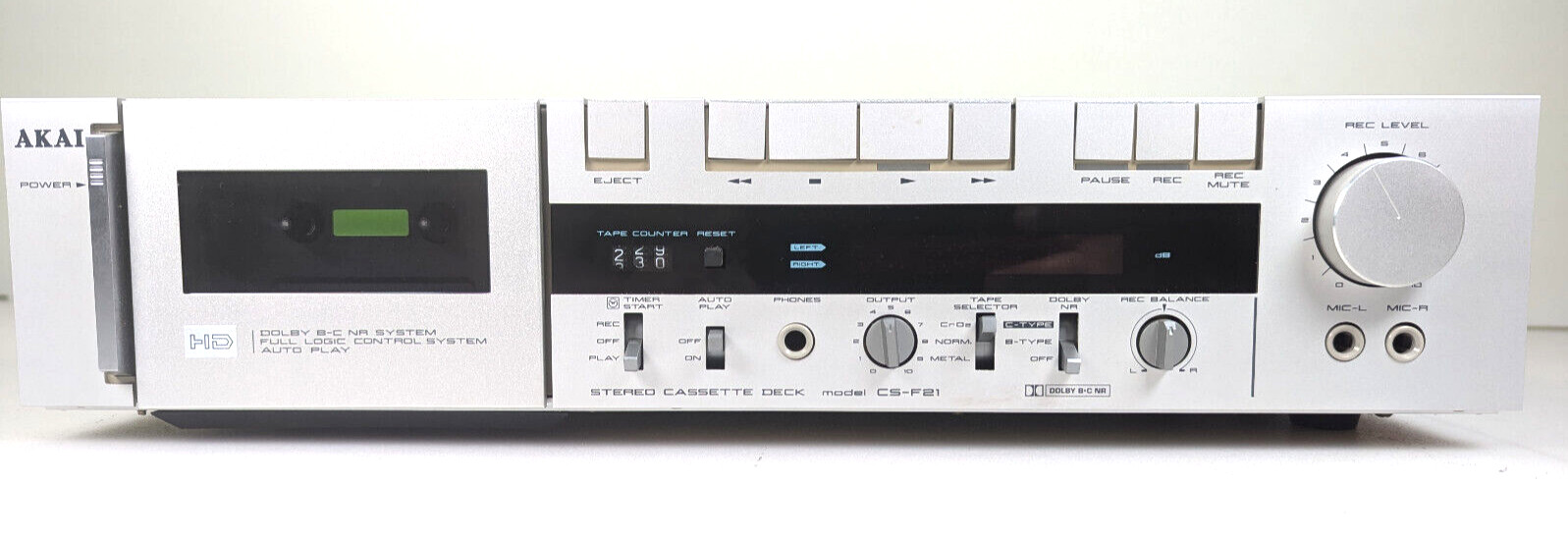
The Akai CS-F21 was engineered as a basic, front-loading cassette deck with manual tape insertion and ejection. It lacked the auto-reverse or Dolby noise reduction systems found in higher-end models, positioning it as an entry-level or utility-focused device. Despite its modest feature set, it was built with Akai’s signature attention to mechanical durability and consistent tape transport.
| Specification | Detail |
| Model | CS-F21 |
| Manufacturer | Akai Corporation |
| Year Introduced | 1982 |
| Type | Compact cassette deck |
| Loading Mechanism | Front-loading, manual |
| Playback Modes | Playback, Record, Stop, Rewind, FF |
| Tape Speed | 4.76 cm/s (1⅞ ips) |
| Recording System | AC bias, manual level adjustment |
| Head Configuration | Combined record/playback head |
| Erase Method | Permanent magnet erase |
| Motor Type | DC motor (belt-driven) |
| Power Requirements | 6V DC (4 x AA batteries or AC adapter) |
| Dimensions (W×H×D) | Approx. 115 × 45 × 180 mm |
| Weight | ~1.2 kg (without batteries) |
| Audio Output | Mono mini-jack (3.5mm) |
| Microphone Input | Yes, 3.5mm jack |
| Line Input | No |
| Noise Reduction | None |
| Auto Reverse | No |
| Auto Stop | Yes (at tape end) |
| Frequency Response | Type I: 30-16,000 Hz ±3 dB at -20 dB VU, Type II: 30-16,000 Hz ±3 dB at -20 dB VU, Type IV: 30-18,000 Hz ±3 dB at -20 dB VU |
Sound Characteristics and Performance
As a budget-oriented cassette deck, the Akai CS-F21 was not designed for audiophile-grade sound reproduction. Its audio performance is best described as functional and clear, with a frequency response that adequately covers the vocal and midrange spectrum—ideal for voice recording, dictation, or casual music playback.
The combined record/playback head limits high-frequency extension and dynamic range compared to decks with separate heads, but for its intended use cases, the fidelity is respectable. Users report a slightly warm tonal balance, likely due to the head gap and tape path design, which can be flattering for voice recordings. Bass response is modest, as expected from a compact mechanism with limited tape contact area.
The manual recording level control allows users to adjust input sensitivity—useful when recording from external microphones or line sources (via microphone input, used in a pinch). However, the lack of VU meters or peak indicators means level setting is largely a matter of trial and error.
Notable Features and Design
The CS-F21’s most notable feature is its portability and battery operation. Powered by four AA batteries or an optional AC adapter, it could be used in the field, classrooms, or for travel. This made it popular among students, journalists, and educators in the early 1980s who needed a rugged, self-contained recording solution.
Its front-loading design simplified tape handling, though it lacked the dust protection of top-loading clamshell mechanisms. The transport controls—large rubberized buttons for play, record, stop, rewind, and fast-forward—are intuitive and tactile, reflecting the ergonomic design trends of the time.
The inclusion of a built-in microphone input (with a basic electret condenser mic often sold separately) enhanced its utility for field recording. While stereo recording was not supported, the mono input was sufficient for most spoken-word applications.
Mechanically, the CS-F21 uses a belt-driven DC motor system, which contributes to quiet operation but may require maintenance over time as belts age and degrade. The tape transport is simple but generally reliable, with rubber pinch rollers and capstans that maintain consistent tape speed.
Common Issues and Maintenance
Like many compact cassette decks of its era, the Akai CS-F21 is prone to a few age-related issues:
- Deteriorating rubber parts: The pinch roller and drive belt are made of rubber and tend to harden, crack, or lose grip after 30+ years. Replacing these with modern equivalents is essential for proper operation.
- Dirty or oxidized heads: The combined record/playback head can accumulate oxide buildup, leading to muffled sound or dropouts. Regular cleaning with isopropyl alcohol and cotton swabs is recommended.
- Worn micro-switches: The mechanical switches that detect tape presence and end-of-tape can wear out, causing erratic auto-stop behavior or failure to engage play mode.
- Battery corrosion: If stored with old batteries, the spring contacts can corrode. Cleaning with vinegar or contact cleaner and replacing damaged springs may be necessary.
Despite these issues, the CS-F21 is relatively easy to service due to its simple construction and accessible internal layout. Replacement belts and cleaning kits are widely available from vintage audio suppliers.
Current Market Value and Collectibility
The Akai CS-F21 is not a highly sought-after collector’s item, but it holds nostalgic value for enthusiasts of 1980s portable audio and analog recording. Units in working condition typically sell for $20–$50 on secondary markets such as eBay or vintage audio forums. Fully restored examples with new belts and cleaned heads may command slightly higher prices, especially if accompanied by original accessories like the microphone or carrying case.
Its collectibility is niche—appealing more to those interested in the history of portable recording, educational technology, or Akai’s broader product lineage. It’s unlikely to appreciate significantly in value, but it remains a charming artifact of pre-digital audio culture.
Conclusion and Legacy
The Akai CS-F21 may not be a high-performance machine, but it represents an important chapter in the democratization of audio recording. At a time when cassette decks were becoming essential tools in homes, schools, and offices, Akai delivered a product that was affordable, portable, and dependable.
While overshadowed by more advanced models, the CS-F21 embodies the practical spirit of early 1980s consumer electronics—where function often took precedence over flash, and durability mattered more than specs. For collectors of vintage audio, it’s a reminder that not every classic needs to be a masterpiece to be meaningful.
Today, the CS-F21 serves as a functional piece of audio history, perfect for those who appreciate the tactile experience of analog recording or want to explore the roots of portable sound. With a little care and maintenance, it continues to spin tapes and capture voices—just as it did over four decades ago.
eBay Listings


As an eBay Partner, we earn from qualifying purchases. This helps support our independent vintage technology research.
Service Manuals & Schematics
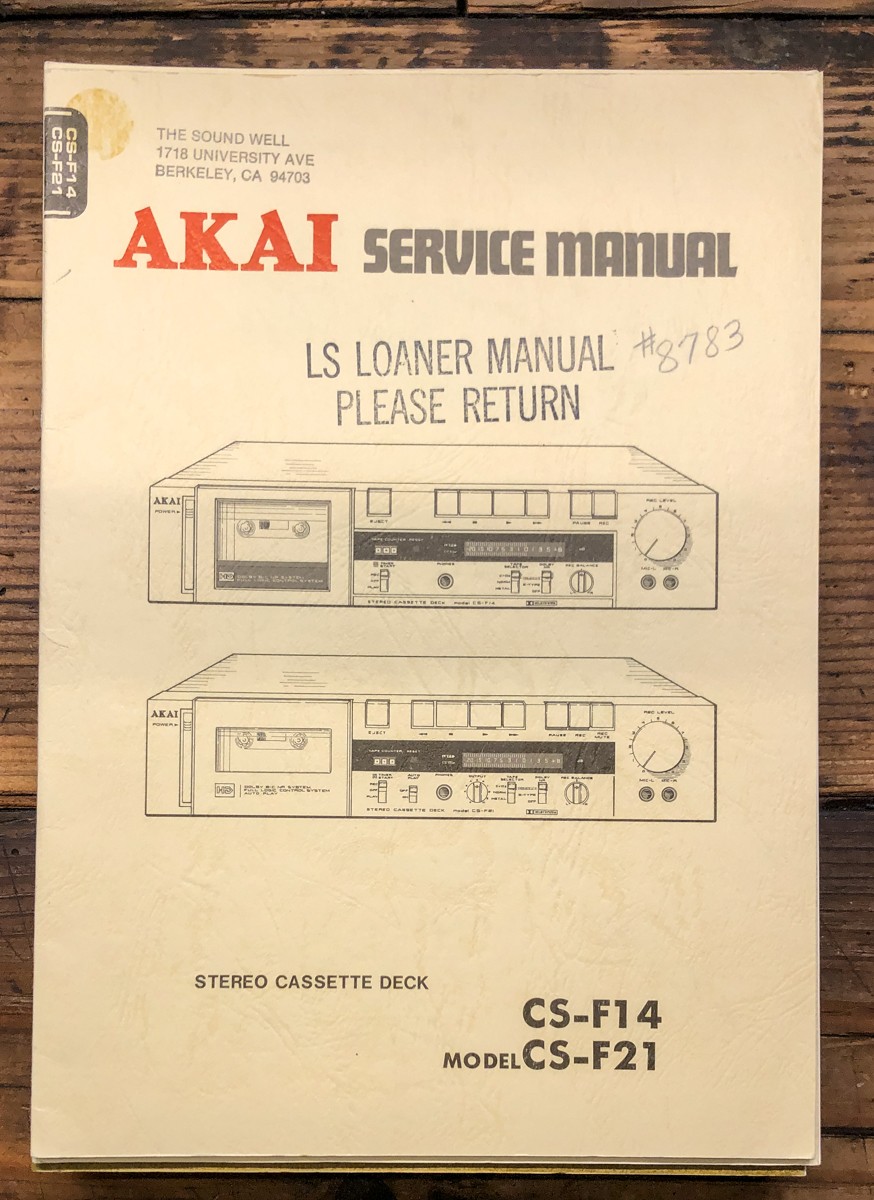
- Manual (1982) — archive.org
Related Models
- Akai CS-F33R (1985)
- Akai DX-59 (1983)
- Akai GX-280D-SS (1979)
- Akai DX-57 (1978)
- Akai AA-5200 (1978)
- Sony TC-2050SD (1978)
- Aiwa AD-F990 (1993)
- Kenwood KX-3060 (1982)
- Sony TC-2130A (1974)
- Sony TC-2220 (1972)