Akai CS-705D: The Unsung Hero of Analog Tape Fidelity
In the late 1970s, when audiophiles were chasing the purest sound reproduction possible, open-reel tape decks stood at the pinnacle of home audio technology. Among the many Japanese manufacturers producing high-end reel-to-reel recorders, Akai carved out a reputation for engineering precision, robust build quality, and exceptional value. The Akai CS-705D, released in 1979, is a prime example of the company’s commitment to analog excellence. Though not as widely celebrated as some of its contemporaries from brands like Sony or TEAC, the CS-705D remains a respected machine among reel-to-reel enthusiasts and vintage audio collectors.
A Glimpse into Akai’s Reel-to-Reel Legacy
Akai entered the consumer audio market in the 1950s and quickly became a major player in tape recording technology. By the 1970s, the company was producing a wide range of reel-to-reel decks, from entry-level models to high-fidelity professional units. The CS-705D emerged during a golden era for analog audio, when cassette tapes were gaining popularity but open-reel decks still represented the gold standard for sound quality.
Positioned as a mid-to-high-tier consumer model, the CS-705D was designed for serious music lovers who wanted studio-grade recording and playback capabilities in their living rooms. It offered a balance of performance, reliability, and user-friendly features that made it a favorite among home recording enthusiasts and audiophiles alike.
Technical Specifications
The CS-705D was engineered with precision components and thoughtful design, reflecting Akai’s deep understanding of analog tape mechanics. Below is a detailed breakdown of its key specifications:
| Feature | Specification |
| Type | 4-track stereo, 1/4" open-reel tape deck |
| Tape Speeds | 7.5 ips, 15 ips (inches per second) |
| Track Configuration | 4-track, 2-channel (full-track or stereo) |
| Head Configuration | 3-head system (erase, record, playback) |
| Recording System | AC bias with noise reduction compatibility |
| Frequency Response | 30Hz – 20kHz (±3dB) at 15 ips |
| Wow and Flutter | < 0.20% (WRMS) |
| Signal-to-Noise Ratio | > 60 dB (Dolby B compatible) |
| Input/Output | Line In/Out (RCA), Mic In (¼" jack) |
| Motor System | Dual capstan, direct-drive with servo control |
| Display | VU meters for level monitoring |
| Power Requirement | 120V AC, 60Hz (North American model) |
| Dimensions | 440 mm (W) × 145 mm (H) × 335 mm (D) |
| Weight | 12.5 kg (27.5 lbs) |
| Noise Reduction | Dolby B |
| Years Produced | 1979-1982 |
The three-head design was a hallmark of higher-end decks, allowing for true post-recording monitoring by separating the record and playback heads. This meant users could hear exactly what was being recorded in real time—a crucial feature for musicians and home recordists.
Sound Characteristics and Performance
The Akai CS-705D delivers the warm, rich, and detailed sound that reel-to-reel enthusiasts cherish. At 15 ips, the deck achieves a frequency response that rivals many professional studio machines of its era, capturing subtle nuances in vocals and instruments with remarkable clarity. The extended low end and smooth high-frequency roll-off contribute to a natural, lifelike presentation.
One of the standout qualities of the CS-705D is its dynamic range and low distortion. Thanks to its precision tape transport and high-quality record electronics, it handles complex passages with ease, avoiding the compression and smearing that can plague lesser decks. When paired with a good preamp and used with high-grade tape (such as Ampex 456 or Scotch 226), the CS-705D can produce recordings that still hold up decades later.
Dolby B noise reduction support helps minimize tape hiss, especially at the 7.5 ips speed, making it a practical choice for long-duration recordings or cassette transfers. However, purists often prefer to run the deck in "flat" mode to preserve the full analog character of the tape.
Notable Features and Innovations
The CS-705D was packed with features that were advanced for its time:
- Three-Head System: Enabled real-time monitoring and improved recording accuracy.
- Dual Capstan Drive: Enhanced tape stability and reduced speed fluctuations, contributing to lower wow and flutter.
- VU Meters: Large, easy-to-read analog meters allowed precise level setting during recording.
- Selectable Tape Types: Optimized bias and equalization settings for normal, high-bias (chrome), and metal tapes—rare in consumer decks of this class.
- Direct Drive Servo Motor: Provided consistent speed control and reduced mechanical wear over time.
- Full Logic Transport: Automatic stop at tape ends and smooth, reliable operation of play, record, and rewind functions.
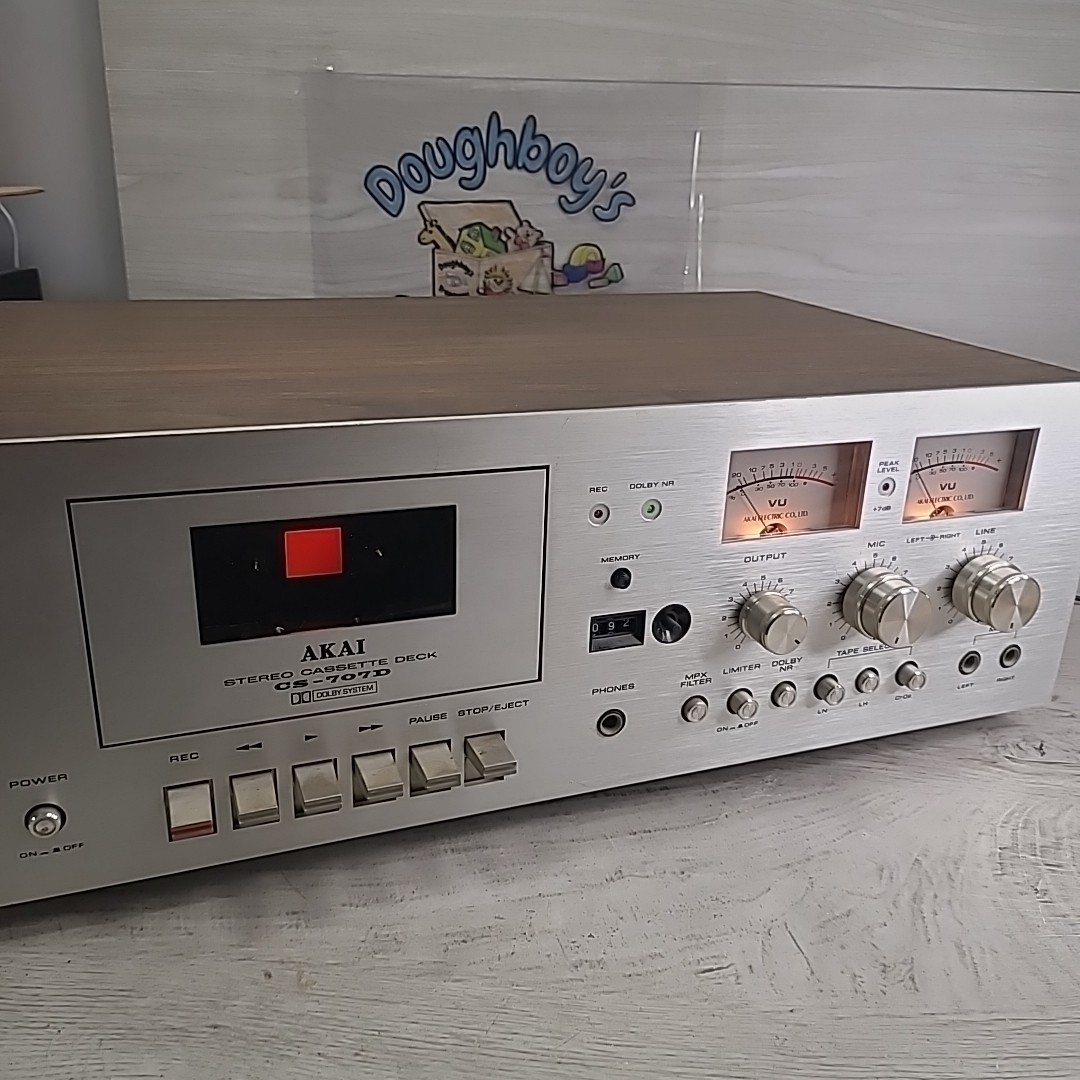
The front panel layout is intuitive, with clearly labeled controls and a clean aesthetic typical of late-’70s Japanese design. The heavy-duty chassis and metal construction give the unit a reassuring heft, signaling its durability and resistance to vibration.
Common Issues and Maintenance
Like all vintage reel-to-reel decks, the Akai CS-705D requires regular maintenance to perform at its best. After 40+ years, common issues include:
- Deteriorated Rubber Components: Idler tires, pinch rollers, and drive belts may have hardened or cracked. These should be replaced with modern equivalents.
- Dirty or Worn Heads: Tape heads can become clogged with oxide residue. Regular cleaning with isopropyl alcohol and demagnetizing are essential.
- Capstan Shaft Drying: The capstan shaft may develop sticky residue, affecting tape speed. Cleaning and light lubrication are recommended.
- Capacitor Aging: Electrolytic capacitors in the power supply and audio circuits may need replacement to prevent hum or failure.
A full servicing—often referred to as a "recap and rebuild"—by a qualified technician can restore the CS-705D to like-new condition. Once maintained, it proves remarkably reliable, a testament to Akai’s engineering.
Current Market Value and Collectibility
The Akai CS-705D is not as widely collected as some of its flashier contemporaries, but it has a loyal following among reel-to-reel aficionados. In good working condition, it typically sells for $300–$600 on the secondary market, depending on location, included accessories, and overall condition.
Fully restored units with new belts, cleaned heads, and recapped electronics command higher prices, especially if they include original boxes or documentation. While not a "rare" model, its solid performance and relative affordability make it an excellent entry point into the world of open-reel audio.
Collectors appreciate the CS-705D not just for its sound, but as a piece of analog history—a machine that represents the peak of consumer tape technology before the digital revolution.
Conclusion and Legacy
The Akai CS-705D may not have the name recognition of a TEAC A-3340 or a Sony TC-800B, but it stands shoulder-to-shoulder with them in terms of performance and build quality. It embodies the best of Akai’s engineering philosophy: no-nonsense reliability, excellent sound, and thoughtful design.
Today, as analog audio enjoys a resurgence, the CS-705D offers a gateway to the magic of tape—its warmth, depth, and tactile engagement. Whether you're transferring vintage recordings, archiving vinyl, or simply indulging in the ritual of analog playback, the CS-705D delivers a deeply satisfying experience.
For those who appreciate the craftsmanship of a bygone era, the Akai CS-705D is more than just a tape deck. It’s a testament to the enduring allure of magnetic tape—and a machine that still earns its place on any serious vintage audio shelf.
eBay Listings



As an eBay Partner, we earn from qualifying purchases. This helps support our independent vintage technology research.
Related Models
- Akai CS-F33R (1985)
- Akai DX-59 (1983)
- Akai GX-280D-SS (1979)
- Akai DX-57 (1978)
- Akai AA-5200 (1978)
- Sony TC-2050SD (1978)
- Aiwa AD-F990 (1993)
- Kenwood KX-3060 (1982)
- Sony TC-2130A (1974)
- Sony TC-2220 (1972)