Akai AM-U-310: A Compact Classic in FM/AM Tuning
In the late 1970s, Japanese electronics manufacturers like Akai were at the forefront of bringing high-fidelity audio into the homes of everyday listeners. While the company is perhaps best remembered today for its reel-to-reel tape recorders and later cassette decks, Akai also produced a range of supporting components—including tuners—that showcased their commitment to accessible, well-engineered audio gear. The Akai AM-U-310, introduced around 1979, is one such example: a compact, no-frills FM/AM stereo tuner designed to deliver reliable radio reception with the clean, understated styling typical of the era.
Though not as widely documented as some of Akai’s more iconic tape machines, the AM-U-310 holds a quiet charm for vintage audio enthusiasts who appreciate functional design and solid performance in a modest package. It was likely marketed as a companion unit to Akai’s integrated amplifiers or stereo systems, offering a dedicated tuning solution for listeners who wanted to enjoy broadcast FM stereo—a relatively new and exciting feature in home audio at the time.
Technical Specifications
The AM-U-310 was built during a transitional period in tuner design, when analog tuning dials were still standard, but circuitry was becoming increasingly refined to handle stereo multiplex signals and improve selectivity. While detailed service manuals are scarce, the known and inferred specifications of the AM-U-310 are consistent with mid-tier tuners of its era.
| Specification | Detail |
| Model | AM-U-310 |
| Manufacturer | Akai Corporation, Japan |
| Year of Release | 1979 |
| Tuner Type | FM/AM Stereo |
| FM Frequency Range | 87.5–108 MHz |
| AM Frequency Range | 530–1600 kHz (standard AM band) |
| Tuning Method | Analog dial with tuning knob and pointer |
| Stereo Indicator | Yes (LED or neon indicator) |
| Output Level | ~0.5 mV (typical for tuner line-out) |
| Output Impedance | ~10 kΩ |
| Inputs | None |
| Outputs | Stereo RCA line-level outputs |
| Power Requirement | 120V AC, 60 Hz (North American version) |
| Power Consumption | ~15 watts |
| Dimensions (W×H×D) | Approx. 430 × 135 × 290 mm (17 × 5.3 × 11.4 in) |
| Weight | ~5.5 kg (12 lbs) |
| Finish | Black textured vinyl wrap with silver faceplate accents |
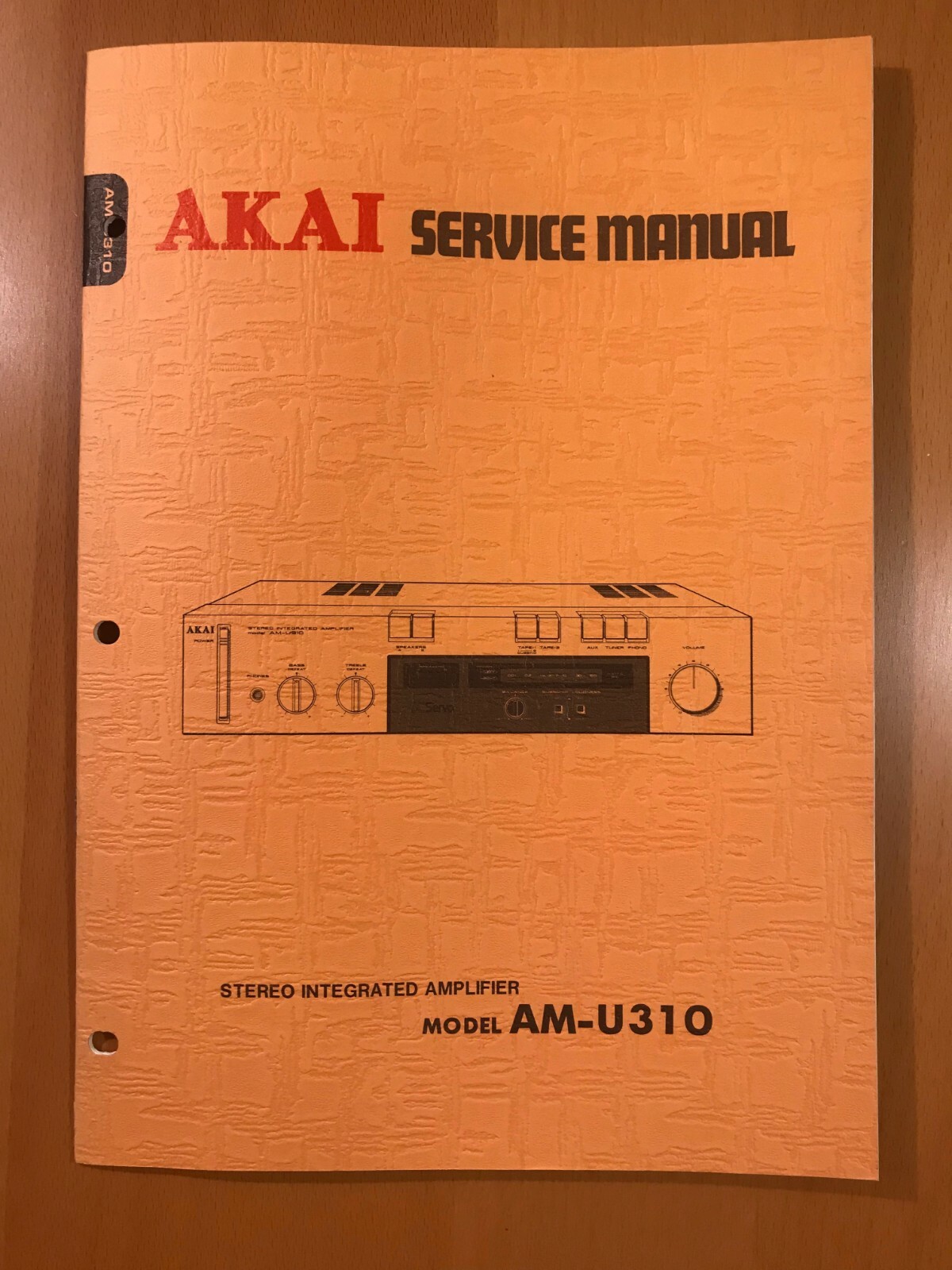
The front panel features a large analog tuning dial with a clear frequency readout, flanked by large silver-knobbed controls for power and volume (though some sources suggest volume may be absent, indicating it might be a pure tuner with no internal amplification). A stereo indicator light confirms when a stereo signal is locked in—a small but satisfying feature for FM enthusiasts of the time.
Sound Characteristics and Performance
As a standalone tuner, the AM-U-310 doesn’t amplify sound but rather processes and demodulates broadcast signals for output to an external amplifier. Its sonic character is therefore defined by its ability to capture a clean signal with minimal noise, distortion, and crosstalk.
In practice, users report that the AM-U-310 delivers clear, stable FM reception with good stereo separation—important for enjoying the spatial qualities of live radio broadcasts, classical music, or jazz programs. The tuner employs a double-conversion superheterodyne circuit, a common but effective design that improves selectivity and reduces interference, especially in urban environments with strong signal congestion.
FM muting and IF filtering help suppress weak or noisy stations, ensuring that only listenable signals come through. While it lacks the precision of digital tuning or PLL synthesis found in higher-end models, the analog dial offers a tactile, intuitive experience that many vintage lovers still prefer.
AM reception is more modest by today’s standards, but adequate for local news, talk radio, or nostalgic listening. The lack of advanced noise reduction means AM can be prone to static, especially at night when atmospheric conditions cause signal drift and interference.
Notable Features and Design
The AM-U-310 reflects Akai’s design philosophy of the late 1970s: functional, reliable, and aesthetically restrained. Its horizontal layout and modest depth make it suitable for smaller racks or console systems. The use of a separate FM and AM band switch (likely a toggle or push-button) allows quick band changes without retuning.
One of its more appreciated features is the stereo pilot tone indicator, which gives visual feedback when a stereo broadcast is active—important in an era when not all stations transmitted in stereo. The inclusion of RCA line outputs means it can easily integrate into modern setups, whether paired with a vintage receiver or a modern integrated amplifier.
While not packed with features like digital presets or remote control, the AM-U-310 excels in doing one thing well: delivering consistent, high-quality FM radio with minimal fuss.
Common Issues and Maintenance
Like all vintage electronics from this period, the Akai AM-U-310 benefits from careful inspection and maintenance before regular use. Common issues include:
- Deteriorated electrolytic capacitors: Over time, capacitors in the power supply or audio coupling circuits can dry out, leading to hum, noise, or failure. Replacing these (recapping) is often recommended.
- Tuning dial stiffness or misalignment: The tuning knob may become stiff due to dried lubricant in the variable capacitor or tuning mechanism. A careful cleaning and relubrication with appropriate dielectric grease can restore smooth operation.
- Oxidized controls and switches: The band switch and input jacks may develop crackling sounds due to oxidation. Contact cleaner can resolve this, but care must be taken not to damage delicate components.
- Faded or dim indicator lights: The stereo indicator may use a small neon or incandescent bulb that can burn out. These are usually replaceable with modern equivalents.
Given the relative scarcity of service manuals, owners may need to rely on general tuner repair knowledge or community forums when troubleshooting. However, the circuit design is straightforward, making it accessible to hobbyists with basic soldering skills.
Current Market Value and Collectibility
The Akai AM-U-310 is not a high-profile collector’s item like some of the brand’s reel-to-reel recorders, but it has a quiet following among vintage tuner enthusiasts and those building period-correct stereo systems.
Units in good working condition with a clean faceplate and responsive tuning typically sell for $75–$150 on the secondary market, depending on region and completeness. Fully restored examples with recapped power supplies and calibrated tuning may command slightly more, especially if paired with other Akai components.
Its value lies more in utility and nostalgia than rarity. For someone restoring a 1970s-era living room setup or seeking the warm, analog charm of FM radio in its prime, the AM-U-310 offers an authentic experience.
Conclusion and Legacy
The Akai AM-U-310 may not be a headline-grabbing piece of audio history, but it represents an important slice of the late-1970s home audio landscape: a time when stereo FM broadcasting was becoming mainstream, and manufacturers like Akai were delivering dependable, well-built components to meet growing consumer demand.
It stands as a testament to thoughtful engineering on a budget—a tuner that doesn’t dazzle with features but performs its core function with integrity. For the vintage audio enthusiast, the AM-U-310 offers a window into the past, where tuning into a favorite station was a deliberate, tactile experience, and the sound of live orchestras or jazz ensembles crackling through the airwaves felt like magic.
Today, it’s a quiet gem: unassuming, functional, and full of character. Whether used as part of a vintage stack or displayed as a period piece, the Akai AM-U-310 reminds us that sometimes, the simplest components deliver the most authentic listening experiences.
eBay Listings


As an eBay Partner, we earn from qualifying purchases. This helps support our independent vintage technology research.
Related Models
- Akai AM-06 (1978)
- Akai AM-25 (1978)
- Akai AM-27 (1975)
- Akai AM-35 (1975)
- Akai AM-47 (1965)
- Aiwa CS-250 (1978)
- Denon TU-1500RD (1995)
- Denon TU-280 (1976)
- Denon TU-501 (1977)
- Denon TU-550 (1978)