Akai AM-U-02: The Forgotten Gem of Modular Hi-Fi
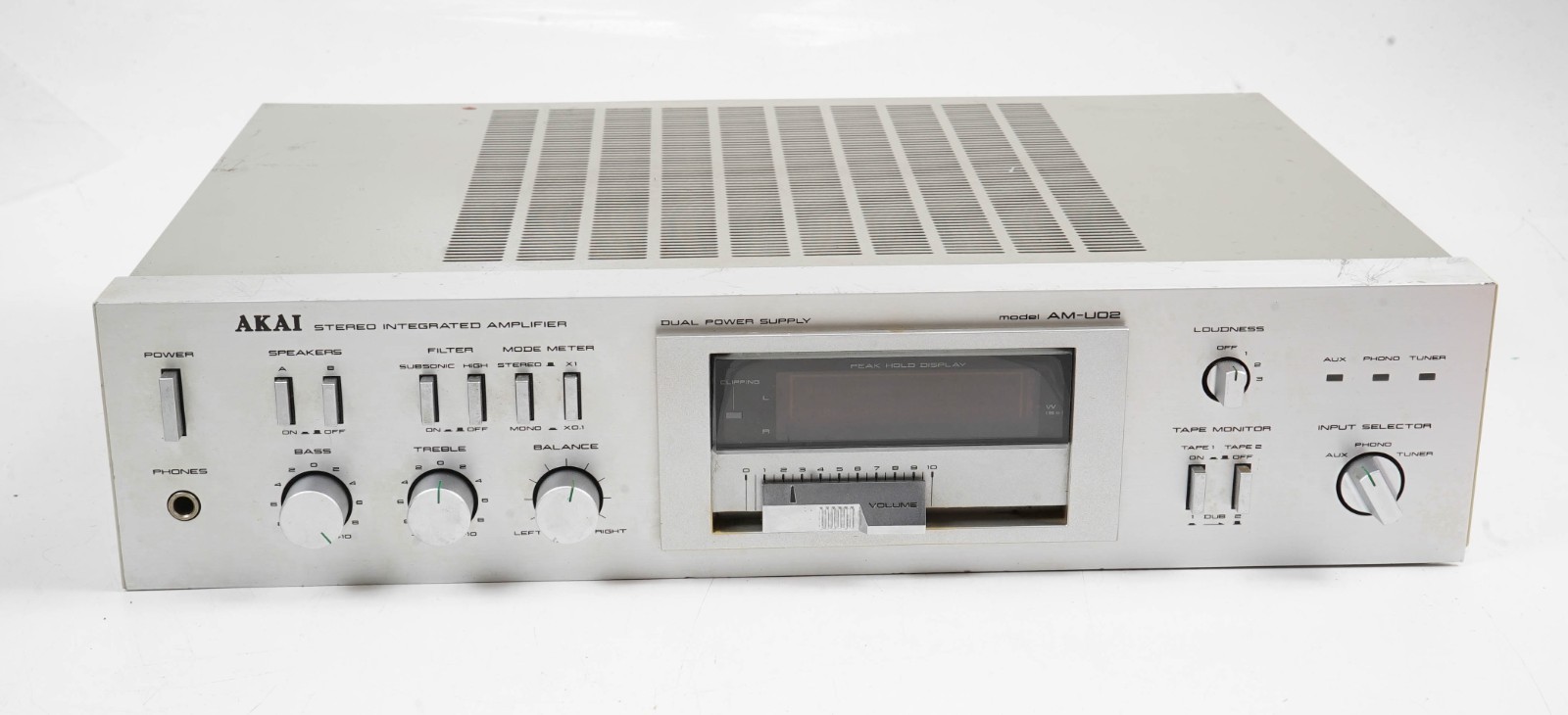
In the late 1970s, Japanese electronics giant Akai was best known for its reel-to-reel tape decks, cassette recorders, and professional broadcast equipment. However, nestled within their broader audio ecosystem was a lesser-known but fascinating product: the Akai AM-U-02, a passive preamplifier module designed for integration into Akai’s modular audio system. While not a standalone amplifier or receiver, the AM-U-02 represents a unique chapter in the evolution of high-fidelity audio design—where modularity, minimalism, and purity of signal path converged in an era dominated by increasingly complex electronics.
Though rarely discussed in mainstream vintage audio circles, the AM-U-02 has quietly gained a cult following among collectors and purists who appreciate its elegant simplicity and historical significance. It stands as a testament to Akai’s forward-thinking approach to system building, where users could mix and match components to create a custom-tailored audio chain.
Technical Specifications
The AM-U-02 was not a powered unit but rather a passive preamp module, meaning it lacked amplification circuitry and relied on external power for source selection and volume control. It was designed to fit into Akai’s proprietary modular chassis systems, such as the Akai AM-Series frames, which allowed users to slide in various functional units—tuners, phono stages, power amps, and preamps—like building blocks.
| Specification | Detail |
| Model | AM-U-02 |
| Manufacturer | Akai Corporation |
| Year of Release | 1978 |
| Type | Passive Preamplifier Module |
| Form Factor | Modular slide-in unit (Akai AM frame) |
| Input Impedance | 47kΩ (typical) |
| Output Impedance | ~10kΩ (passive attenuation network) |
| Inputs | 3 line-level (RCA) |
| Outputs | 1 preamp out (RCA) |
| Control Functions | Volume, Source Selection |
| Power Requirement | None (passive design) |
| Dimensions (approx.) | 125mm (W) × 45mm (H) × 100mm (D) |
| Weight | 350g |
| Finish | Brushed aluminum front panel, black |
The unit features a minimalist front panel with a large rotary knob for volume (a high-quality potentiometer, likely Alps or equivalent) and a smaller selector knob for input switching. There are no tone controls, power switch, or indicator lights—consistent with its passive philosophy. Signal routing is handled through precision switches and a passive resistive ladder network, preserving signal integrity by avoiding active gain stages.
Sound Characteristics and Performance
The AM-U-02’s sound signature is defined by what it doesn’t do: it doesn’t color, boost, or compress the audio signal. As a passive preamp, its role is purely to attenuate and route—making it a favorite among audiophiles who追求 (seek) transparency and neutrality.
When paired with high-output sources (such as modern DACs or line stages) and sensitive power amplifiers, the AM-U-02 delivers a remarkably open and uncolored sound. Detail retrieval is excellent, with a natural midrange and smooth high-frequency response. Bass remains tight and well-controlled, though users with low-sensitivity speakers or low-gain power amps may find the lack of voltage gain limiting.
Because it has no power supply or active components, the AM-U-02 introduces virtually no noise or hum. The signal path is as close to "straight wire with volume control" as analog design allows. This makes it especially appealing in low-gain systems where minimizing electronic interference is a priority.
Notable Features and Innovations
The most striking feature of the AM-U-02 is its modular integration. Akai envisioned a hi-fi system where users could upgrade or reconfigure their setup without replacing entire components. The AM-U-02 slides into a chassis alongside other modules—such as the AM-T-01 FM tuner or AM-P-03 power amp—creating a seamless, unified system with shared power and grounding.
This modular concept was ahead of its time, predating modern systems like the Linn Selekt or even today’s modular DACs. While not widely adopted, Akai’s AM-Series frames offered a glimpse into a future of customizable, expandable audio gear.
Other notable design elements include:
- High-quality passive components: Metal film resistors and film capacitors ensure longevity and signal purity.
- Precision mechanical switches: Durable, low-contact-resistance switches for reliable input selection.
- Shielded internal layout: Minimizes crosstalk and interference, despite the lack of a power supply.
The AM-U-02 also reflects Akai’s engineering discipline—born from their professional audio heritage. Build quality is excellent, with robust PCB construction and a solid aluminum faceplate.
Common Issues and Maintenance
Due to its passive nature, the AM-U-02 is remarkably reliable. With no tubes, transistors, or power supplies to fail, the most common issues are mechanical:
- Worn potentiometer: The volume control (typically an Alps RK27 or similar) may develop crackling or channel imbalance after decades of use. Cleaning with contact cleaner can help, but replacement may be necessary.
- Loose connectors: RCA jacks can become loose over time. Solder joints should be inspected and reflowed if needed.
- Dust accumulation: As a slide-in module, it can collect dust inside the chassis. Regular cleaning with compressed air is recommended.
- Compatibility issues: The AM-U-02 requires the correct AM-series frame and backplane. Standalone use is possible with an adapter harness, but original mounting is preferred for authenticity.
Because replacement parts are scarce, preservation is key. Enthusiasts are advised to keep original modules in working condition rather than modifying them for modern use.
Current Market Value and Collectibility
The Akai AM-U-02 is rare—especially outside Japan. It was never exported in large numbers and was often sold as part of a complete system. As a result, standalone units command attention on auction sites and vintage audio forums.
In recent years, prices have risen steadily:
- Working condition: $120–$200 USD
- With original chassis and matching-number modules: $300+
- NOS (New Old Stock): Rare, but can fetch $250+ if available
Collectibility is driven by several factors:
- Modular system rarity: Few complete Akai AM-Series systems survive today.
- Passive preamp appeal: Growing interest in minimalist, high-fidelity signal chains.
- Design aesthetics: The clean, industrial look fits well in retro-modern setups.
While not a household name, the AM-U-02 is gaining recognition as a niche classic—particularly among fans of Japanese hi-fi from the 1970s.
Conclusion and Legacy
The Akai AM-U-02 may not have the fame of a Marantz 2270 or the power of a Sansui G-3300, but it holds a special place in the history of modular audio design. It embodies a philosophy of simplicity, precision, and user customization that feels remarkably modern, even decades later.
For the vintage audio enthusiast, the AM-U-02 is more than just a preamp—it’s a piece of Akai’s innovative spirit, a reminder that sometimes the best sound comes from doing less. Whether used in a restored modular system or adapted into a modern passive setup, the AM-U-02 continues to deliver pure, unadulterated analog performance.
If you’re lucky enough to find one in good condition, consider it not just a component, but a conversation piece—a quiet innovator from an era when Japanese engineering was reshaping the world of high-fidelity sound.
eBay Listings


As an eBay Partner, we earn from qualifying purchases. This helps support our independent vintage technology research.
Related Models
- Akai AM-A301
- Akai AM-U04
- Akai AM-U7
- Akai AM-U-2 (1975)
- Akai AM-A-70 (1978)
- Luxman L-530 (1975)
- Luxman R-404 (1975)
- Luxman RV-371 (1975)
- Luxman SQ-38U (1975)
- Luxman T-14 (1972)