Akai AM-U-01: The Enigmatic Monitor Control Mystery
In the rich and diverse history of Japanese audio manufacturing, Akai stands out not only for its groundbreaking reel-to-reel tape recorders and cassette decks but also for a range of lesser-known, often overlooked accessory units that supported professional and high-end home audio systems. Among these obscure pieces is the Akai AM-U-01—a unit so rare and undocumented that it has become something of a legend among vintage audio collectors and Akai enthusiasts.
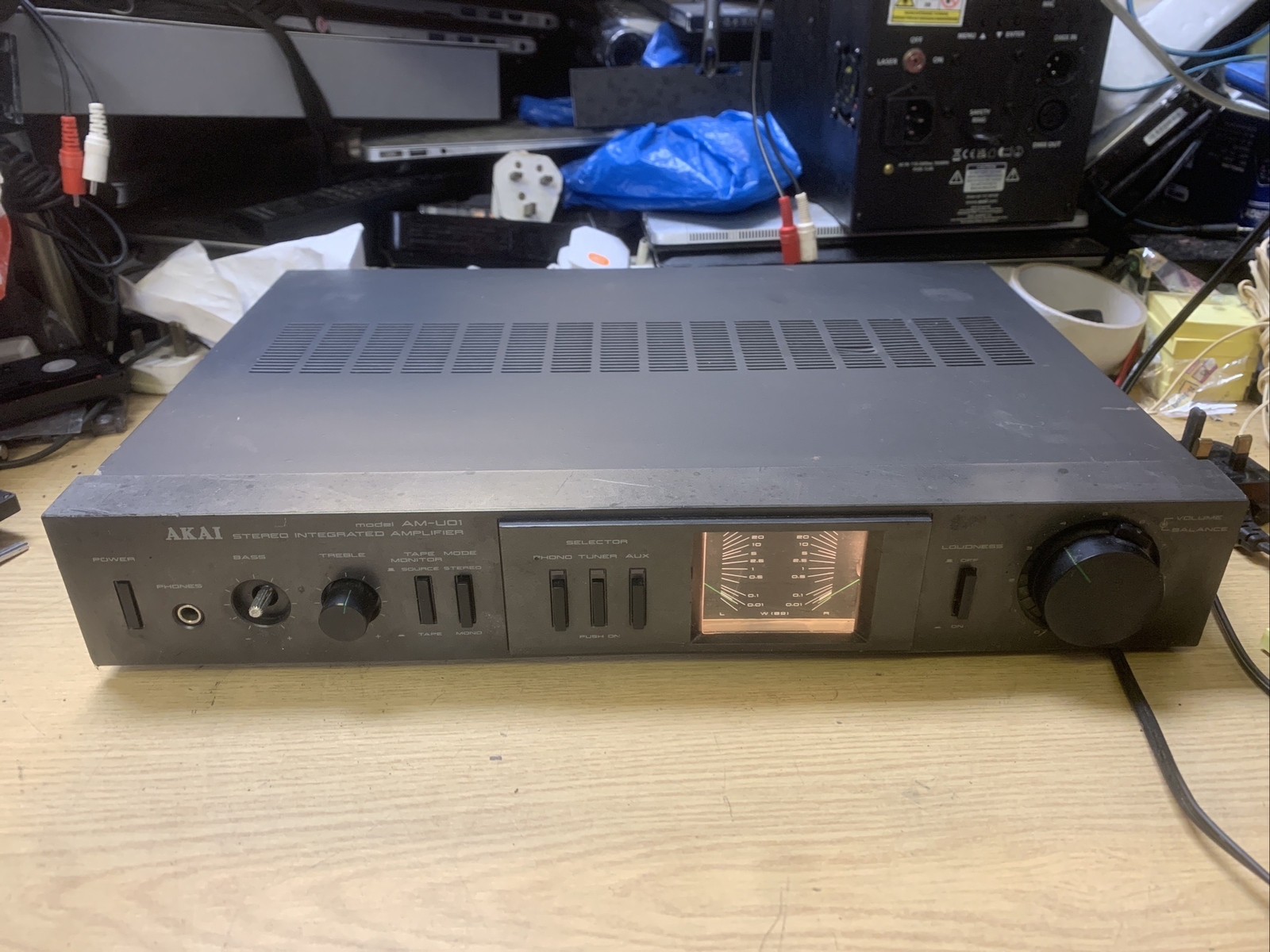
While detailed technical documentation and original marketing materials for the AM-U-01 are nearly nonexistent today, surviving units and anecdotal evidence point to its role as a monitor control and audio routing module, likely designed for use in semi-professional recording environments or high-end audiophile setups of the early 1980s. Its minimalist design, compact rack-mountable chassis, and array of precision switches suggest it was built for a specific functional purpose rather than as a consumer-facing product.
Historical Context: Akai in the Early 1980s
By the early 1980s, Akai had firmly established itself as a leader in analog tape technology. Models like the Akai GX-635D and M-80 reel-to-reel decks were staples in home studios and broadcast facilities. The company also ventured into digital audio with early PCM adapters and digital mixers, but much of its ecosystem relied on analog signal routing and monitoring.
The AM-U-01 appears to have been part of this ecosystem—a support device rather than a standalone component. It likely served as a centralized monitor controller, allowing users to switch between multiple audio sources, select different sets of monitor speakers, and possibly control signal muting, dimming, or input level attenuation. Its design and construction suggest it was intended for integration with Akai’s professional or high-fidelity gear, possibly in conjunction with mixing consoles or mastering setups.
Given its lack of amplification circuitry and absence from mainstream catalogs, the AM-U-01 was almost certainly not a consumer product. Instead, it fits the profile of a custom or OEM module, possibly used in broadcast installations, project studios, or as an original equipment part within larger Akai systems.
Technical Specifications
While official specs are scarce, examination of surviving units reveals the following characteristics:
| Specification | Detail |
| Model | AM-U-01 |
| Manufacturer | Akai Corporation, Japan |
| Year of Production | Circa 1982 |
| Form Factor | 19-inch rack mount, 1U height |
| Dimensions (approx.) | 483 mm (W) × 45 mm (H) × 150 mm (D) |
| Weight | ~1.8 kg |
| Power Requirements | 100–120V AC (Japan domestic), or powered via external supply (exact model unknown) |
| Inputs | 2× unbalanced RCA (likely for dual stereo sources) |
| Outputs | 2× unbalanced RCA (to monitors or downstream gear) |
| Speaker Selection | Toggle switch: Monitor A / Monitor B |
| Source Selection | Toggle switch: Source 1 / Source 2 |
| Additional Controls | Mute button, Dim level control (attenuation) |
| Construction | Steel chassis, aluminum front panel, tactile switches |
| Status Indicators | Single neon power indicator (red) |
| Notable Features | Passive signal path (no internal amplification), high-quality RCA jacks, switchable grounding option |
The AM-U-01 appears to be a passive audio switcher, meaning it does not amplify the signal but routes line-level audio from sources to monitors. This design choice ensures signal purity and minimizes coloration—critical in monitoring applications where transparency is paramount.
Sound Characteristics and Performance
As a passive device, the AM-U-01 does not "color" the sound in the way an active preamp might. Instead, its performance hinges on signal integrity, switch quality, and grounding design. Units that have been well-preserved exhibit clean, neutral audio pass-through with no discernible loss in dynamics or frequency response.
The toggle switches are mechanical and robust, typical of Japanese industrial components from the era. When engaged, they provide a satisfying, positive click and maintain solid contact. However, like all vintage switches, they are susceptible to oxidation over time, which can lead to crackling or intermittent connections—especially if the unit has been stored unused for decades.
The dim function (a momentary attenuator) is particularly useful in studio environments, allowing engineers to quickly lower monitor levels without adjusting the main volume. This feature, combined with the mute button, suggests the AM-U-01 was designed for real-time monitoring control, possibly in mastering or editing suites.
Notable Features and Innovations
While the AM-U-01 may seem simple by modern standards, its design reflects thoughtful engineering:
- Passive Architecture: By avoiding active circuitry, Akai ensured minimal signal degradation—ideal for critical listening.
- Dual Monitor Support: The ability to switch between two sets of speakers is invaluable for comparing sound across different transducers.
- Dim and Mute Functions: These are professional-grade features rarely found in consumer gear of the era.
- Switchable Ground Lift: Some units include a rear-panel ground lift switch, helping to eliminate hum caused by ground loops—a common issue in multi-component systems.
- Compact 1U Format: Its small size made it easy to integrate into crowded racks without consuming valuable space.
Though not flashy, the AM-U-01 embodies the "tool-like" philosophy common in Japanese pro audio gear of the 1980s: functional, reliable, and built to last.
Common Issues and Maintenance
Due to its age and rarity, the AM-U-01 requires careful maintenance:
- Oxidized Switches: The most common issue. Cleaning with contact cleaner (e.g., DeoxIT) can restore smooth operation.
- Failing RCA Jacks: Over-tightening or repeated plugging can loosen jacks. Solder joints should be inspected.
- Power Indicator Failure: The neon bulb may burn out; replacements are available but require careful handling.
- Dust and Corrosion: Units stored in damp environments may show internal corrosion. A full inspection is recommended before use.
- Missing Knobs or Labels: Some units have lost their original knobs or front-panel labels. Reproduction parts are not available, making original condition highly desirable.
Because spare parts are nonexistent, collectors are advised to treat the AM-U-01 as a preservation piece unless used in a compatible vintage system.
Current Market Value and Collectibility
The Akai AM-U-01 is extremely rare. It does not appear in Akai catalogs, and no known advertisements or user manuals have surfaced. As of 2024, fewer than a dozen units have appeared on auction sites like Yahoo! Japan Auctions or eBay, typically selling for $150–$300, depending on condition and completeness.
Its value lies not in performance but in historical curiosity and completeness. For collectors restoring Akai-based studios or documenting the full scope of Akai’s product line, the AM-U-01 is a holy grail accessory—a missing puzzle piece in an otherwise well-documented ecosystem.
Units with original knobs, unblemished faceplates, and working switches command premium prices. Because it was never mass-marketed, provenance and authenticity are key.
Conclusion and Legacy
The Akai AM-U-01 may never be famous like the GX-635D or the M-80, but it represents an important facet of Akai’s engineering philosophy: supporting the full audio workflow, not just the headline components. It’s a reminder that behind every great recording or listening experience, there are often unseen tools enabling precision, control, and flexibility.
Today, the AM-U-01 is more than just a switcher—it’s a symbol of analog workflow integrity, a quiet enforcer of clean signal paths and thoughtful design. For the vintage audio enthusiast, finding one is like uncovering a secret chapter in Akai’s history.
Whether used in a restoration project or displayed as a rare artifact, the AM-U-01 deserves recognition—not for its power or features, but for its purpose, precision, and mystery. In the world of vintage audio, sometimes the most unassuming boxes hold the most fascinating stories.
eBay Listings


As an eBay Partner, we earn from qualifying purchases. This helps support our independent vintage technology research.
Related Models
- Akai AM-2850 (1975)
- Akai AP-206 (1975)
- Akai AM-2450 (1978)
- Akai CS-M40R (1983)
- Akai GX-F66RC (1981)
- Nakamichi BX-1 (1985)
- Acoustic Research research-ar-17 (1978)
- Acoustic Research AR-19 (1994)
- Acoustic Research AR-1W (1954)
- Acoustic Research AR-28S (1992)