Akai AM-M-939: The Forgotten Modular Marvel of Japanese Hi-Fi
In the golden era of modular audio systems during the late 1970s, Japanese manufacturers like Akai, Sansui, Yamaha, and Technics experimented with flexible, component-based designs that allowed audiophiles to build custom systems piece by piece. Among these innovations, the Akai AM-M-939 stands out as a rare and intriguing example of Akai’s modular philosophy—an integrated audio module that blends tuner, preamplifier, and tape-monitoring functions in a compact, rack-mountable chassis. Though not as widely recognized as its contemporaries, the AM-M-939 offers a fascinating glimpse into Akai’s engineering ambitions during a transformative period in high-fidelity audio.
Historical Context: Akai’s Modular Era
Akai, best known for its reel-to-reel tape recorders and later cassette decks, expanded into full stereo systems in the 1970s. Unlike competitors who focused on standalone receivers or separates, Akai pursued a modular approach with its "M-Series"—a line of components designed to fit into standardized chassis and be combined in custom configurations. The AM-M-939 was part of this ecosystem, intended to serve as the central control and signal-routing hub for a modular setup.
Released around 1979, the AM-M-939 was not a traditional receiver or amplifier. Instead, it functioned as a tuner/preamp/monitoring module, designed to be paired with external power amplifiers and source components—often other Akai M-Series units like tape decks or phono preamps. This modular concept appealed to audiophiles who valued customization, clean signal paths, and the ability to upgrade individual components over time.
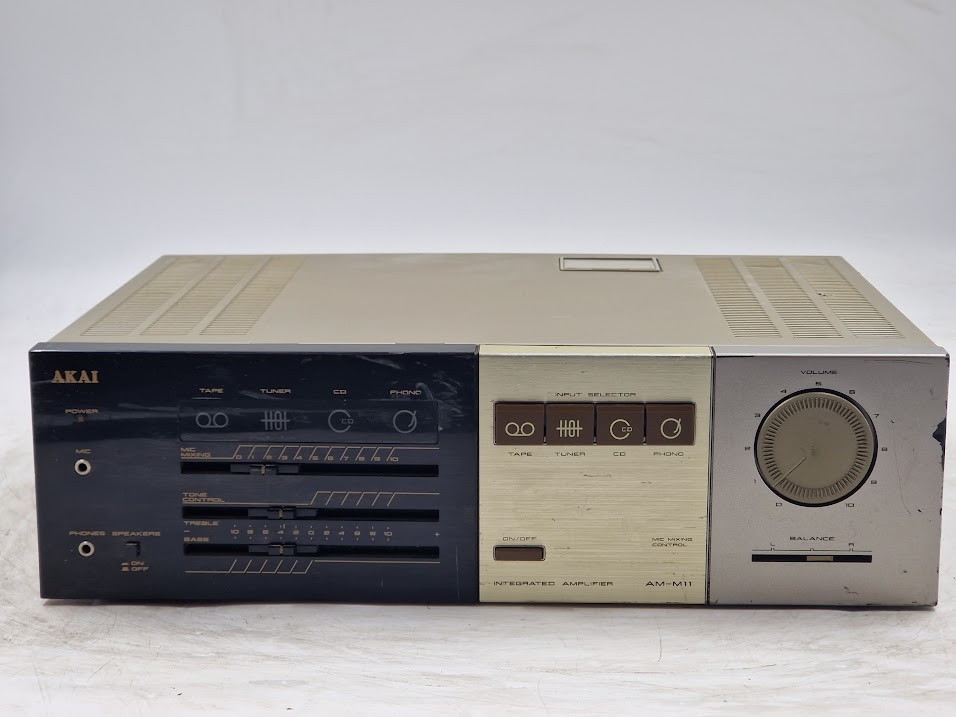
The AM-M-939 was typically housed in a sleek, brushed aluminum front panel with Akai’s signature minimalist aesthetic—knobs with smooth detents, crisp labeling, and a compact form factor that emphasized integration over showmanship. It was often used in conjunction with Akai’s AMP-M series power amplifiers and TP-M series tape decks, forming a cohesive, rack-ready system.
Technical Specifications
| Specification | Detail |
| Model | AM-M-939 |
| Manufacturer | Akai Corporation, Japan |
| Year of Release | 1979 |
| Category | Modular Audio Component (Tuner/Preamp) |
| Tuner Bands | FM, AM (MW/LW) |
| Tuner Type | Analog PLL or Capacitor-Tuned (exact type varies by region) |
| Inputs | 2x Line (RCA), Tape In (RCA), Phono (MM) |
| Outputs | Main Out (RCA), Tape Out (RCA), Headphones |
| Monitoring Features | Tape monitor loop, Source bypass |
| Tone Controls | Bass, Treble (±12dB at 100Hz/10kHz) |
| Volume Control | Dual-gang potentiometer with stepped attenuation |
| Impedance | Not applicable (line-level preamp module) |
| Power Output | Not applicable (no built-in amplifier) |
| Power Supply | Internal linear transformer (100–120V AC) |
| Dimensions (W×H×D) | 430 × 135 × 290 mm (standard 19" rack width) |
| Weight | Approx. 6.8 kg |
Sound Characteristics and Performance
As a preamp/tuner module, the AM-M-939 doesn’t deliver power to speakers, but its sonic character is defined by its signal clarity, tonal neutrality, and low noise floor. The phono stage, designed for moving magnet (MM) cartridges, offers warm, detailed vinyl playback with a slight midrange emphasis—typical of Japanese preamps of the era. The line inputs are clean and transparent, making the AM-M-939 an excellent front-end for external amplification.
The FM tuner section, while not as refined as high-end standalone tuners, delivers solid reception with decent stereo separation and a warm, analog character. It lacks digital tuning or memory presets, relying instead on analog dial tuning with a mechanical counter—a charming throwback to pre-digital radio. The AM band is serviceable for news and talk radio, though not optimized for high-fidelity music.
One of the most appreciated features among collectors is the tape monitoring loop, which allows users to switch between live input and tape playback seamlessly—a must-have for tape enthusiasts and home recording hobbyists of the time.
Notable Features and Innovations
- Modular Integration: The AM-M-939 was designed to slide into Akai’s standardized chassis system, allowing users to build a complete audio system with interchangeable components.
- Tape Monitor Function: A hallmark of high-end preamps, this feature lets users route any input to the tape output for recording, or monitor the tape input independently.
- Clean Signal Path: With minimal circuitry and high-quality RCA jacks, the AM-M-939 prioritizes signal integrity.
- Compact Rack Design: At 3U height, it fits neatly into standard racks, making it ideal for space-conscious setups.
- Dual-Level Volume Control: Offers both fine and coarse adjustment, a feature borrowed from professional audio gear.
Common Issues and Maintenance
Due to its age and relative rarity, the AM-M-939 requires careful maintenance to perform optimally:
- Capacitor Aging: The internal electrolytic capacitors, especially in the power supply, may have dried out. Replacing them is recommended to prevent hum or channel imbalance.
- Potentiometer Noise: The volume and tone controls can develop crackling over time. Cleaning with contact cleaner may help, but replacement with modern equivalents is often necessary.
- Tuner Alignment: The FM tuner may drift or lose sensitivity. A professional alignment can restore performance.
- Oxidation on Connectors: RCA jacks and internal connectors should be inspected and cleaned to ensure solid connections.
- Knob and Dial Wear: The tuning dial and knobs may become loose or wobbly. Replacement knobs are rare, so gentle handling is advised.
Because the AM-M-939 lacks a built-in amplifier, it’s essential to pair it with a compatible power amp—ideally another vintage Japanese unit like an Akai AMP-M300 or a Technics SU series amplifier for tonal synergy.
Current Market Value and Collectibility
The Akai AM-M-939 is a rare find on the vintage audio market. It doesn’t command the high prices of sought-after receivers like the Pioneer SX series or Sansui G-2500, but its uniqueness and modularity make it a prized item among collectors of obscure Japanese gear.
As of 2024, a working AM-M-939 in good cosmetic condition typically sells for $150–$300, depending on region and completeness. Units with original knobs, manuals, or matching M-Series components may fetch higher prices. Fully restored models with recapped power supplies and aligned tuners are especially desirable.
Its collectibility stems not from raw performance, but from its historical significance as a representative of Akai’s modular vision—a path the company would eventually abandon in favor of more conventional integrated designs.
Conclusion: A Hidden Gem of Modular Hi-Fi
The Akai AM-M-939 may not be a powerhouse amplifier or a legendary receiver, but it embodies a fascinating chapter in audio history—one where customization, modularity, and system-building were at the forefront of hi-fi design. For the vintage audio enthusiast, it’s more than just a preamp; it’s a piece of Akai’s engineering heritage, a testament to a time when audiophiles could build their dream systems one module at a time.
While it demands care and restoration, the AM-M-939 rewards patience with its clean sound, thoughtful design, and unique place in the modular audio landscape. Whether you’re building a complete Akai M-Series system or simply seeking a distinctive preamp with vintage charm, the AM-M-939 deserves a second look. In the world of forgotten classics, it’s a quiet standout—modest in appearance, but rich in character.
eBay Listings


As an eBay Partner, we earn from qualifying purchases. This helps support our independent vintage technology research.
Related Models
- Akai AM-A301
- Akai AM-U04
- Akai AM-U7
- Akai AM-U-2 (1975)
- Akai AM-A-70 (1978)
- Luxman L-530 (1975)
- Luxman R-404 (1975)
- Luxman RV-371 (1975)
- Luxman SQ-38U (1975)
- Luxman T-14 (1972)