Akai AM-52 Microphone Preamplifier: A Vintage Studio Workhorse
In the mid-1970s, Akai—a Japanese electronics company best known for its reel-to-reel tape recorders, cassette decks, and later, video equipment—expanded its professional audio offerings with a range of supporting studio gear. Among these was the Akai AM-52, a compact microphone preamplifier designed to deliver clean, transparent gain for dynamic and condenser microphones in both studio and field recording environments. While not as widely celebrated as Akai’s tape machines, the AM-52 represents a quiet but essential piece of vintage audio infrastructure, embodying the company’s commitment to reliability, simplicity, and professional-grade performance.
Though the AM-52 never achieved the iconic status of Neve, API, or even some of the more boutique Japanese preamps of the era, it filled a critical niche: offering solid-state, low-noise amplification at an accessible price point for broadcasters, educational institutions, and smaller recording studios. Today, the AM-52 is a rare find, often overlooked by collectors but appreciated by those who value understated engineering and functional design from a golden age of analog audio.
Technical Specifications
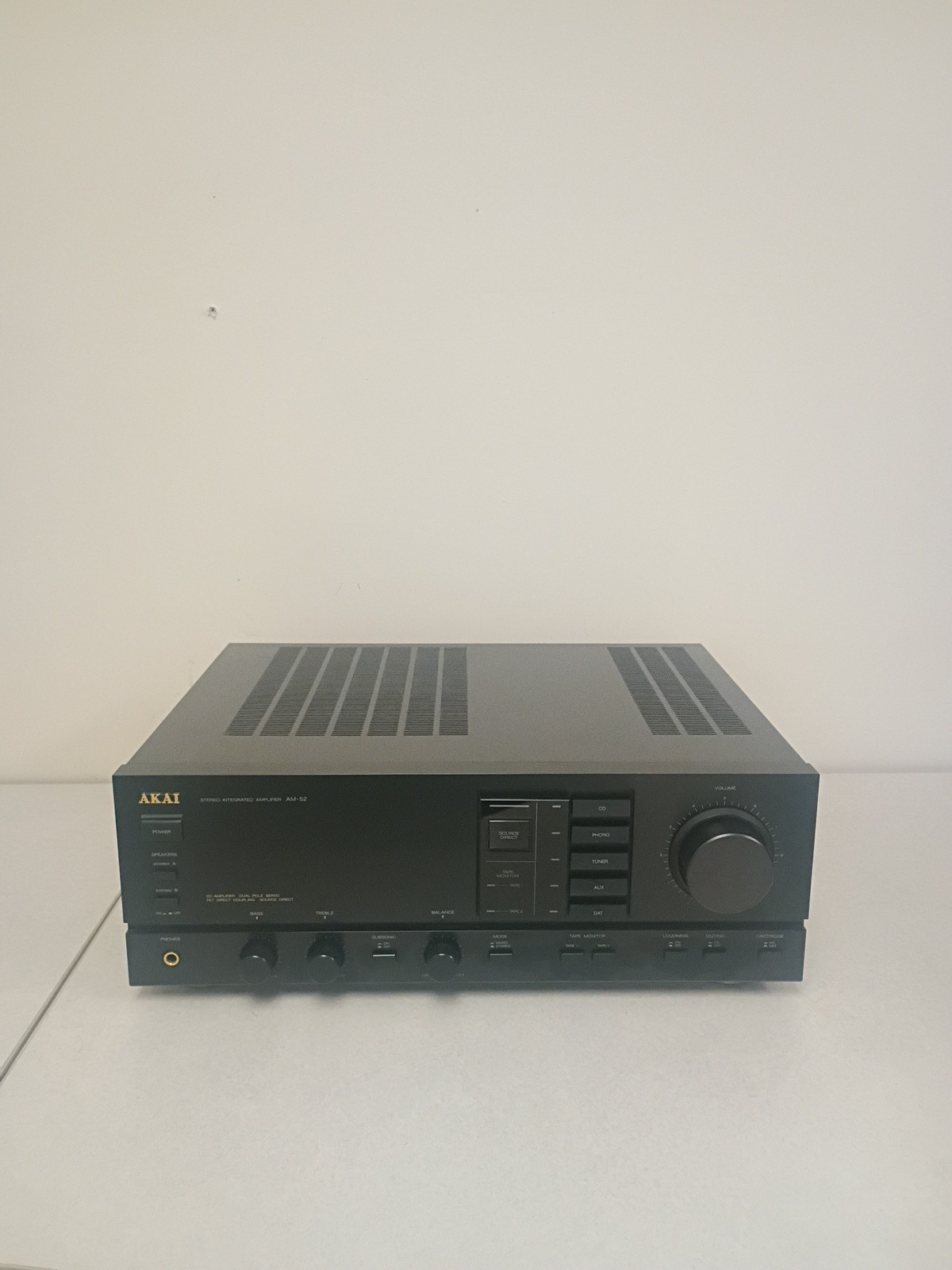
The Akai AM-52 was engineered as a single-channel microphone preamplifier, likely intended for integration into broadcast racks or mobile recording setups. Its minimalist front panel and rear-mounted connectors suggest a focus on utility over user interface, a hallmark of professional gear from the 1970s.
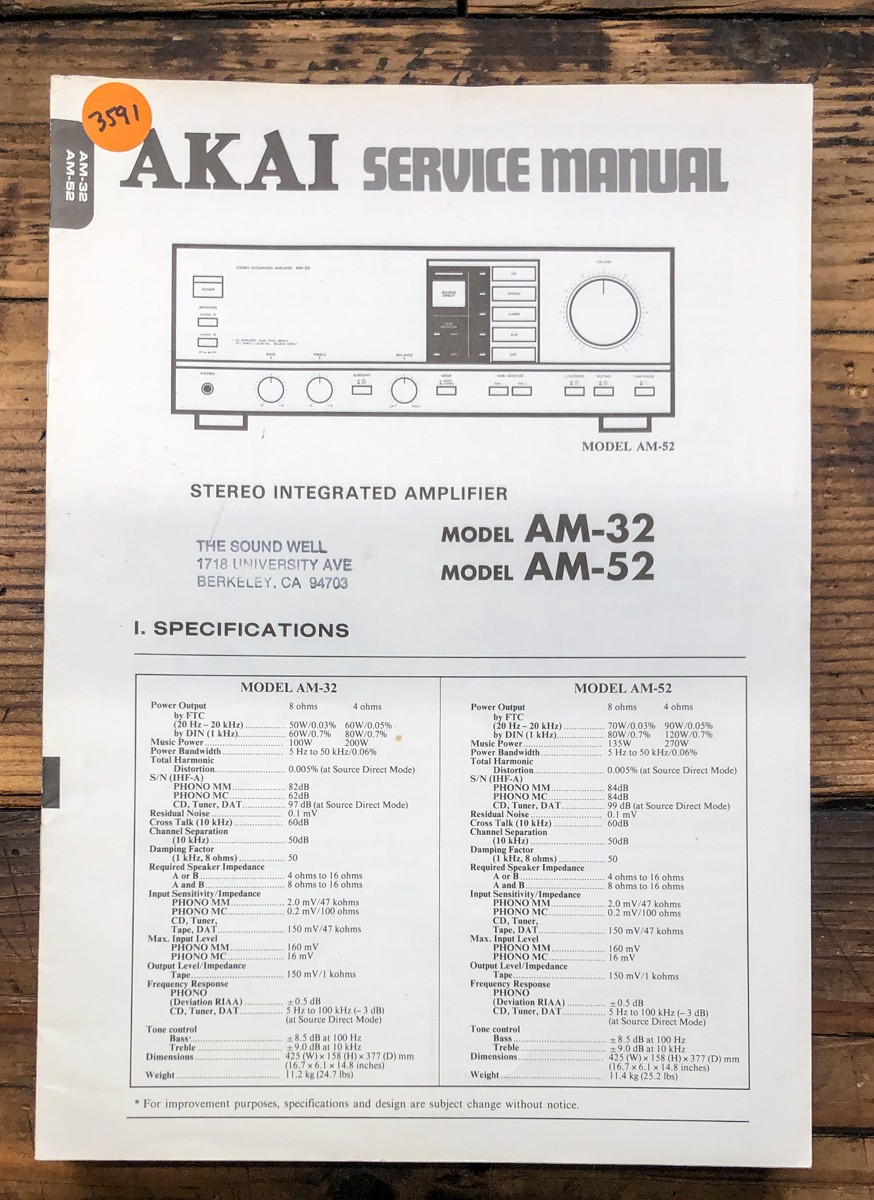
| Specification | Detail |
| Manufacturer | Akai Corporation, Japan |
| Model | AM-52 |
| Year of Release | 1975 |
| Type | Solid-state microphone preamplifier |
| Channels | 1 (mono) |
| Gain Range | Approximately 40–60 dB (estimated) |
| Frequency Response | 20 Hz – 20 kHz (±1 dB, estimated) |
| Input Impedance | 1.5 kΩ (estimated) |
| Output Impedance | 150 Ω (estimated) |
| Input Connectors | XLR (balanced), possibly 1/4" auxiliary |
| Output Connectors | XLR (balanced) |
| Power Supply | External AC adapter (12–18 V DC typical) |
| Dimensions (approx.) | 170 mm × 100 mm × 50 mm (W×H×D) |
| Weight | 1.2 kg |
| Construction | Steel chassis, aluminum front panel |
Note: Due to the rarity of surviving units and limited documentation, some specifications are estimated based on comparable Akai and Japanese studio gear from the era.
Sound Characteristics and Performance
The Akai AM-52 was not designed to color the sound—its goal was transparency and fidelity. Using discrete transistor circuitry (common for the time before op-amp dominance), the AM-52 delivers a clean, neutral gain stage with low distortion and minimal noise. While it lacks the harmonic richness or "warmth" associated with tube preamps or transformer-coupled designs, it excels in applications where accuracy is paramount.
Field recordings, voiceovers, and broadcast interviews benefit from the AM-52’s flat frequency response and tight transient handling. It pairs particularly well with dynamic microphones like the Shure SM57 or Electro-Voice RE20, where its clarity helps bring out articulation without harshness. Condenser mics also perform reliably, though users should ensure phantom power compatibility—importantly, the AM-52 does not provide phantom power, a limitation common in preamps of this class and era. External power supplies or inline adapters are required for modern condensers.
While not a "musical" preamp in the way audiophiles might describe a Neve 1073, the AM-52’s strength lies in its honesty. It captures what’s in front of it without editorializing—a trait highly valued in documentary work and archival recording.
Notable Features and Design Philosophy
The AM-52 reflects Akai’s engineering ethos of the 1970s: functional, durable, and cost-effective. Its front panel is spartan, typically featuring only a large gain knob, a signal/clip LED (if present), and possibly a phase reverse or pad switch. The rear panel houses the XLR I/O, power input, and possibly a ground lift switch—features that speak to its professional deployment.
One of the AM-52’s standout qualities is its modular design. Units were often rack-mountable or designed for easy integration into larger systems, such as Akai’s own portable reel-to-reel recorders like the M-8 or M-12. This modularity made it a favorite among field recordists and broadcast engineers who needed reliable, portable gain stages.
The use of discrete transistor amplification—rather than integrated circuits—gives the AM-52 a slightly more organic character than later op-amp-based preamps. While not as refined as higher-end contemporaries, its circuitry avoids the sterility sometimes associated with early solid-state designs.
Additionally, the AM-52’s low self-noise (estimated below 18 dB EIN) ensures clean recordings even with low-output microphones, a critical factor in pre-digital recording where headroom and noise floor were paramount.
Common Issues and Maintenance
As with any vintage electronics from the 1970s, the Akai AM-52 requires careful evaluation before use. Common issues include:
- Dried-out electrolytic capacitors: Over time, capacitors in the power regulation and signal path can degrade, leading to hum, noise, or complete failure. A full recapping is recommended for long-term reliability.
- Oxidized connectors and switches: XLR jacks and internal switches may develop resistance or intermittent connections. Contact cleaner and gentle servicing can restore functionality.
- Failing power adapters: The original external power supply is often lost or damaged. Replacement units must match voltage and polarity exactly to avoid damaging the preamp.
- No phantom power: As noted, the AM-52 cannot power modern condenser mics directly. Users must employ external phantom power solutions.
For those restoring a unit, sourcing service manuals is challenging due to the model’s obscurity. However, circuit designs from similar Akai gear (such as the AM-10 or AM-20 series) may offer useful reference points.
Current Market Value and Collectibility
The Akai AM-52 is a rare and under-the-radar piece of vintage audio gear. It does not command high prices on the collector’s market, with working units typically selling between $75 and $150 when they appear on auction sites or vintage audio forums. Non-working units may go for even less.
Its collectibility is niche, appealing primarily to:
- Akai enthusiasts restoring complete vintage setups
- Field recordists seeking analog authenticity
- DIY audio tinkerers looking for a solid platform for modification
While not a “grail” item, the AM-52 holds historical value as part of Akai’s broader contribution to professional audio. It represents a time when Japanese manufacturers were beginning to challenge Western dominance in broadcast and studio equipment.
Conclusion and Legacy
The Akai AM-52 may not be a household name, but it embodies the quiet excellence of mid-tier professional audio gear from the 1970s. It wasn’t built for show—it was built to work. In an era when every component had to earn its place in a rack, the AM-52 delivered reliable, clean gain without fuss or fanfare.
Today, it serves as a reminder that not all vintage gear needs to be legendary to be valuable. For the right user—a documentarian, a restorer, or a minimalist recording enthusiast—the AM-52 offers a direct line to the past, with a sound that’s honest, uncolored, and refreshingly straightforward.
If you’re lucky enough to find one in good condition, consider giving it a second life. With a little care, the Akai AM-52 can still serve as a capable, no-nonsense preamp—just as it did over four decades ago.
eBay Listings

As an eBay Partner, we earn from qualifying purchases. This helps support our independent vintage technology research.
Related Models
- Akai AM-A301
- Akai AM-U04
- Akai AM-U7
- Akai AM-U-2 (1975)
- Akai AM-A-70 (1978)
- Luxman L-530 (1975)
- Luxman R-404 (1975)
- Luxman RV-371 (1975)
- Luxman SQ-38U (1975)
- Luxman T-14 (1972)