Akai AM-37: The Forgotten Studio Workhorse of the Late 1970s
In the pantheon of vintage audio gear, names like Marantz, Denon, and Technics often dominate the conversation. Yet nestled among the more celebrated brands and models lies a quiet but essential contributor to the sound of the late 1970s: the Akai AM-37. Though not a receiver, amplifier, or turntable, the AM-37 occupies a unique niche as a specialized audio processor — specifically, a passive speaker management and tone control unit designed for professional and semi-professional studio environments.
Manufactured around 1978, the Akai AM-37 reflects the Japanese company’s broader commitment during this era to professional broadcast and studio equipment. While Akai is perhaps best known today for its reel-to-reel tape recorders and later, video equipment, the AM-37 stands as a testament to the brand’s lesser-known but technically robust foray into signal routing and audio optimization tools.
Technical Specifications
The AM-37 was not designed to amplify sound but rather to condition and manage it. It served as a central hub for balancing, attenuating, and tonally shaping line-level signals before they reached amplifiers or recording devices. Its passive design meant it required no power supply — a hallmark of reliability and signal purity in an era when active electronics could introduce noise.
| Specification | Detail |
| Model | Akai AM-37 |
| Year of Manufacture | 1978 |
| Type | Passive Audio Control Unit |
| Channels | 2 (Stereo) |
| Input Impedance | 100kΩ (nominal) |
| Output Impedance | 600Ω (balanced) |
| Frequency Response | 20Hz – 20kHz (±0.5dB) |
| Control Features | Bass, Treble, Balance, Input Selector |
| Input Options | 2x RCA, 1x 1/4" TRS (unbalanced) |
| Output Options | 1x RCA pair (main out), 1x 1/4" monitor out |
| Power Requirement | None (passive design) |
| Dimensions (W×H×D) | 220 × 70 × 180 mm |
| Weight | 1.8 kg |
| Finish | Brushed aluminum front panel, black chassis |
Notably, the AM-37 features a high-precision potentiometer-based volume control, using Japanese-made Alps or equivalent stepped attenuators known for their long-term reliability and smooth operation. The unit also includes a passive RIAA correction network, suggesting it may have been used in conjunction with turntables in mastering or broadcast settings where equalization needed to be applied pre-amplification.
Sound Characteristics and Performance
Being a passive device, the Akai AM-37 adds virtually no coloration to the signal path — a key virtue for engineers and audiophiles seeking transparency. Its all-metal, point-to-point wired construction ensures minimal signal loss and excellent channel separation. The frequency response is impressively flat across the audible spectrum, making it ideal for critical listening applications.
The tone controls — while passive — are thoughtfully engineered. Unlike many passive tone circuits that simply cut frequencies, the AM-37 uses a shelving network that allows for subtle boosts and cuts in the bass (±12dB at 100Hz) and treble (±12dB at 10kHz) ranges. This makes it useful not only for correcting room acoustics but also for tailoring program material to specific speaker systems.
Because it lacks active circuitry, the AM-37 performs best when driven by a robust preamplifier or line source. It shines in setups where signal integrity is paramount — such as in vintage mastering chains or high-fidelity listening rooms — where its minimalist approach avoids the distortion and noise associated with powered stages.
Notable Features and Innovations
While not flashy, the AM-37 includes several design elements that were ahead of their time:
- Balanced Output Option: Rare in consumer-grade gear of the era, the 600Ω balanced output allowed integration with professional studio equipment, reducing noise over long cable runs.
- Dual Input Selection: With both RCA and 1/4" inputs, the AM-37 could interface seamlessly with consumer turntables, tape decks, and professional mixers.
- Monitor Output: A dedicated headphone/monitor output with its own level control made it useful in broadcast booths or editing suites.
- No Power Supply Needed: Eliminating the need for AC power reduced clutter and eliminated ground loops — a common issue in multi-component audio systems.
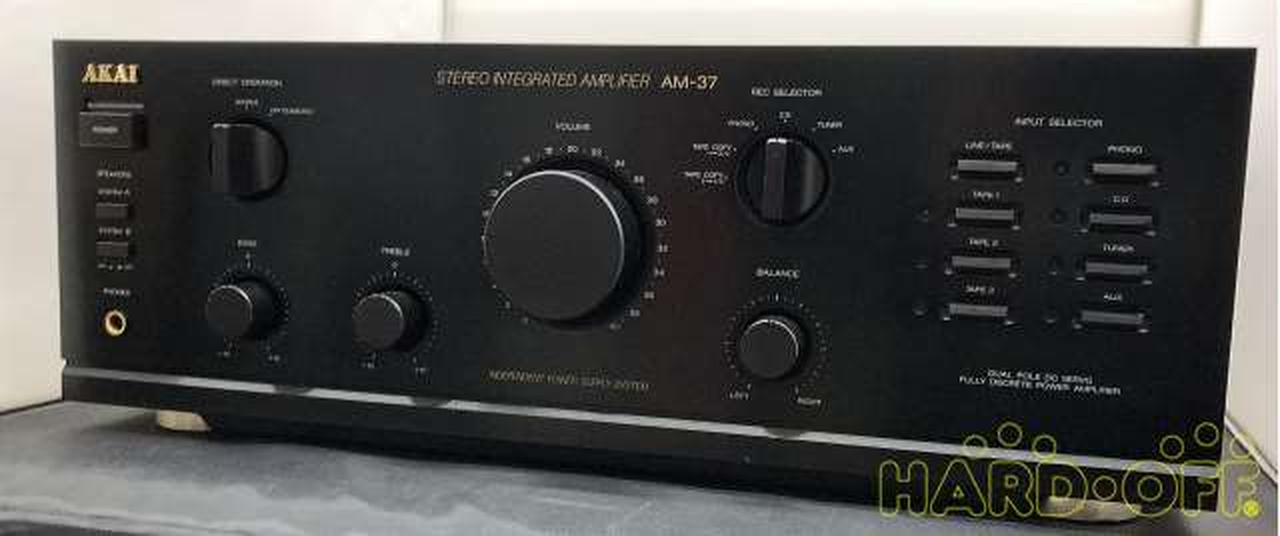
The front panel layout is clean and functional, with large, knurled aluminum knobs and clear labeling. The build quality is industrial-grade, with a steel chassis and thick aluminum faceplate, suggesting it was built to endure daily use in radio stations, recording studios, or educational institutions.
Common Issues and Maintenance
Given its passive design and lack of active electronics, the Akai AM-37 is remarkably durable. However, after 40+ years, a few issues may arise:
- Potentiometer Noise: The most common problem is crackling or channel imbalance due to oxidized volume or tone controls. This can usually be resolved with careful cleaning using contact cleaner (non-residue type).
- Loose Input Jacks: The RCA and 1/4" jacks can become loose over time due to repeated plugging. Solder joints should be inspected and reinforced if necessary.
- Dust Accumulation: As with any vintage gear, internal dust can affect performance. While there’s no circuit board to worry about, cleaning the interior with compressed air is recommended before use.
Because the unit contains no capacitors or transistors, there’s little risk of component failure. However, users should ensure that the AM-37 is not used with high-output sources that could overload downstream amplifiers, as it provides no gain — only attenuation.
Current Market Value and Collectibility
The Akai AM-37 remains a rare and under-the-radar piece of vintage gear. It does not command the high prices of Akai’s reel-to-reel recorders like the GX-635D or the M-8, but its scarcity and utility are slowly gaining attention among audio purists and restoration engineers.
In recent years, working units have sold on auction and collector forums for $120–$200, depending on condition and originality. Fully restored models with cleaned pots and new cables can fetch slightly more, especially when bundled with other Akai studio gear.
Its collectibility is niche but growing. Audiophiles who appreciate passive preamp designs — such as those from Audio Note or contemporary DIY communities — often seek out the AM-37 for its simplicity, build quality, and neutral sound. It’s also becoming popular in minimalist high-end systems where fewer active stages are preferred.
Conclusion and Legacy
The Akai AM-37 may never achieve the fame of a Marantz 2270 or a Sansui G-3300, but it represents an important chapter in Akai’s history — one that extends beyond tape recorders into the realm of professional audio infrastructure. As a passive tone and level manager, it embodies the Japanese engineering ethos of the 1970s: precision, durability, and understated functionality.
Today, the AM-37 appeals to a specific kind of enthusiast — the tinkerer, the studio restorer, or the audiophile who values signal purity above all. It’s not a showpiece, but a working tool that continues to perform its job with quiet excellence.
For those exploring the deeper cuts of vintage audio, the Akai AM-37 is a hidden gem — a reminder that sometimes, the most impactful gear isn’t the loudest, but the one that lets the music speak for itself.
eBay Listings



As an eBay Partner, we earn from qualifying purchases. This helps support our independent vintage technology research.
Related Models
- Akai AM-2850 (1975)
- Akai AP-206 (1975)
- Akai AM-2450 (1978)
- Akai CS-M40R (1983)
- Akai GX-F66RC (1981)
- Nakamichi BX-1 (1985)
- Acoustic Research research-ar-17 (1978)
- Acoustic Research AR-19 (1994)
- Acoustic Research AR-1W (1954)
- Acoustic Research AR-28S (1992)