Akai AM-35: A Refined Vintage Tuner from the Golden Age of Hi-Fi
In the mid-1970s, Japanese electronics manufacturers like Akai were at the forefront of bringing high-quality, affordable audio components to the global market. While Akai is perhaps best remembered today for its reel-to-reel tape recorders and later cassette decks, the company also produced a full range of stereo components—including tuners. The Akai AM-35, introduced around 1975, is a compact AM/FM stereo tuner that exemplifies Akai’s commitment to solid engineering and elegant design during the golden era of hi-fi.
Though not as widely documented as some of its contemporaries from Pioneer, Sony, or Yamaha, the AM-35 holds a quiet distinction among vintage audio enthusiasts for its clean signal reception, minimalist aesthetic, and reliable performance. As a standalone tuner, it was designed to integrate seamlessly into a component-based stereo system, offering listeners a dedicated path to broadcast radio with clarity and fidelity.
Technical Specifications
The Akai AM-35 was engineered to deliver consistent AM and FM reception with stereo decoding for compatible broadcasts. While detailed service manuals are scarce today, surviving units and user reports confirm the following specifications:
| Specification | Detail |
| Model | AM-35 |
| Manufacturer | Akai Corporation, Japan |
| Year Introduced | 1975 |
| Type | AM/FM Stereo Tuner |
| Tuning System | Analog needle-pointer with tuning dial |
| Frequency Coverage | FM: 87.5–108 MHz, AM: 530–1600 kHz |
| IF Frequencies | FM: 10.7 MHz, AM: 455 kHz |
| Stereo Separation | Approx. 30 dB (at 1 kHz) |
| Output Level | 150 mV (line-level) |
| Output Impedance | 10 kΩ |
| Input Power | 120V AC, 60 Hz (North American version) |
| Power Consumption | 15 watts |
| Dimensions (W×H×D) | 430 × 135 × 290 mm (17 × 5.3 × 11.4 in) |
| Weight | 5.2 kg (11.5 lbs) |
| Finish | Black textured vinyl over steel, brushed aluminum front panel |
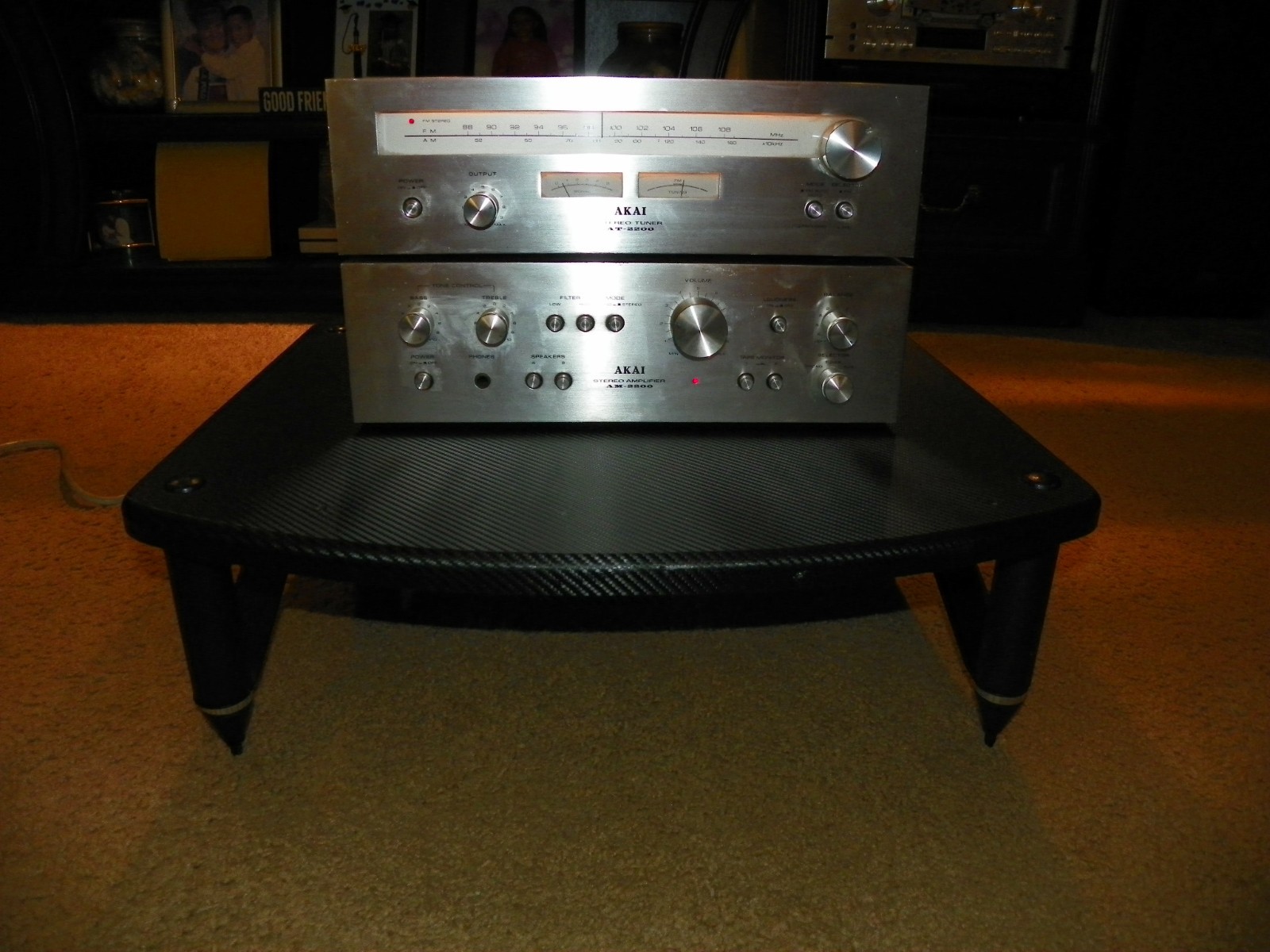
The AM-35 features dual analog meters for signal strength on both AM and FM bands, a stereo indicator LED, and a simple yet effective tuning knob with a calibrated dial and luminous pointer. It includes standard RCA line outputs for connection to a preamplifier or integrated amplifier, as well as a 3.5mm stereo headphone jack—an uncommon but welcome feature for a tuner of this class.
Sound Characteristics and Performance
The Akai AM-35 was not designed to be a sonic powerhouse, but rather a transparent and accurate window into broadcast audio. Its FM section delivers warm, natural midrange reproduction with smooth highs, typical of well-engineered analog tuners from the era. Stereo imaging is stable, with decent channel separation that enhances the listening experience on strong local stations.
On the AM band, the tuner performs admirably for its time. The AM section benefits from a well-shielded ferrite rod antenna and effective filtering, minimizing noise and crosstalk. While AM radio fidelity is inherently limited, the AM-35 extracts clear, listenable audio from news, talk, and music stations, especially when tuned to strong local signals.
One of the tuner’s strengths is its low noise floor. Thanks to a clean power supply and well-laid-out circuitry, background hiss and hum are minimal—particularly important for a component that spends much of its time amplifying weak radio signals. The headphone amplifier, though basic, is sufficient for casual listening and retains the tuner’s overall clarity.
Notable Features and Design
The AM-35 reflects the design language of mid-1970s Japanese hi-fi: understated elegance with functional precision. The front panel is dominated by a large tuning dial, flanked by dual VU-style signal strength meters. The brushed aluminum faceplate gives it a premium feel, while the recessed knobs and compact form factor make it a natural fit for component racks.
Key features include:
- Stereo/mono switch – Allows users to optimize reception in weak signal areas by switching to mono, improving clarity and reducing noise.
- Fine-tuning control – A secondary knob for precise FM station alignment, essential before the era of digital tuning.
- Local/Distant switch – Adjusts the IF bandwidth to balance sensitivity and selectivity.
- Headphone output – A rare inclusion, enabling private listening without external amplification.
- Antenna terminals – Screw-down terminals for both FM 75Ω coaxial and AM loop antenna connections.
Internally, the AM-35 uses discrete transistor circuitry with minimal ICs, consistent with the technology of the time. Its build quality is robust, with point-to-point wiring and high-quality capacitors in critical signal paths.
Common Issues and Maintenance
As with any 50-year-old electronic device, the Akai AM-35 may require some maintenance to perform optimally today. The most common issues include:
- Deteriorated electrolytic capacitors – Especially in the power supply. These should be replaced to prevent hum, instability, or damage to other components.
- Stiff or noisy tuning potentiometer – Caused by dried lubricant or dust. Cleaning with contact cleaner and relubrication can restore smooth operation.
- Faded or dim dial illumination – The original incandescent bulbs may have burned out. LED replacements are available and recommended for longevity.
- Weak signal reception – Often due to degraded internal wiring or poor antenna connections. Checking and replacing antenna cables can dramatically improve performance.
Servicing the AM-35 requires caution due to the presence of high voltages in the power supply section. However, its relatively simple design makes it accessible to hobbyists with basic soldering skills. Finding an original manual is challenging, but schematic diagrams have surfaced in online vintage audio forums, aiding in restoration efforts.
Current Market Value and Collectibility
The Akai AM-35 is not a high-profile collector’s item like some of the legendary tuners from Sansui or Technics, but it has quietly gained appreciation among vintage audio enthusiasts. Its value lies in its completeness, condition, and functionality.
As of 2024, working units in good cosmetic condition typically sell for $75–$150 on auction and resale sites. Fully restored models with replaced capacitors, upgraded bulbs, and cleaned controls may command slightly higher prices, especially when paired with other Akai components.
Collectibility is moderate. While Akai’s reel-to-reel recorders remain the crown jewels of the brand’s legacy, the AM-35 appeals to those building period-correct systems or seeking a no-frills tuner with authentic 1970s charm. Its rarity—compared to mass-market tuners from Sony or Pioneer—adds to its niche appeal.
Conclusion and Legacy
The Akai AM-35 may not have revolutionized tuner design, but it represents the quiet reliability and thoughtful engineering that defined Japan’s hi-fi boom of the 1970s. It was never meant to be flashy, but rather a dependable, well-built component for the discerning listener who valued clarity and simplicity.
Today, the AM-35 serves as both a functional tuner and a nostalgic artifact of an era when radio was a primary source of music and information. For vintage audio collectors, it’s a rewarding find—a chance to restore and enjoy a forgotten piece of hi-fi history. And for those building a classic system, the AM-35 offers a warm, analog gateway to the airwaves, reminding us that sometimes, the simplest components deliver the most authentic listening experience.
If you stumble upon one in a thrift store or estate sale, don’t overlook it. With a little care, the Akai AM-35 can still bring the world of radio to life—just as it did nearly half a century ago.
eBay Listings



As an eBay Partner, we earn from qualifying purchases. This helps support our independent vintage technology research.
Related Models
- Akai AM-06 (1978)
- Akai AM-25 (1978)
- Akai AM-27 (1975)
- Akai AM-47 (1965)
- Akai AM-93 (1975)
- Aiwa CS-250 (1978)
- Denon TU-1500RD (1995)
- Denon TU-280 (1976)
- Denon TU-501 (1977)
- Denon TU-550 (1978)