Akai AM-2850 (1979–1981)
That moment when you fire up the Akai AM-2850 and those twin power meters swing to life—this isn’t just an amplifier, it’s a statement.
Overview
The Akai AM-2850 Integrated Amplifier isn’t the loudest name in vintage hi-fi, but for those who’ve spent time with it, it’s a revelation. Built between 1979 and 1981 by Akai Electric Co., Ltd., this stereo integrated amplifier was positioned as a high-performance centerpiece for serious audiophiles who demanded both power and precision. With an original price of approximately 998 DM, it wasn’t cheap—but it wasn’t trying to be. It was engineered to deliver, and by all accounts, it did.
Owners report a solid, punchy sound with a strong power supply that drives speakers with confidence. It’s not a shy, polite amp; it’s got presence. One StereoNET user put it simply: “This is about as good as AKAI's get!” And that’s no exaggeration—among Akai’s lineup, the AM-2850 stands tall, a culmination of their late-’70s design philosophy. It’s well built, functional, and, according to forum feedback, remarkably easy to service—music to the ears of anyone who’s wrestled with brittle plastics or unrepairable modern gear.
But here’s the thing: this isn’t a subtle background player. The volume knob, as one HiFi Engine user noted, has a steep taper—just a few clicks can take you from whisper-quiet to room-filling sound. Whether that’s a flaw or a feature depends on your listening style. Some find it unforgiving; others appreciate the directness. Either way, it suggests the electronics might benefit from a refresh after decades of dormancy. But if you’re willing to put in a little work—or find one that’s already been serviced—you’re rewarded with a transparent, dynamic amplifier that punches well above its weight class.
Specifications
| Manufacturer | Akai Electric Co., Ltd. |
| Model | AM-2850 |
| Product Type | Stereo Integrated Amplifier |
| Years of Manufacture | 1979–1981 |
| Power Output (Rated) | 85 watts per channel into 8Ω (stereo) |
| Power Output (Measured) | 105W per channel, both channels driven @ 1kHz into 8 ohms |
| Frequency Response | 10 Hz to 50 kHz |
| Total Harmonic Distortion | 0.03% |
| Damping Factor | 50 |
| Input Sensitivity | 3mV (MM), 30mV (DIN), 150mV (line) |
| Signal to Noise Ratio (Phono) | 80 dB (MM) |
| Signal to Noise Ratio (Line) | 95dB |
| Speaker Load Impedance | 4Ω (minimum) |
| Semiconductors | 43 x transistors, 31 x diodes, 1 x IC |
| Inputs | Phono (MM), Tuner, Aux, Tape 1, Tape 2 |
| Outputs | 2 sets of speaker outputs |
| Dimensions | 440 x 170 x 430mm |
| Weight | 15.7kg |
Key Features
The Meters That Mesmerize
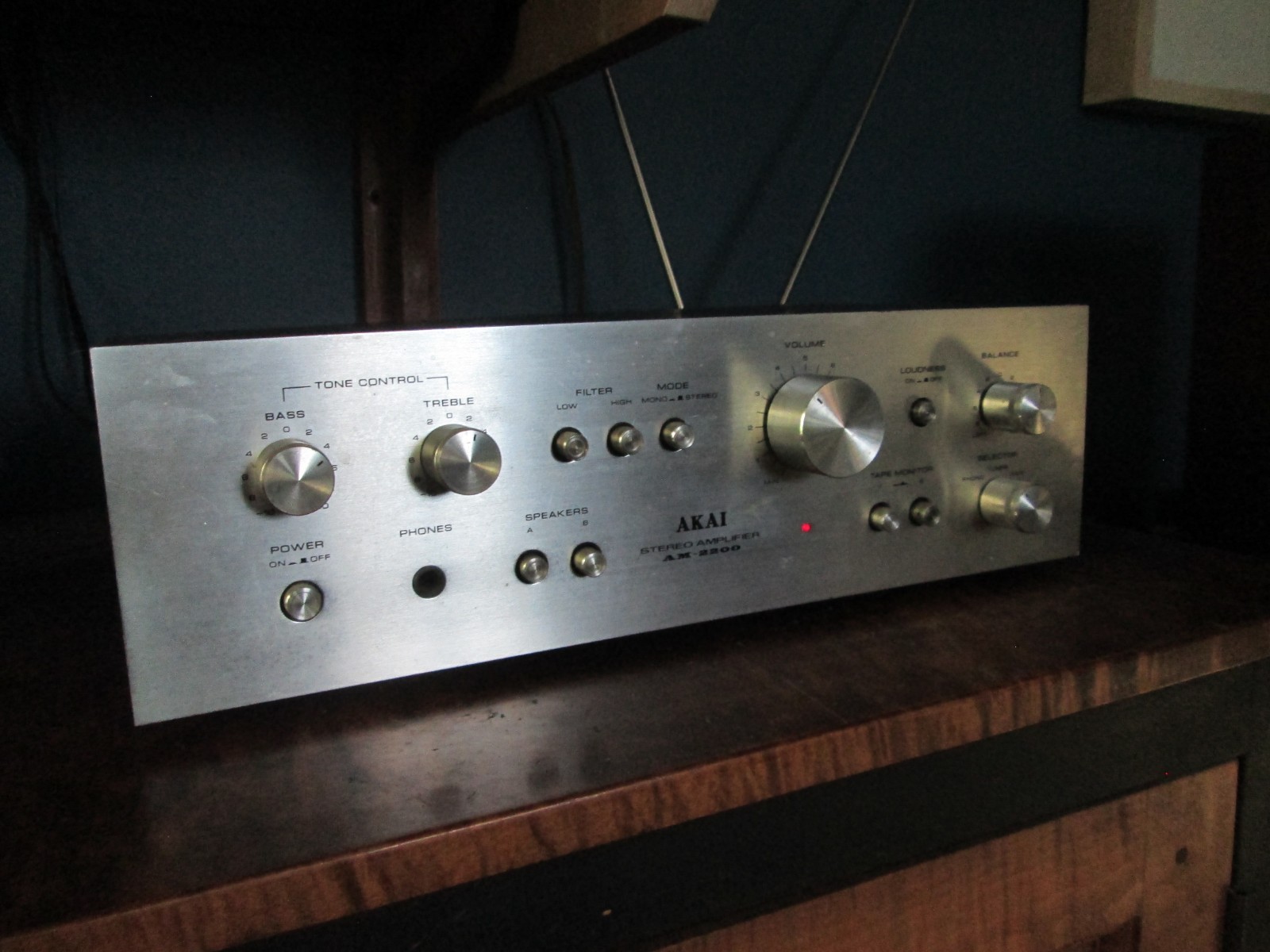
Let’s talk about those illuminated power meters. They’re not just functional—they’re theatrical. When the AM-2850 powers up, they glow with a quiet authority, dancing in real time with the music. One reviewer called them “yum,” and honestly, it’s hard to argue. They’re a visual promise of performance, and the amp delivers. These aren’t gimmicks; they’re calibrated indicators of output, giving you immediate feedback on how hard you’re driving the system.
Illuminated Volume Dial
Even the volume knob gets in on the light show. Its illuminated ring ensures you can see your level setting in a dark room, but it also adds to the overall sense of craftsmanship. Everything about the front panel feels deliberate—no cheap plastics, no flimsy switches. It’s industrial, but not cold. It invites interaction.
Built to Last, Easy to Fix
Forum users consistently note that Akai models of this era, including the AM-2850, are “well built and easy to work on.” With 43 transistors and 31 diodes laid out on serviceable boards, this isn’t a surface-mount nightmare. If capacitors need replacing or a joint needs resoldering, it’s a feasible job for a competent hobbyist. The modular design and accessible layout mean you’re not at the mercy of a specialist—or a landfill—when time takes its toll.
Collectibility & Value
As of March 2013, a unit in very good condition—both cosmetically and functionally—sold for $450 AUD after having been serviced and fully checked. Controls operated smoothly, all lights worked, and the amplifier performed as expected. That price point reflects its status: not a superstar like a Marantz or Luxman, but a respected performer among those in the know.
Today, finding a working AM-2850 is a win. The main caveat? That volume control behavior. Multiple sources suggest the taper is aggressive, and one user explicitly notes the electronics may need refreshing. That doesn’t mean it’s faulty—it means it’s vintage. Electrolytic capacitors degrade, pots get noisy, and after 40+ years, a recap and cleaning are likely necessary for optimal performance. But the fact that it’s considered “easy to work on” makes that a feature, not a dealbreaker.
Parts are still out there—HifiShark listed a replacement meter for $36 in 2024 and a service manual for €39 in 2026—so support exists. And given the praise for its “punchy sound” and strong power delivery, it’s no surprise that collectors and rebuilders are still chasing this model. It’s not just nostalgia; it’s a genuinely capable amplifier that can hold its own in a modern setup.
eBay Listings



As an eBay Partner, we earn from qualifying purchases. This helps support our independent vintage technology research.
Related Models
- Akai AP-206 (1975)
- Akai AM-2450 (1978)
- Akai CS-M40R (1983)
- Akai GX-F66RC (1981)
- Akai AM-A-200 (1979)
- Nakamichi BX-1 (1985)
- Acoustic Research research-ar-17 (1978)
- Acoustic Research AR-19 (1994)
- Acoustic Research AR-1W (1954)
- Acoustic Research AR-28S (1992)