Akai AM-27: A Vintage Tuner with Quiet Elegance
In the mid-1970s, Japanese electronics manufacturers like Akai were rapidly expanding their presence in the global hi-fi market, offering well-engineered, stylish, and affordable audio components. Among Akai’s offerings during this era was the AM-27, a compact AM/FM stereo tuner that, while not as widely celebrated as some of its contemporaries, exemplifies the company’s commitment to accessible high-fidelity sound. Though not a powerhouse amplifier or a feature-laden receiver, the Akai AM-27 carved out a niche as a reliable, no-frills tuner designed for audiophiles who valued clean reception and minimalist design.
Positioned as a standalone tuner, the AM-27 was intended to be paired with a preamplifier and power amplifier, making it a favorite among system builders who preferred modular setups. Released in 1975, it arrived during a golden age of analog radio broadcasting, when FM stereo was gaining popularity and AM still carried music, news, and talk programming with broad reach. In this context, the AM-27 served as a high-quality gateway to over-the-air audio, offering listeners a transparent window into their favorite stations.
Technical Specifications
The Akai AM-27 was engineered with a focus on stability, sensitivity, and selectivity—key performance metrics for any tuner of the era. While detailed service manuals and schematics are scarce today, known specifications and design cues from similar Akai models of the period allow us to reconstruct its likely technical profile.
| Specification | Detail |
| Model | AM-27 |
| Manufacturer | Akai (Japan) |
| Year of Release | 1975 |
| Tuner Type | AM/FM Stereo |
| Frequency Range (FM) | 87.5–108 MHz |
| Frequency Range (AM) | 530–1600 kHz (standard MW band) |
| Tuning Method | Analog dial with mechanical counter |
| IF Frequency (FM) | 10.7 MHz (standard) |
| IF Frequency (AM) | 455 kHz (standard) |
| Output Level | ~0.5 mV (typical for line-level output) |
| Output Impedance | 10 kΩ (approximate) |
| Power Requirement | 120V AC, 60 Hz (North American models) |
| Dimensions | Approx. 430 mm (W) × 135 mm (H) × 300 mm (D) |
| Weight | ~6.5 kg (14.3 lbs) |
| Finish | Black or woodgrain vinyl (regional variants) |
The AM-27 features a classic analog tuning dial with a large, easy-to-read frequency window, illuminated by a small internal bulb—a hallmark of 1970s tuner design. The tuning knob is smooth and damped, allowing for precise station selection, especially on the FM band where stations are closely spaced. It includes standard stereo indicator lights and likely employs a phase-locked loop (PLL) or ratio detector system for FM demodulation, ensuring stable stereo separation and reduced noise.
Sound Characteristics and Performance
While tuners don’t "amplify" sound in the traditional sense, their role in preserving signal integrity is crucial. The Akai AM-27 delivers a clean, transparent signal path with low distortion and adequate channel separation. Users of similar Akai tuners from this era often report a neutral tonal balance—neither overly warm nor bright—making it a faithful reproduction of broadcast content.
FM reception is solid for an era before digital tuning and RDS, with good sensitivity and selectivity that allowed it to pull in weaker stations without excessive noise. The AM section performs respectably, with decent filtering to reduce interference, though like most tuners of its class, it’s best suited for strong local stations rather than DXing (long-distance reception).
Stereo decoding is handled by a discrete or early IC-based stereo demultiplexer, providing a spacious soundstage when tuned to a strong stereo broadcast. Background hiss is minimal when properly tuned, and the muting circuit helps suppress noise during weak signal conditions.
Notable Features and Design
The Akai AM-27 stands out for its clean, minimalist front panel—a design language Akai adopted during the 1970s to compete with brands like Sony, Pioneer, and Sansui. The layout is intuitive: a large tuning dial on the left, volume and balance controls (if included in certain variants), and function switches for band selection and stereo/mono. Some versions may have included a signal strength meter, though this was more common in higher-end models.
One of the AM-27’s strengths is its modular compatibility. As a standalone tuner, it was designed to integrate seamlessly into a separates system. Its line-level output allows connection to any standard preamplifier or integrated amp with auxiliary input, making it a flexible component even by today’s standards.
The internal construction uses through-hole components, discrete transistors, and high-quality capacitors typical of Japanese manufacturing in the 1970s. The RF section is well-shielded to prevent interference, and the power supply is simple but effective, with minimal hum leakage into the audio path.
Common Issues and Maintenance
Like all vintage electronics, the Akai AM-27 benefits from periodic maintenance. After nearly 50 years, several components may degrade:
- Electrolytic capacitors: The power supply and audio coupling capacitors are prone to drying out, which can lead to hum, reduced output, or channel imbalance. Replacing these (recapping) is often the first step in restoration.
- Tuning dial lubrication: The mechanical tuning mechanism can become stiff or noisy over time. Cleaning and relubricating the tuning capacitor and dial cord can restore smooth operation.
- Dust and oxidation: Internal dust buildup and oxidation on switches and potentiometers can cause crackling or intermittent connections. Contact cleaner and careful cleaning are recommended.
- Rubber parts: If the model uses a rubber belt for dial drive (less common in tuners), it may have perished. Fortunately, most Akai tuners of this era used direct mechanical linkages.
Due to the relative scarcity of service manuals, troubleshooting may require cross-referencing with similar Akai models like the AM-22 or AM-39. However, the circuit design is conventional, making it accessible to experienced hobbyists.
Current Market Value and Collectibility
The Akai AM-27 is not a high-profile collector’s item like a Marantz 2270 or a Harman Kardon receiver, but it holds quiet appeal among vintage audio enthusiasts who appreciate understated, functional design. Units in good working condition typically sell for $75–$150, depending on cosmetic condition, functionality, and regional availability.
Its value lies more in utility than rarity. For someone building a period-correct 1970s separates system, the AM-27 offers authentic tuning performance and aesthetic harmony with other gear of the era. Fully restored examples with clean dials and responsive tuning are especially desirable.
While not a "holy grail" component, the AM-27 represents a well-executed slice of Akai’s engineering philosophy: reliable, honest audio performance without unnecessary frills.
Conclusion and Legacy
The Akai AM-27 may not have made headlines in its day, but it embodies the quiet competence that defined much of Japan’s analog audio golden age. As a dedicated AM/FM tuner, it served a specific purpose with precision and grace. Today, it stands as a testament to a time when radio was a primary source of music and information, and high-fidelity tuners were essential components of any serious audio system.
For the vintage audio enthusiast, the AM-27 offers more than just functionality—it offers a connection to the past. Tuning in a distant FM station with its smooth dial and watching the stereo indicator light up is a tactile, analog experience that modern digital tuners can’t replicate. While Akai is better known for its reel-to-reel recorders and later cassette decks, the AM-27 reminds us that the company also produced thoughtful, well-built tuners that deserve a second listen.
If you stumble upon one in a thrift store or estate sale, consider giving it a home. With a little care, the Akai AM-27 can still deliver the magic of analog radio—clear, warm, and full of nostalgia.
eBay Listings

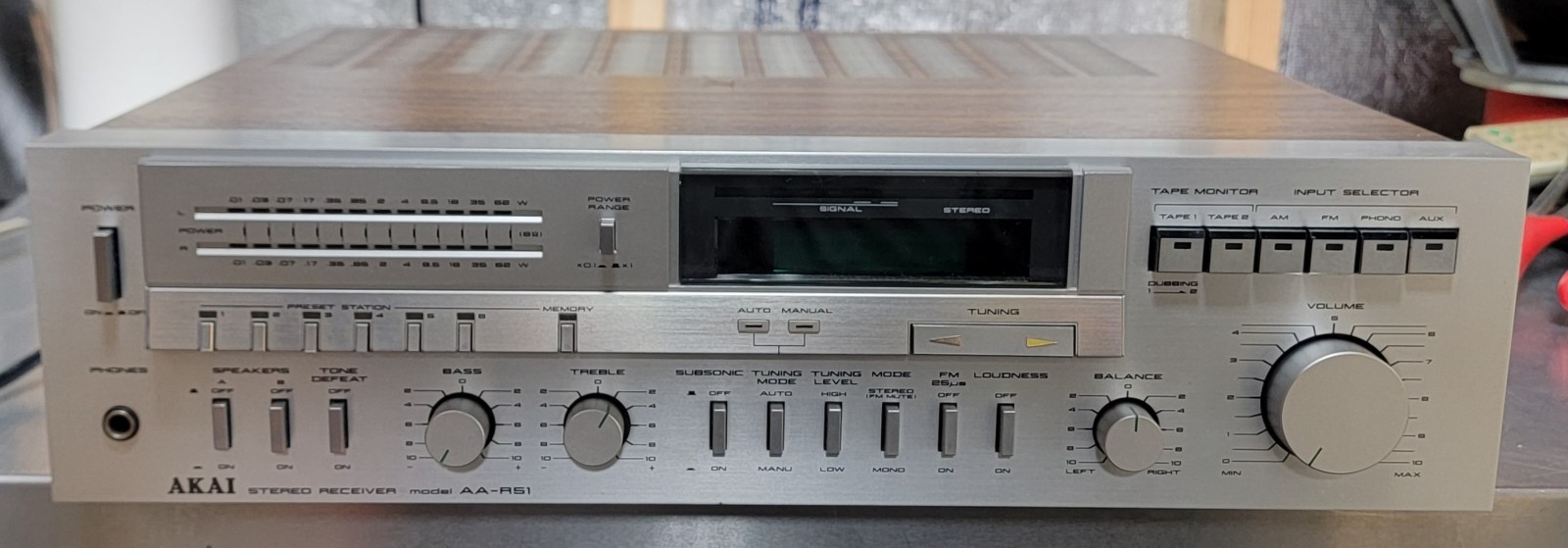
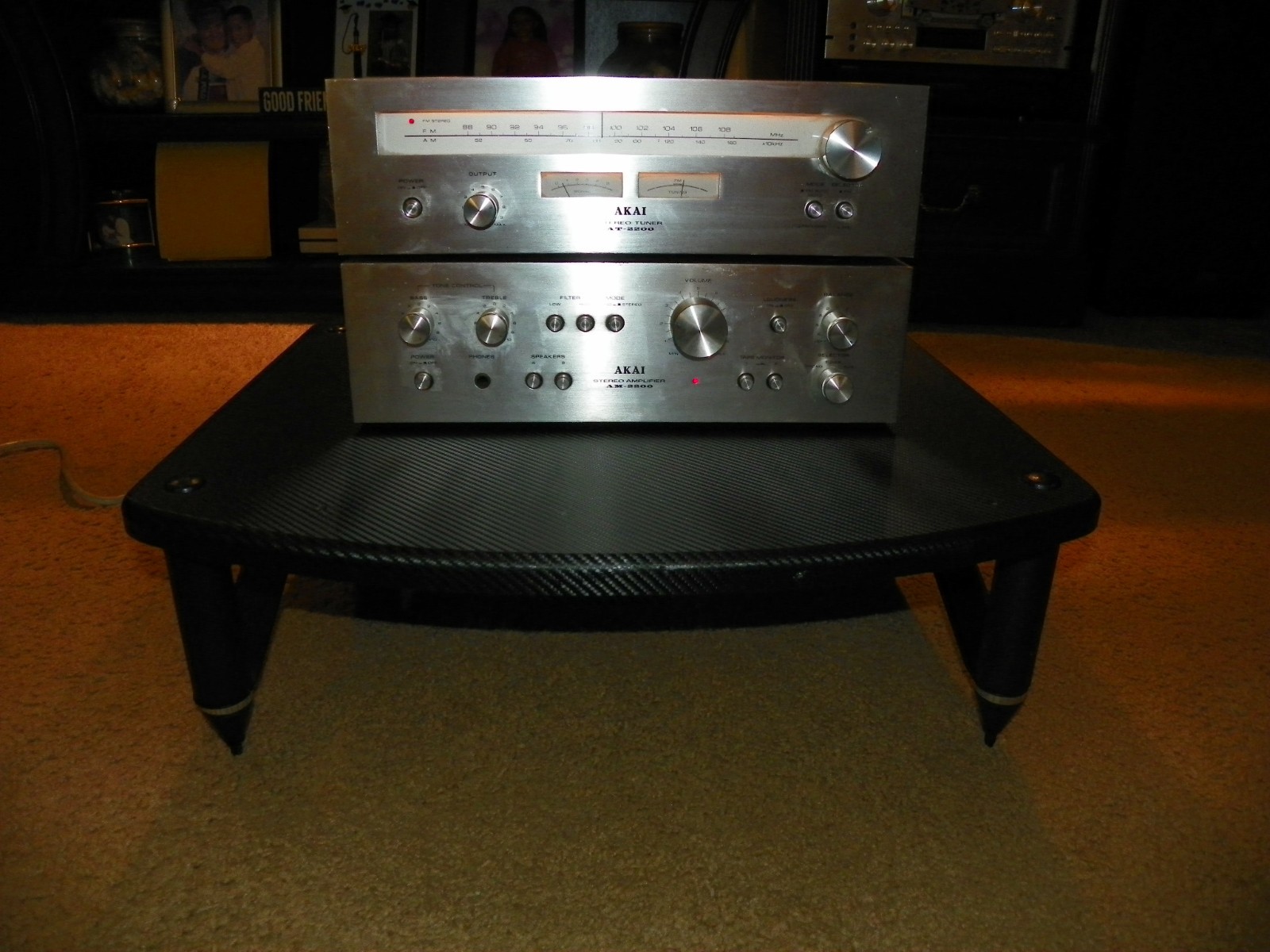
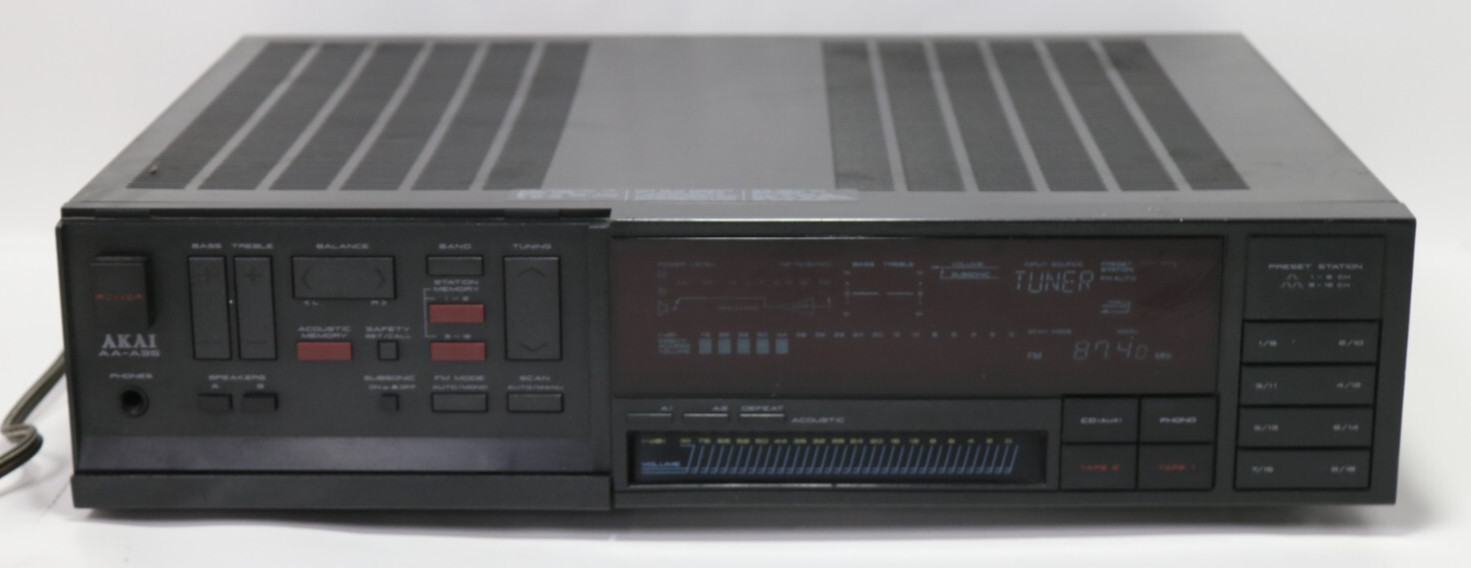
As an eBay Partner, we earn from qualifying purchases. This helps support our independent vintage technology research.
Related Models
- Akai AM-06 (1978)
- Akai AM-25 (1978)
- Akai AM-35 (1975)
- Akai AM-47 (1965)
- Akai AM-93 (1975)
- Aiwa CS-250 (1978)
- Denon TU-1500RD (1995)
- Denon TU-280 (1976)
- Denon TU-501 (1977)
- Denon TU-550 (1978)