Akai AA-5500: The Forgotten Audiophile Powerhouse
In the golden era of high-fidelity audio during the late 1970s, Japanese manufacturers like Pioneer, Denon, and Sansui were capturing the spotlight with bold designs and powerful receivers. Yet, nestled among these giants was Akai—a brand better known for its reel-to-reel tape recorders and cassette decks—quietly crafting one of the most refined and underappreciated amplification systems of its time: the Akai AA-5500.
Though not as widely recognized as its contemporaries, the AA-5500 stands as a testament to Akai’s commitment to precision engineering and audiophile-grade sound. Unlike the all-in-one receivers that dominated living rooms, the AA-5500 was part of Akai’s modular high-end audio philosophy, designed for discerning listeners who valued purity of signal, build quality, and long-term reliability.
A Departure from the Norm: Akai’s Modular Vision
Released in 1978, the Akai AA-5500 was not a receiver, preamplifier, or power amplifier in the traditional sense. Instead, it functioned as a modular control amplifier—a central hub designed to integrate seamlessly with other components in Akai’s high-end lineup, particularly their M-series power amplifiers and TP-series tuners. This modular approach mirrored the philosophy of brands like Harman Kardon and Marantz, where users could build a system piece by piece, tailored to their listening preferences.
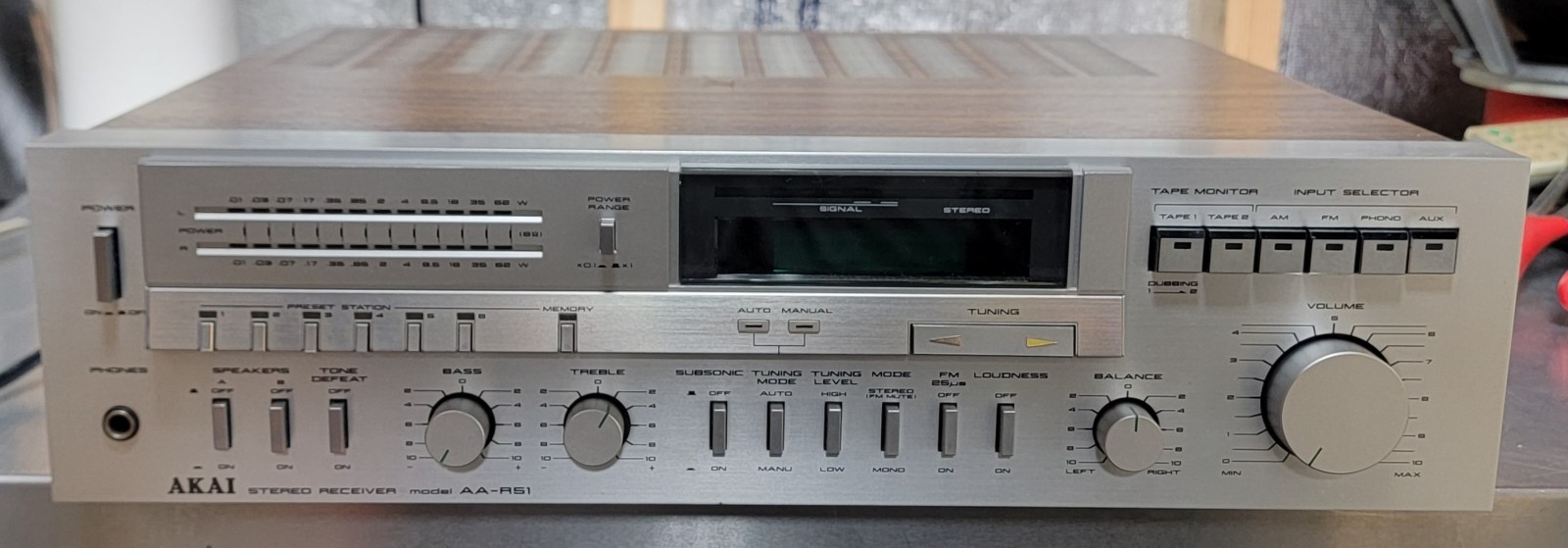
The AA-5500 was typically paired with the Akai M-5500 dual monaural power amplifier, forming a high-current, low-feedback amplification chain capable of driving even the most demanding speakers of the era. Its sleek, minimalist front panel—featuring a large central VU meter, stepped attenuator volume control, and brushed aluminum finish—exuded the understated elegance favored by audiophiles who prized function over flash.
Technical Specifications
| Specification | Detail |
| Model | Akai AA-5500 |
| Year of Release | 1978 |
| Type | Modular Control Amplifier |
| Inputs | 4 line-level (RCA), 1 tape loop |
| Output Impedance | 600Ω (balanced), 150Ω (unbalanced) |
| Frequency Response | 20Hz – 20kHz (+/-0.5dB) |
| Total Harmonic Distortion | <0.03% (1kHz, rated output) |
| Signal-to-Noise Ratio | >90dB (A-weighted) |
| Volume Control | Precision stepped attenuator (24-step) |
| Construction | Dual mono signal path, discrete circuitry |
| Power Supply | Toroidal transformer, regulated rails |
| Dimensions (W×H×D) | 430 × 145 × 340 mm |
| Weight | 12.5 kg (27.5 lbs) |
| Finish | Brushed aluminum, black faceplate |
Notably, the AA-5500 featured both balanced (XLR) and unbalanced (RCA) connectivity—a rarity in consumer gear of the late 1970s—making it a forward-thinking choice for studio-influenced home systems. The internal layout emphasized short signal paths, high-quality metal-film resistors, and polypropylene capacitors, minimizing coloration and maximizing transparency.
Sound Characteristics and Performance
The sonic signature of the Akai AA-5500 is best described as neutral, detailed, and dynamically expressive. Unlike many Japanese amplifiers of the era that leaned toward warmth or lushness, the AA-5500 aimed for accuracy—revealing the true character of recordings without editorializing.
Its stepped attenuator ensured precise channel matching and eliminated the channel imbalance common in potentiometer-based volume controls. Combined with the low-noise regulated power supply, this contributed to an exceptionally black background, allowing subtle details in music—reverberation tails, finger noise on guitar strings, or breath between vocal phrases—to emerge with startling clarity.
When paired with the M-5500 power amp, the system delivered tight, controlled bass, a crisp and open midrange, and airy highs that never became fatiguing. It excelled with acoustic recordings, jazz trios, and classical works, where spatial imaging and instrument separation are paramount.
Notable Features and Innovations
1. Modular Design Philosophy: The AA-5500 was part of Akai’s broader ecosystem. It could be rack-mounted with matching components using Akai’s proprietary chassis alignment system, ensuring both aesthetic cohesion and mechanical stability.
2. Dual-Mono Preamp Architecture: Though not fully dual-mono like some contemporary separates, the AA-5500 used independent left/right circuit boards for the critical gain stages, reducing crosstalk and improving stereo imaging.
3. VU Meter as a Functional Tool: The large central VU meter wasn’t just for show—it provided real-time feedback on output levels, helping users avoid clipping and optimize gain staging, especially useful when integrating tape decks or external processors.
4. High-Quality Internal Wiring: Akai used oxygen-free copper (OFC) internal cabling, a feature that wouldn’t become standard in consumer audio for another decade.
5. Low-Feedback Design: The AA-5500 employed minimal global negative feedback, a design choice favored by purists for its natural transient response and reduced phase distortion.
Common Issues and Maintenance
Like any vintage electronic equipment, the Akai AA-5500 requires careful attention after decades of use. Common issues include:
- Dried-up electrolytic capacitors: The power supply and signal path capacitors should be checked or replaced, especially if the unit has been powered off for years.
- Oxidized switches and controls: The stepped attenuator and input selector can develop crackling or channel dropouts. These can often be cleaned with contact cleaner, but physical wear may require replacement.
- Dim or failing VU meter: The meter’s internal coil or power supply may degrade. Replacement VU meters are available but can be expensive.
- Dust accumulation: Due to its open chassis design, dust can settle on circuit boards and connectors. Gentle cleaning with compressed air is recommended.
For long-term reliability, a full recapping and servicing by a qualified technician is strongly advised before regular use. Given the AA-5500’s use of regulated power supplies and precision components, it’s worth the investment for serious collectors.
Current Market Value and Collectibility
The Akai AA-5500 remains a rare and under-the-radar gem in the vintage audio world. Unlike mass-market receivers, it was produced in limited numbers and primarily sold through high-end audio dealers. As a result, finding a complete, working unit today is uncommon.
In recent years, interest has grown among modular system enthusiasts and reel-to-reel collectors, especially those restoring full Akai setups. On the secondary market, a fully functional AA-5500 typically sells for $400–$700, with higher prices for units paired with matching M-5500 amplifiers or original packaging.
Its value is likely to appreciate as audiophiles rediscover the virtues of modular, low-feedback designs and as Akai’s legacy in professional audio gains renewed appreciation.
Conclusion: A Hidden Classic
The Akai AA-5500 may not have the name recognition of a Marantz 2270 or a Pioneer SX-1980, but it represents a high point in Akai’s foray into serious high-fidelity audio. It was a product built for those who valued engineering integrity over marketing hype, and sonic transparency over tonal coloration.
Today, the AA-5500 stands as a quiet achiever—a component that, once heard in a well-matched system, commands respect. For the vintage audio collector or the modular system builder, the Akai AA-5500 is more than just a relic; it’s a window into a time when audio excellence was measured not by watts or flashy features, but by the purity of the listening experience.
If you’re lucky enough to find one in good condition, consider it not just a purchase—but an invitation to rediscover what high-fidelity once meant.
eBay Listings



As an eBay Partner, we earn from qualifying purchases. This helps support our independent vintage technology research.
Related Models
- Akai AM-A301
- Akai AM-U04
- Akai AM-U7
- Akai AM-U-2 (1975)
- Akai AM-A-70 (1978)
- Luxman L-530 (1975)
- Luxman R-404 (1975)
- Luxman RV-371 (1975)
- Luxman SQ-38U (1975)
- Luxman T-14 (1972)