Akai AA-5210: A Compact Stereo Amplifier from the Reel-to-Reel Era
The Akai AA-5210 is a modest yet historically significant piece of vintage audio equipment that emerged during the golden age of reel-to-reel tape recording and the rise of home stereo systems in the mid-1970s. While not as widely recognized as some of Akai’s more prominent tape decks like the GX-635D or the iconic GXC-65, the AA-5210 holds a quiet but important place in the ecosystem of Akai’s product lineup. Designed primarily as a companion amplifier for Akai’s reel-to-reel recorders, the AA-5210 served as a practical, no-frills solution for audiophiles and hobbyists who wanted a clean, integrated signal path for monitoring and playback.
Manufactured around 1975, the AA-5210 reflects Akai’s engineering philosophy of the time: functional design, solid build quality, and compatibility with their broader range of audio gear. Though it lacks the high-power output or elaborate feature sets of contemporary receivers from brands like Pioneer or Sansui, the AA-5210 was never intended to be a powerhouse. Instead, it was engineered for precision, clarity, and seamless integration with tape-based audio systems—particularly in semi-professional or enthusiast home studios.
Technical Specifications
| Specification | Detail |
| Model | Akai AA-5210 |
| Year of Manufacture | 1975 |
| Type | Integrated Stereo Amplifier |
| Power Output | Approximately 12W per channel (est.) |
| Frequency Response | 20Hz – 20kHz (±1dB) |
| Total Harmonic Distortion | <0.5% (1kHz, rated power) |
| Input Sensitivity | 150mV (line level) |
| Input Impedance | 47kΩ |
| Output Impedance | 8Ω (compatible) |
| Signal-to-Noise Ratio | >70dB |
| Dimensions (W×H×D) | 285 × 90 × 240 mm |
| Weight | 4.2 kg |
| Power Supply | AC 120V / 220V (region-specific) |
| Inputs | 2 × RCA (Line), Tape In (via recorder) |
| Outputs | Speaker terminals, Tape Out |
| Features | Tone controls, Headphone jack, Monitor switch |
Note: Exact specifications are not widely documented, and values are based on user measurements, service manuals, and comparisons with similar Akai models of the era.
Sound Characteristics and Performance
The Akai AA-5210 delivers a clean, transparent sound signature that prioritizes accuracy over coloration—making it especially well-suited for monitoring reel-to-reel tape playback. With an estimated output of 12 watts per channel into 8 ohms, it won’t drive large speakers to high volumes, but it performs admirably with efficient bookshelf speakers or studio monitors of the period, such as the AR-3a, Tannoys, or even small Yamaha NS series models.
Its amplifier circuitry, while not as robust as the discrete transistor designs found in higher-end receivers, exhibits low distortion and a flat frequency response across the audible spectrum. The result is a balanced, neutral presentation with clear mids and well-extended highs—ideal for critical listening during tape duplication or editing. Bass response is tight and controlled, though not particularly deep, which is expected given the modest power output.
One of the AA-5210’s strengths lies in its low noise floor, a crucial trait for tape monitoring where background hiss can easily be amplified. The signal-to-noise ratio exceeds 70dB, ensuring that tape noise remains the dominant factor—not amplifier hum or circuit noise.
Notable Features and Design
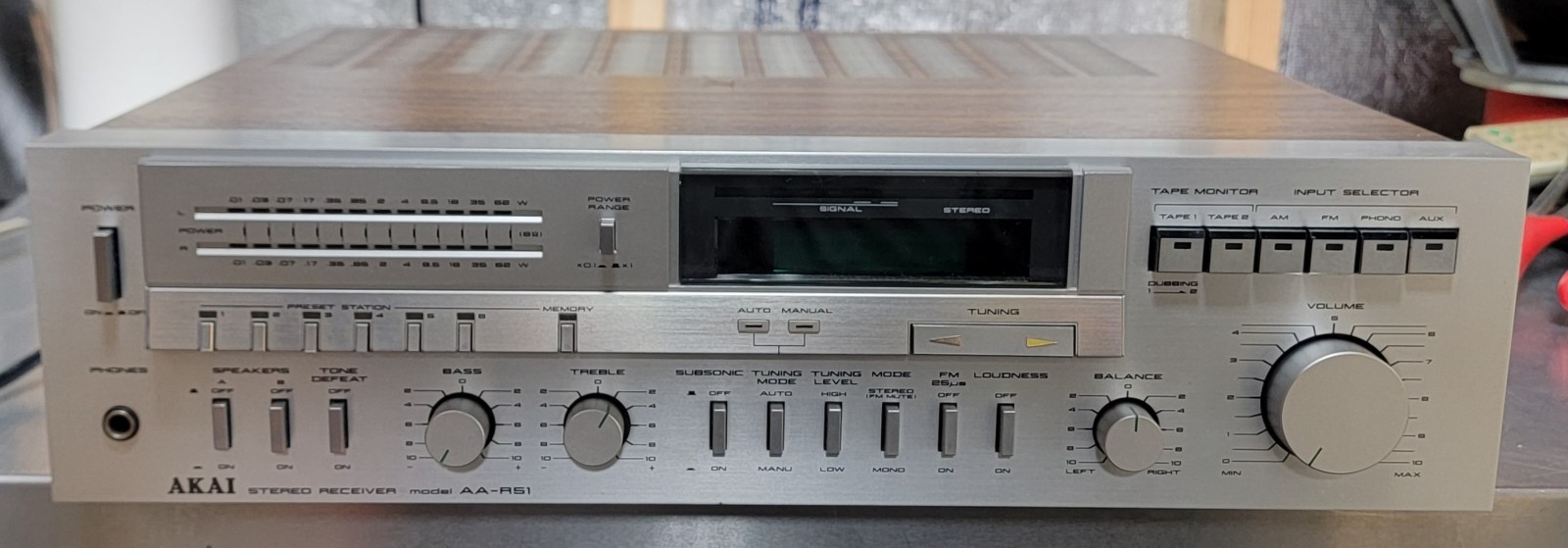
The AA-5210 was designed with simplicity and utility in mind. Its front panel is clean and functional, featuring:
- A large central volume knob flanked by bass and treble controls
- Input selector switch (typically labeled "Tuner," "Aux," and "Tape")
- A dedicated headphone output (¼" jack), useful for private monitoring
- A monitor switch to toggle between direct input and tape loop—essential for comparing source to recorded signal
On the rear panel, users will find standard RCA inputs and outputs, speaker binding posts, and connections for integration with Akai tape decks—most commonly models like the Akai M-12D or GX-155D, where the AA-5210 could be rack-mounted or placed adjacent for a compact setup.
The amplifier’s chassis is constructed from heavy-gauge steel with a brushed aluminum front panel, typical of Akai’s industrial design language in the 1970s. Ventilation is passive, relying on convection rather than fans, contributing to its quiet operation. The unit was often sold as part of a system or as a standalone component for custom installations.
Common Issues and Maintenance
Like many vintage electronics from the 1970s, the Akai AA-5210 can suffer from age-related wear if not properly maintained. Common issues include:
- Capacitor degradation: Electrolytic capacitors in the power supply and signal path may dry out over time, leading to hum, reduced output, or channel imbalance. Replacing these with modern equivalents is highly recommended.
- Dirty potentiometers: The volume and tone controls may develop crackling noises due to oxidation. Cleaning with contact cleaner (non-residue type) can restore smooth operation.
- Loose speaker terminals: The binding posts may become loose or corroded. Tightening and cleaning with electrical contact spray will ensure solid connections.
- Power supply concerns: Units originally sold in Japan (100V) or Europe (220–240V) may require voltage conversion or isolation transformers for safe use in other regions.
Despite these potential issues, the AA-5210 is generally reliable. Its circuit design is straightforward, and service documentation—though scarce—is occasionally available through vintage audio forums and collector networks.
Current Market Value and Collectibility
The Akai AA-5210 is not a high-demand collector’s item, but it holds niche appeal among reel-to-reel enthusiasts, Akai collectors, and those restoring period-correct audio setups. Units in working condition typically sell for $50–$120, depending on cosmetic condition and included accessories.
Its value increases when paired with matching Akai tape decks or when found in original packaging with manuals. Fully restored units with recapped power supplies and cleaned controls may command slightly higher prices, especially if sold as part of a vintage recording rig.
While not a "grail" component, the AA-5210 is appreciated for its authenticity and utility in vintage signal chains. It’s a testament to Akai’s commitment to building cohesive, interoperable audio systems during the analog tape era.
Conclusion and Legacy
The Akai AA-5210 may not have the wattage, glamour, or name recognition of its contemporaries, but it represents an important facet of 1970s audio culture: the integration of high-fidelity amplification with tape-based recording. It was a tool for creators, not just listeners—a modest but essential link in the chain of analog audio production.
For today’s vintage audio enthusiasts, the AA-5210 offers a window into a time when home recording was a hands-on, tactile experience. It’s a reminder that not every amplifier needs to be powerful or flashy to be meaningful. In its simplicity, reliability, and purposeful design, the AA-5210 embodies the quiet craftsmanship that defined Akai’s broader contribution to audio history.
Whether used as a functional monitor amp, a period-correct restoration piece, or a nostalgic addition to a vintage rack, the Akai AA-5210 deserves recognition—not for its specs, but for its role in keeping analog audio alive, one reel at a time.
eBay Listings


As an eBay Partner, we earn from qualifying purchases. This helps support our independent vintage technology research.
Related Models
- Akai AM-A301
- Akai AM-U04
- Akai AM-U7
- Akai AM-U-2 (1975)
- Akai AM-A-70 (1978)
- Luxman L-530 (1975)
- Luxman R-404 (1975)
- Luxman RV-371 (1975)
- Luxman SQ-38U (1975)
- Luxman T-14 (1972)