Akai AA-5000: The Audiophile's Reel-to-Reel Companion
In the golden era of analog audio, when tape ruled the recording and playback world, Akai stood out as a Japanese innovator committed to quality, precision, and accessibility. While the company is perhaps best known for its portable cassette recorders and consumer reel-to-reel decks like the iconic GX-61D, Akai also ventured into the high-end professional and audiophile space with supporting components that elevated the entire tape experience. One such component was the Akai AA-5000, a sophisticated preamplifier and monitoring unit designed specifically to complement Akai’s top-tier reel-to-reel tape recorders.
Though not a standalone amplifier or receiver, the AA-5000 played a crucial role in high-fidelity tape systems of the late 1970s. Released around 1978, it was engineered to serve as the control and monitoring hub for Akai’s professional-grade tape decks, particularly those used in semi-pro studios and discerning home audio setups. While details on the AA-5000 are scarce today—owing to its niche status and limited production run—it remains a sought-after piece among reel-to-reel enthusiasts and vintage audio collectors.
Technical Specifications
The Akai AA-5000 was not a power amplifier but rather a high-performance preamplifier and monitor controller tailored for use with reel-to-reel tape machines. It featured precision circuitry for clean signal routing, level monitoring, and source selection, ensuring minimal coloration and maximum fidelity when working with analog tape.
| Specification | Detail |
| Model | AA-5000 |
| Manufacturer | Akai Electric Co., Ltd. (Japan) |
| Year of Release | 1978 |
| Category | Reel-to-reel preamp / monitor controller |
| Inputs | Line-level inputs (RCA), Tape input (from deck) |
| Outputs | Tape output (to recorder), Monitor output (to power amp) |
| Monitoring Features | Dual VU meters (left/right), level calibration controls |
| Tone Controls | None (pure signal path) |
| Impedance | Not applicable (line-level device) |
| Power Output | Not applicable (preamp only) |
| Power Supply | Internal linear power supply (110V/220V switchable) |
| Dimensions (W×H×D) | Approx. 430 × 145 × 320 mm |
| Weight | Approx. 10.5 kg |
| Finish | Brushed aluminum front panel, black chassis |
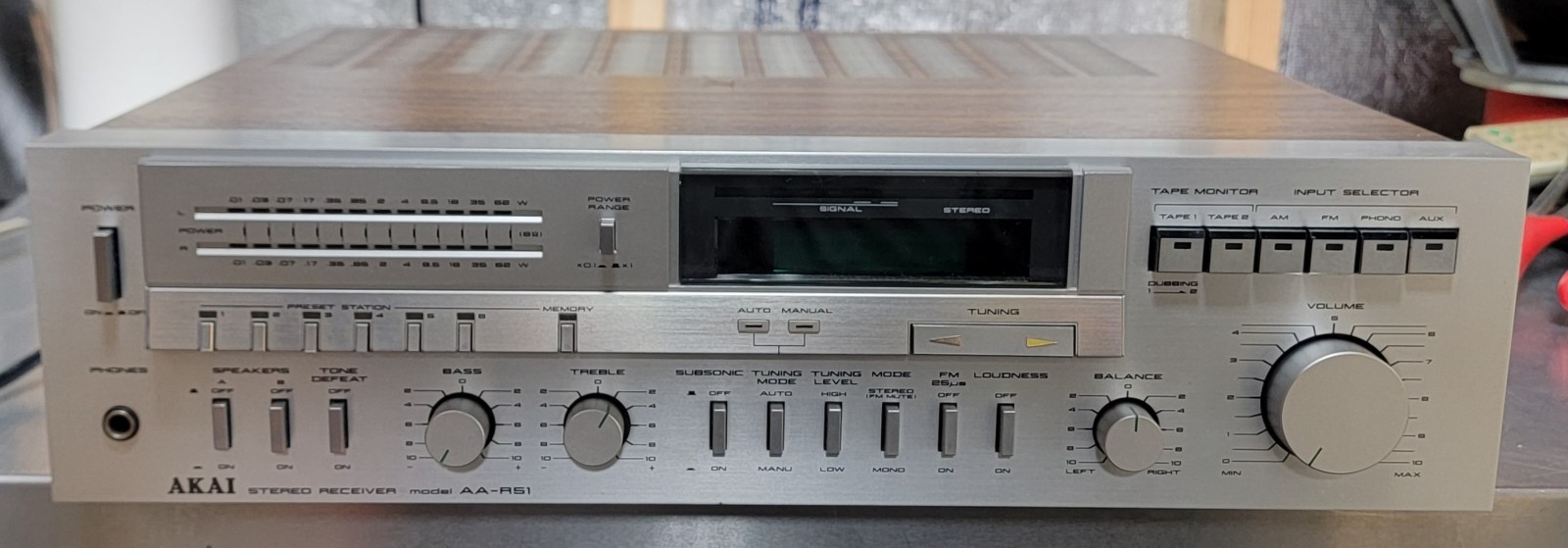
The AA-5000 was typically paired with Akai’s high-end tape decks such as the Akai M-12D or M-8700, forming a cohesive, high-performance analog recording and playback chain. Its minimalist front panel design emphasized function over flair, with large VU meters dominating the layout—essential for accurate level setting during recording and playback.
Sound Characteristics and Performance
The AA-5000 was engineered for transparency. Unlike many consumer preamps of the era that added warmth or coloration, the AA-5000 aimed for a neutral, accurate signal path—critical for professional monitoring and critical listening. Its discrete transistor-based circuitry (typical of late '70s Japanese high-end gear) delivered low noise, wide frequency response, and excellent channel separation.
When used in a full Akai tape system, the AA-5000 ensured that the subtle nuances captured on tape—such as tape hiss, harmonic richness, and spatial imaging—were preserved without added distortion. Audiophiles appreciated its clean gain structure and precise metering, which allowed for optimal bias and level calibration on tape decks.
The dual VU meters were not just decorative; they were calibrated for both playback and record modes, enabling users to match levels between input and output with high accuracy. This was especially important when aligning tape heads or duplicating master recordings.
Notable Features and Innovations
While the AA-5000 may appear simple at first glance, it incorporated several thoughtful design elements that reflected Akai’s engineering philosophy:
- Dual-Mode Monitoring: The unit allowed seamless switching between direct line input monitoring and tape playback monitoring, making it ideal for real-time recording and overdubbing.
- High-Quality VU Meters: Large, responsive meters with center-zero capability enabled precise level balancing between left and right channels—a must for stereo recording.
- Tape Loop Functionality: The AA-5000 facilitated a clean tape loop between itself and a compatible Akai recorder, minimizing signal degradation and ensuring optimal recording levels.
- Professional Build Quality: With a heavy steel chassis, high-grade potentiometers, and gold-plated connectors, the AA-5000 was built to last in both studio and home environments.
- No Tone Controls: A deliberate design choice to preserve signal integrity, appealing to purists who preferred uncolored sound.
Though it lacked modern conveniences like remote control or digital integration, the AA-5000 was a purpose-built tool for analog fidelity—something increasingly valued in today’s high-resolution audio landscape.
Common Issues and Maintenance
Like all vintage electronics from the late 1970s, the Akai AA-5000 requires careful maintenance to perform optimally today. Common issues include:
- Dried-up electrolytic capacitors: The internal power supply and signal path capacitors may need replacement to prevent hum, noise, or channel imbalance.
- Oxidized potentiometers and switches: Regular use of contact cleaner can restore smooth operation of volume and selector controls.
- VU meter inaccuracies: Over time, VU meter needles can stick or become uncalibrated. Reconditioning or professional recalibration may be necessary.
- Worn connectors: RCA jacks and tape output terminals may become loose; resoldering or replacement ensures reliable connections.
Because the AA-5000 was not mass-produced, replacement parts can be difficult to source. However, its circuitry shares similarities with other Akai and Japanese pro-audio gear of the era, making repairs feasible for experienced technicians.
Owners are advised to have the unit serviced by a specialist in vintage analog equipment before regular use, especially if it has been in storage for decades.
Current Market Value and Collectibility
The Akai AA-5000 is a rare find. Unlike more common Akai cassette or receiver models, the AA-5000 was produced in limited numbers and targeted a niche market. As such, it rarely appears on the secondary market, and when it does, prices can vary widely.
In excellent working condition, the AA-5000 typically sells for $400–$700, depending on geographic region and accompanying documentation or original packaging. Units that have been professionally restored or are part of a matched Akai system (e.g., paired with an M-12D deck) can command higher prices, especially among serious reel-to-reel collectors.
Its collectibility stems not from brand fame but from its role in preserving the integrity of analog tape workflows. For enthusiasts restoring vintage studios or building high-end analog playback systems, the AA-5000 represents a missing link in achieving authentic 1970s-era sound quality.
Conclusion and Legacy
The Akai AA-5000 may not be a household name, but for those immersed in the world of reel-to-reel audio, it represents the pinnacle of Akai’s commitment to analog excellence. More than just a preamp, it was a precision instrument—a bridge between the recording medium and the listener.
While overshadowed by flashier receivers or amplifiers of the era, the AA-5000’s legacy lies in its purity of purpose: to deliver uncolored, accurate sound with the reliability and build quality Akai was known for. Today, as analog tape enjoys a quiet renaissance among audiophiles and musicians, the AA-5000 stands as a testament to a time when every detail of the audio chain mattered.
For the vintage audio collector, the AA-5000 is more than a rare component—it’s a piece of analog history, meticulously engineered for those who demand the best from their tape machines.
eBay Listings


As an eBay Partner, we earn from qualifying purchases. This helps support our independent vintage technology research.
Related Models
- Akai AM-A301
- Akai AM-U04
- Akai AM-U7
- Akai AM-U-2 (1975)
- Akai AM-A-70 (1978)
- Luxman L-530 (1975)
- Luxman R-404 (1975)
- Luxman RV-371 (1975)
- Luxman SQ-38U (1975)
- Luxman T-14 (1972)