Akai 4000D (1970–1973)
A Japanese-built reel-to-reel tape recorder from the early 1970s with a 3-head system and GX head technology
Overview
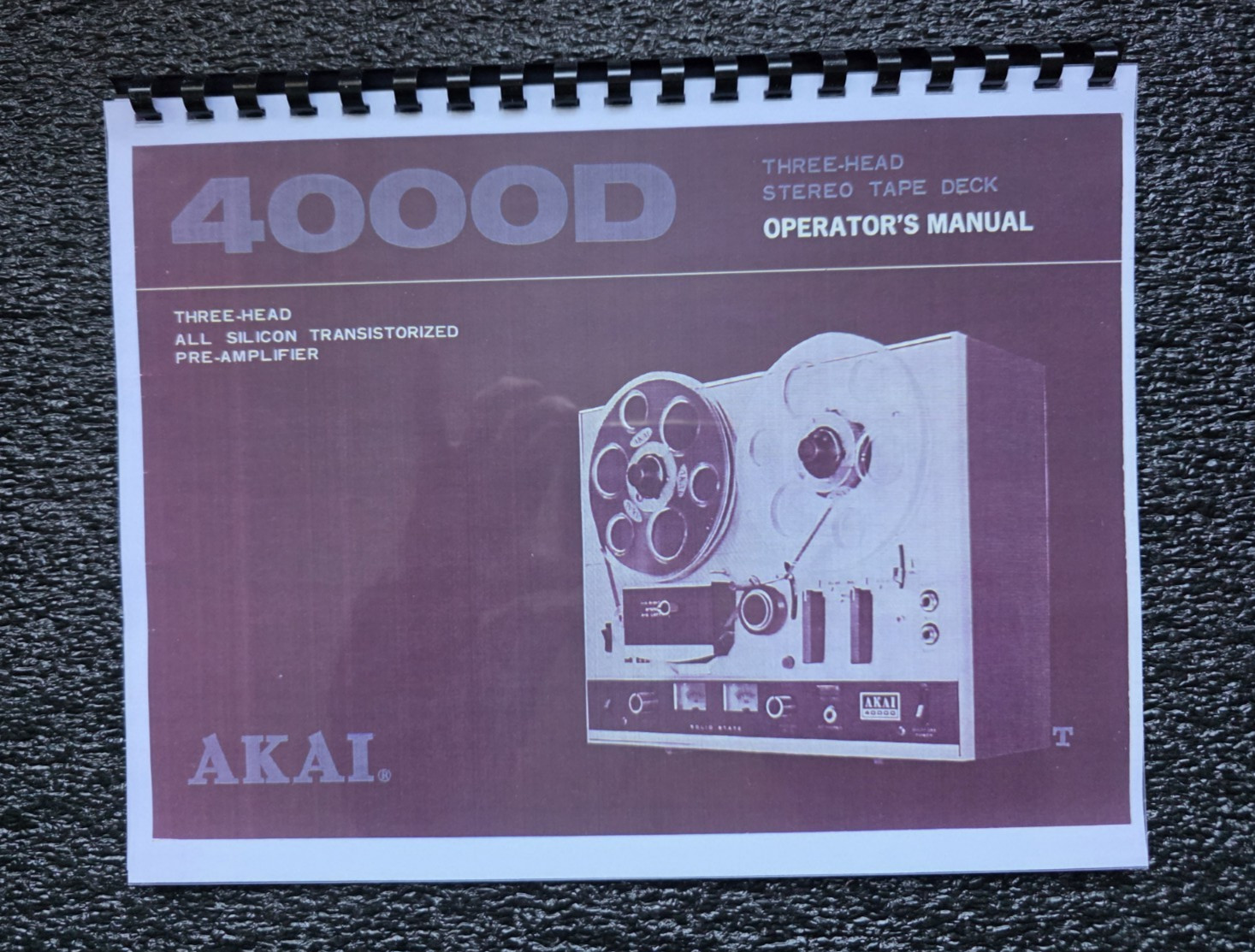
The Akai 4000D is a reel-to-reel tape recorder made in Japan by Akai Electric Co., Ltd. between 1970 and 1973. It was the basic model in the 4000 series. It records stereo and monaural on a 4-track 2-channel system. The 3-head setup has separate record, playback, and erase heads, so you can monitor the tape while you record. Tape speeds are 19 cm/s and 9.5 cm/s, with NAB equalization. The head gap is 1 μm, achieved through ultra-precision processing.
Specifications
| Product type | Reel-to-reel tape recorder |
| Production years | 1970 - 1973 |
| Manufacturer | Akai Electric Co., Ltd. |
| Made in | Japan |
| Color | Silver / Black |
| Track system | 4-track 2-channel stereo / monaural system |
| Tape speed | 19cm/s, 9.5cm/s (± 2%) |
| Wow and flutter | 0.08% RMS or less (19cm/s) |
| Frequency characteristic | 30 Hz ~ 24 kHz ± 3 dB (19cm/s), 30 Hz ~ 16 kHz ± 3 dB (9.5cm/s) |
| Distortion factor | 1.0% at 19cm/s, 1 kHz, 0 VU |
| Signal-to-noise ratio (S/N) | 60dB (JIS) |
| Crosstalk | 40dB |
| Erasure rate | 70 dB or more |
| Recording bias frequency | 100kHz |
| Heads | 3 heads (record, play, erase) — Recording: GX head / Playing: GX head / Erasing: erase heads |
| Motor | One 4-pole induction motor |
| Fast forward / rewind time | 120/150 seconds (60Hz/50Hz, 370m tape) |
| Recording time | 2-hour stereo recording (9.5cm/s, 370m tape used) |
| Input - Microphone | 0.25 mV / Impedance 600 Ω |
| Input - Line | 70mV/100k Ω or more |
| Input - DIN | 2mV/10k Ω |
| Output - Line | 0 ~ 775 mV (maximum, 0 VU) / Load impedance 50k Ω or more |
| Output - DIN | 0.3 V (max., 0 VU) |
| Output - Headphone | 0 ~ 100mV/8 Ω (maximum, 0 VU) |
| Semiconductor used | Transistor : 11 / Diode : 4 pcs / Integrated circuit Linear ICs : 4 units |
| Power supply voltage | 100 VAC, 50Hz/60Hz |
| Power consumption | 36W |
| External dimensions | Width 440x Height 315x Depth 230 mm |
| Weight | 13.2kg |
| Original price | ¥69,800 (around 1978) |
| Attachment | Model 17 (No. 7) Empty Reel x1, Connection code x2 |
| Sold Separately | Dust Cover DC-4000 (¥5,000) |
Design
The Akai 4000D uses GX heads for both recording and playback. They are made from a low-noise crystal ferrite material developed through Akai's own magnetic technology. Compared to Permalloy or Sendust heads, they offer better dynamic response, better electromagnetic conversion efficiency, and more resistance to wear and dust buildup. The 3 independent heads allow real-time monitoring during recording, and the 1 μm gap comes from ultra-precision machining. A single 4-pole induction motor drives the transport, paired with a large flywheel for stable tape movement. Operation is by a 2-lever mechanism. A tape selector optimizes performance for different tape types (e.g., Scotch #211 or #1500). The line and microphone input circuits are independent, which supports mixing. A VU meter linked to a monitor switch shows input and output levels. The unit also has a 4-digit index counter, temporary stop and auto-stop mechanisms, and adjustable output levels for line and headphone outputs.
Context
The Akai 4000D was the base model in the 4000 series lineup. It offered core professional-grade features in a consumer-accessible package, and it was the entry point into Akai's GX-head-equipped reel-to-reel range. The emphasis was on reliability and high-fidelity performance for home recording enthusiasts.
eBay Listings


As an eBay Partner, we earn from qualifying purchases. This helps support our independent vintage technology research.