Aiwa AD-WX110U: A Compact Workhorse for Cassette Enthusiasts
By 1998, the cassette tape was no longer king. CDs ruled the mainstream, and MP3s loomed on the horizon. Yet for home tapers, mixtape makers, and vinyl archivists, the humble cassette still had life. Enter the Aiwa AD-WX110U—a no-nonsense dual cassette deck built not for show, but for duty. It didn’t dazzle with speed or specs, but it worked. Reliably. Quietly. Day after day. In an era of shrinking shelf space and fading analog interest, this compact machine kept the tape flame alive in dorm rooms, secondhand setups, and bedroom studios across North America. No frills. No fuss. Just a trusted tool for copying tapes, preserving memories, and spinning mixtapes one side at a time.
Aiwa had spent decades carving a name for itself with smart, affordable audio gear—gear that didn’t skimp on reliability. The AD-WX110U carried that torch. Gone were the high-speed dubbing decks and metal bias circuits of the ’80s golden age. This was a new decade, and Aiwa responded with a machine focused on simplicity, durability, and footprint. It wasn’t meant for audiophiles tweaking azimuths or chasing flat frequency response. It was for real people who needed to copy a CD to tape, record a late-night radio show, or play back a well-worn mixtape without flipping sides by hand.
Technical Specifications
The AD-WX110U is a utilitarian dual cassette deck through and through. It skips the extras—no three-head system, no manual bias control, no high-speed dubbing—but delivers where it counts: consistent, trouble-free operation. It’s the kind of deck you plug in and forget about, until you need it again.
| Specification | Detail |
| Model | AD-WX110U |
| Manufacturer | Aiwa Corporation |
| Year of Release | 1998 |
| Type | Dual Cassette Deck |
| Recording Capability | Tape-to-tape dubbing (real-time only) |
| Playback Compatibility | Type I (Normal), Type II (Chrome) |
| Noise Reduction | Dolby B NR |
| Motor Type | Single direct-drive motor |
| Tape Transport | Rubber pinch roller, basic mechanism |
| Head Configuration | Single play/record head (fixed gap) |
| Input/Output | Line In (RCA), Line Out (RCA) |
| Power Requirement | AC 120V, 60Hz (North American model) |
| Dimensions (W×H×D) | 430 × 125 × 280 mm (approx.) |
| Weight | 3.2 kg (7.1 lbs) |
| Display | Basic LED window for time and mode |
| Special Features | Auto reverse (playback only on one side), pause function, erase safety tab lock |
| Tape Speed | 4.8 cm/s |
Sound Characteristics and Performance
Pick up the AD-WX110U expecting studio-grade fidelity, and you’ll be disappointed. This isn’t a deck for critical listening or mastering. But judge it on its own terms—a budget-friendly, real-time dubbing machine from the late ’90s—and it holds up surprisingly well. The single fixed-gap head keeps things simple, and while it won’t extract every nuance from a tape, it delivers a warm, listenable sound that’s miles ahead of a Walkman.
Dolby B noise reduction tames the hiss, especially on chrome tapes, giving recordings a cleaner edge. Frequency response lands around 80 Hz – 13 kHz—not wide, but enough for casual use. Bass feels present, if not deep. Highs are softened, but not muffled. For copying CDs, archiving vinyl rips, or making mixtapes from the radio, it’s more than capable.
Dubbing happens in real time—no shortcuts here. But the transport is steady, the tape path smooth. The auto-reverse function works only on playback, letting you listen to both sides of a tape without lifting a finger. It’s a small luxury, but one that adds real convenience. Just don’t expect it to do the same during recording.
Notable Features and Design
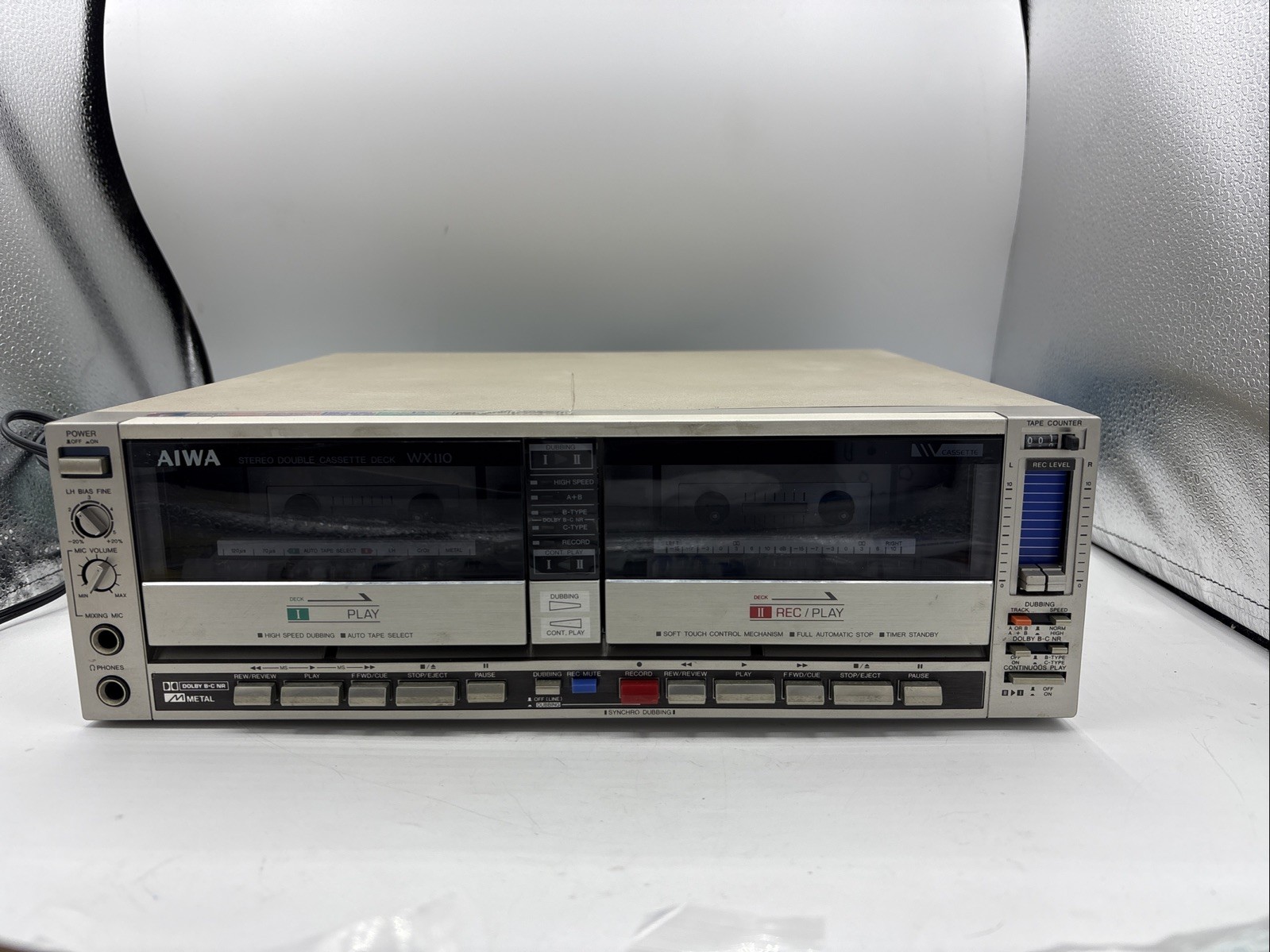
The AD-WX110U wears its late-’90s roots proudly. Compact, clean, and unassuming, it’s a far cry from the hulking dual decks of the ’80s. The black plastic chassis, silver trim, and recessed cassette wells give it a minimalist, almost clinical look—perfect for slipping onto a crowded shelf or fitting into a secondary system.
Up front, the controls are straightforward: play, record, stop, rewind, fast forward, pause. No clutter. No confusion. The LED display tracks elapsed time and mode—basic, but legible in dim light. On the back, RCA inputs and outputs let you connect a CD player, a turntable (with preamp), or a receiver. It’s a self-contained hub for analog transfer and tape-to-tape copying.
One standout feature? The erase safety tab lock. Break off the tab on a cassette, and the deck won’t record over it. A small thing, but essential for protecting irreplaceable recordings. It’s details like this that show Aiwa still cared about real-world use, even in a budget model.
No level meters. No bias switches. No high-speed dubbing. And that’s the point. The AD-WX110U doesn’t pretend to be what it’s not. It’s a plug-and-play machine that does its job without drama.
Common Issues and Maintenance
Decades of dormancy take their toll. Like any cassette deck from the era, the AD-WX110U can suffer from age-related wear—especially if it’s been sitting in a closet since Y2K.
- Worn pinch rollers: Rubber hardens over time, leading to speed wobble or tape slippage. A cleaning with isopropyl alcohol might help, but replacement is often the fix.
- Sticky transport: Old lubricants dry out, dust builds up. The mechanism may jam or hesitate. A professional cleaning and relube can restore smooth operation.
- Dirt or misalignment on the head: Oxide buildup dulls sound and causes dropouts. Regular cleaning with a swab and denatured alcohol keeps it sharp.
- Capstan corrosion: Humid storage can rust the metal shaft, affecting tape tension and speed. Light corrosion can be polished; severe cases need replacement.
The good news? The AD-WX110U uses standard components. No proprietary parts. Replacement pinch rollers and belts (if needed—some units are direct drive) are easy to find through audio restoration suppliers. It’s a repairable machine, not a disposable one.
Current Market Value and Collectibility
You won’t find collectors lining up to pay hundreds for an AD-WX110U. It’s not rare. It’s not exotic. But among cassette preservationists, analog hobbyists, and retro audio tinkerers, it’s earned quiet respect. In working condition, it typically sells for $30–$60 on eBay or Reverb—less if untested, more if pristine.
Its value isn’t in prestige, but in purpose. For anyone digitizing old tapes or making new mixtapes, the AD-WX110U is a simple, self-contained solution. No complex setup. No calibration. Just plug in, press record. Some users even modify theirs—upgrading internal wiring or adding external meters for better monitoring.
It may not be a flagship, but the AD-WX110U marks a turning point: the final wave of cassette decks built for the mass market. A time when analog gave way to digital, and manufacturers prioritized convenience over perfection.
Conclusion and Legacy
The Aiwa AD-WX110U doesn’t carry the legacy of the HS-J77 or the XK-M270. No glowing reviews. No cult following. But as one of the last dual cassette decks Aiwa released for North America, it carries quiet significance. It represents the end of an era—when mixtapes were handmade, recordings were physical, and music moved at the speed of tape.
Today, it’s a functional relic. A machine that still works, still copies, still plays. For those archiving family recordings, reliving teenage mixtapes, or just enjoying the tactile rhythm of analog, the AD-WX110U delivers. No fanfare. No compromises. Just steady, reliable service.
In a world of instant streams and infinite playlists, this unassuming deck reminds us of a slower way to love music—one tape, one side, one moment at a time.
eBay Listings



As an eBay Partner, we earn from qualifying purchases. This helps support our independent vintage technology research.
Related Models
- Aiwa AD-F990 (1993)
- Aiwa AA-8700 (1981)
- Aiwa AA-8900 (1982)
- Aiwa AD-1200 (1980)
- Aiwa AD-1250 (1982)
- Sony TC-2050SD (1978)
- Kenwood KX-3060 (1982)
- Sony TC-2130A (1974)
- Sony TC-2220 (1972)
- Sony TC-FX6 (1982)