Advent Model 201 (1971)
The machine that proved cassettes could sound as good as reel-to-reel—without the fuss.
Overview
You can almost hear the skepticism in 1971: “Cassettes? For serious listening?” Then along came the Advent Model 201, and suddenly, that little plastic shell wasn’t just for car tapes and voice memos anymore. This was the first true hi-fi cassette deck—no qualifiers, no excuses. It didn’t just flirt with high fidelity; it delivered performance that reviewers at the time said could go toe-to-toe with reel-to-reel decks costing far more. And it did it in a walnut-clad box that looked like it belonged under a good stereo system, not buried in a drawer.
Advent didn’t invent the cassette, but with the Model 201, they redefined what it could be. Where earlier cassette decks treated tape as a convenience, the 201 treated it like a medium. It was engineered from the ground up to exploit the full potential of Dolby B noise reduction and chromium dioxide (CrO2) tape—specifically the company’s own ADVOCATE Crolyn tapes. This wasn’t an afterthought; it was a system. The electronics were all Advent’s own design, the transport was built like a tank, and the specs? For 1971, they were borderline audacious.
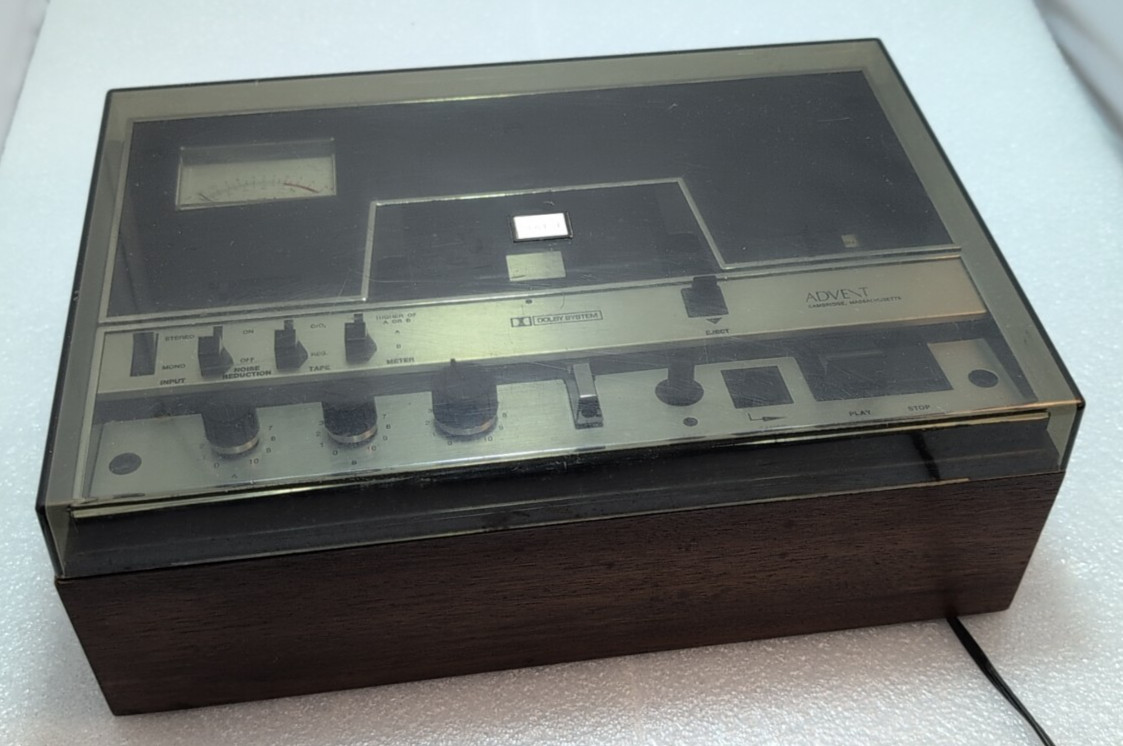
It wasn’t a flashy machine. No mirrored faceplate, no blinking VU meters. Just a clean, serious front panel and a solid wood case that said, “I’m here to play music, not impress your roommate.” And play music it did—clean, quiet, and with a frequency response that stretched deep into the highs, especially when you fed it the right tape. Owners report recordings that “were indistinguishable from the source,” whether that was FM radio, a turntable, or a pre-recorded Dolbyized cassette, which at the time were being hailed as the most important development in recorded music since stereo LPs.
Specifications
| Manufacturer | Advent |
| Production years | Introduced in 1971 |
| Speed | 1,875 ips |
| Wow and Flutter | less than 0,15% DIN weighted |
| High Speed Wind Times | 45 seconds for a C-60 |
| End of Tape Shut Off | Fully automatic. Disengages pinch roller and heads from the cassette |
| Input Sensitivity/Impedance | 35 mV (0 VU)/ 50 k Ω (nominally) |
| Input Impedance varies with setting of Input and record Level controls | from 25 k Ω to 100 k Ω |
| Output Level | 580 mV (at maximum, from 0 VU tape level) |
| Minimum Recommended Load Impedance | 2 k Ω |
| Distortion (tape dependent) | less than 0,1% ( up to and beyond tape saturation) |
| Frequency Response with Crolyn Tape | 35 - 15,000 Hz ±2 dB |
| Frequency Response with Regular Tape | 35 - 14,000 Hz ±2 dB |
| Signal-to-Noise Ratio (referenced to 0 VU, Dolby system off) with Crolyn Tape | better than 54 dB |
| Signal-to-Noise Ratio (referenced to 0 VU, Dolby system off) with Regular Tape | 48 dB |
| Noise reduction | Dolby type B |
| Noise reduction (with Dolby system On) | 10 dB at 4,000 Hz and above; 9 dB at 2,400 Hz; 6 dB at 1,200 Hz; 3 dB at 600 Hz |
| Compatible tape type | chromium dioxide (CrO2) tape |
| Bias Frequency | 110 kHz |
| Power Requirements | 120 V AC, 60 Hz |
| Power Consumption | 25 watts |
| Weight | around 15-pounds |
Key Features
The Dolby Breakthrough
The Advent Model 201 wasn’t just one of the first decks to include Dolby B—it was the first consumer cassette deck to do so. That’s a big deal. Before Dolby, cassette tape hiss was a constant, grating presence, especially in quiet passages. The Model 201’s implementation of the patented Dolby System didn’t just reduce noise—it made cassettes listenable at high volumes, in quiet rooms, on good speakers. With Dolby on and Crolyn tape, the noise floor dropped to better than 54 dB, which in 1971 was reel-to-reel territory. It wasn’t magic, but it was close.
Engineered for CrO2
While most decks of the era were designed around standard ferric tape, the Model 201 was built to exploit the superior high-frequency response and dynamic range of chromium dioxide tape. Advent didn’t just support CrO2—they championed it, selling their own ADVOCATE Crolyn tapes and tuning the deck’s bias and equalization specifically for it. The result? A frequency response that hit 15,000 Hz ±2 dB with Crolyn, compared to 14,000 Hz with regular tape. That extra 1 kHz might not sound like much, but it’s the difference between “detailed” and “airy.”
Transport Built to Last
The transport is where the Model 201 earns its “heavy duty” label. It uses a high-torque AC motor, coupled through a rubber idler to an oversized, balanced capstan flywheel. This isn’t some flimsy plastic gear train—it’s overbuilt, stable, and designed for consistent speed. The capstan assembly spins with a smoothness that belies its age, and the fully automatic end-of-tape shut-off actually disengages the pinch roller and heads, reducing wear. It’s a commercial-grade mechanism repurposed for home use, and it shows.
Solid Construction, Serious Looks
Wrapped in solid walnut, the Model 201 doesn’t try to be modern. It wants to be part of your furniture. The wood surround gives it weight and damping, and the overall build quality feels like something that could outlive its owner. It’s not huge—just substantial enough to feel serious, at around 15 pounds. There’s no flashy chrome or plastic trim; just a clean, functional faceplate with large, tactile controls. This is a machine for people who care more about sound than style.
Historical Context
The Model 201 didn’t emerge from nowhere. It was a direct response to the failure of the Advent 200, launched in 1970, which used an unreliable Nakamichi transport mechanism and was quickly pulled from the market. Advent didn’t just tweak it—they rebuilt it. The 201 wasn’t just an upgrade; it was a statement. It was the first hi-fi cassette deck, period. And it arrived at a moment when most audiophiles still looked down on cassettes as inherently inferior.
But the Model 201 changed that. Reviewers took notice—Stereo Review famously declared it could compete with more expensive reel-to-reel decks. That was unheard of. It proved that with the right engineering, a cassette could be a legitimate high-fidelity source. It helped launch the era of “Dolbyized” pre-recorded cassettes, which were suddenly being treated as serious alternatives to LPs. The deck wasn’t a massive commercial hit—Advent’s speakers sold far better—but its influence was outsized. It made the case that convenience and quality weren’t mutually exclusive.
Collectibility & Value
Today, the Advent Model 201 trades in a wide price band, and condition is everything. Listings on Hifishark.com show examples ranging from $35 for a no-cover, working unit to €350 for a “legendary” high-end example. Most fall between $40 and $80, with street value often cited around $40. A Model 201A once sold on eBay for $214, but that’s an outlier. More typical is the $45 paid for one that simply powered up—proof that even non-functional units have nostalgic value.
Parts and service materials are available, which helps. NOS spindle clutch assemblies turn up for $19, service manuals go for $29, and capacitor restoration kits are offered for $125—suggesting there’s a small but active repair community. The original Advent 200’s mechanical flaws are well-documented, but the 201 fixed those, so reliability isn’t a major concern for surviving units. Still, after 50 years, rubber idlers and dried lubricants are the real enemies. A full mechanical refresh is often needed, but the electronics, being entirely Advent’s own design, tend to hold up well.
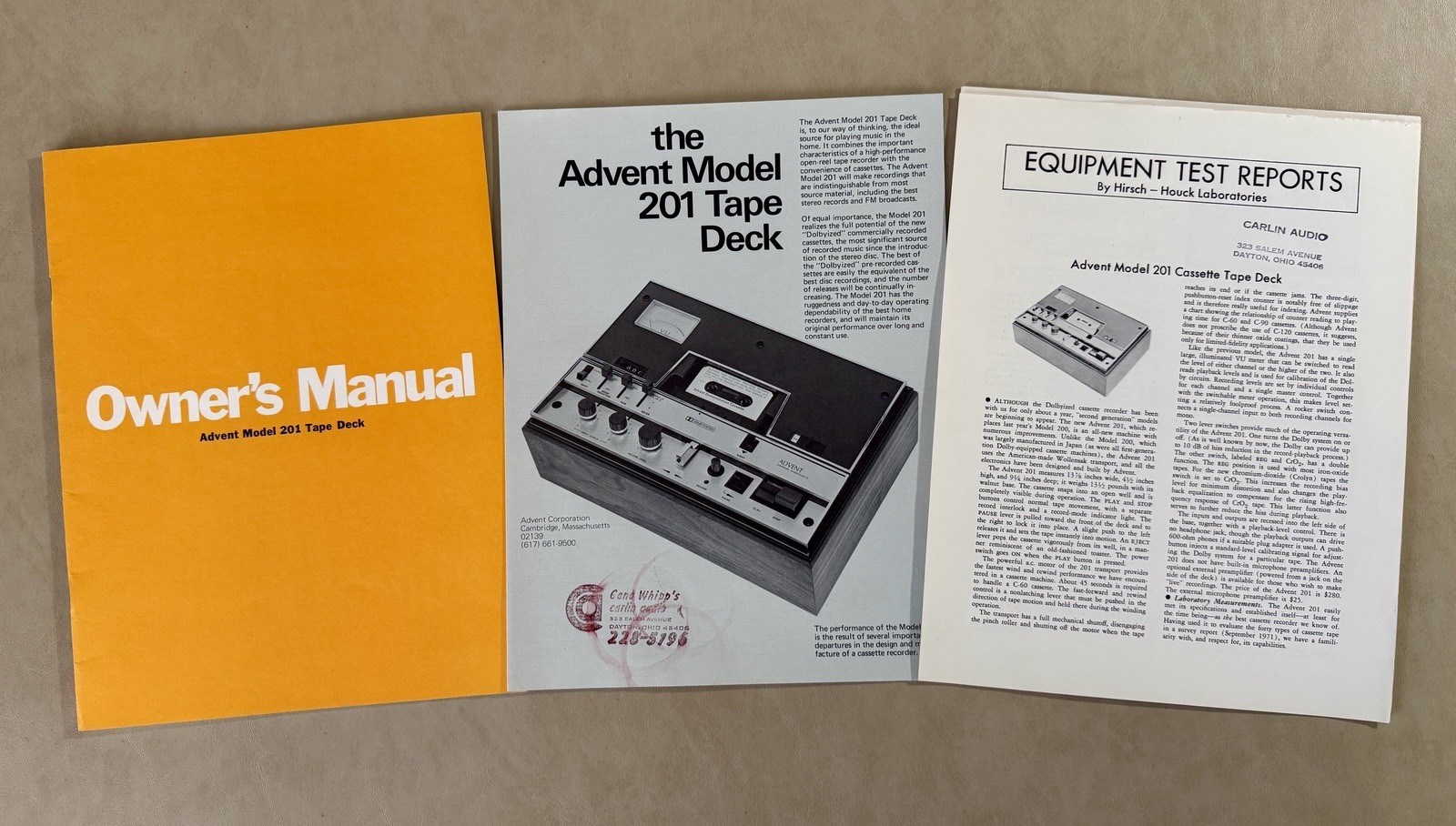
If you find one in working order, especially with the original case and manuals, consider it a win. These decks were built to last, and owners report flawless performance even after decades in storage—provided they’re brought back gently, with new belts and a cleaning.
eBay Listings


As an eBay Partner, we earn from qualifying purchases. This helps support our independent vintage technology research.