Advent 3002 (1978–1983)
A compact bookshelf speaker that punches way above its size with honest, uncolored sound—just don’t expect it to survive the decades without a rebuild.
Overview
Pull a pair of Advent 3002s out of their original packaging today and you’ll find a paradox: a speaker that was engineered with serious intent, built to deliver transparent sound in a modest footprint, yet almost guaranteed to arrive with crumbling foam and tired capacitors. These aren’t showpieces meant to gather dust—they’re working-class monitors from an era when “high fidelity” wasn’t a marketing slogan but a design mandate. And if you’re willing to roll up your sleeves, they can still deliver a startlingly neutral listen that belies their bookshelf stature.
The 3002 emerged in 1978 as part of Advent’s second wave, a family of speakers that traded the iconic “bullnose” cabinets of the original Large Advent for cleaner, more contemporary lines. Where the earlier models were statement pieces—big, bold, and physically imposing—the 3002 was designed for real rooms: dorms, apartments, dens where space mattered. But don’t mistake its size for compromise. Advent’s engineers, led by the legendary Henry Kloss, were obsessed with accuracy, and the 3002 carried that torch. It wasn’t about hyped bass or sparkly highs; it was about disappearing from the room and letting the music speak plainly.
For its time, the 3002 struck a rare balance: compact enough to fit on a shelf, yet capable of delivering a frequency response that dipped down to 48 Hz—remarkable for a box this small in the late ’70s. The design leaned on acoustic suspension principles, a hallmark of Kloss’s approach, using a sealed cabinet to tighten bass response and eliminate the flabby overhang that plagued many ported designs. The result was a speaker that didn’t boom, but *resolved*—you heard the texture of a bassline, not just its pitch. And up top, the “Direct Report” tweeter (a flush-mounted dome) avoided the harshness that plagued so many of its contemporaries, offering a smooth, non-fatiguing high end.
Still, the 3002 wasn’t the flagship. That honor went to the larger Advent /4 and /9 models. Instead, the 3002 occupied a sweet spot: more refined than the budget-minded /1, more compact than the full-sized /4, and priced to move. It was the speaker you bought when you wanted honest sound without commandeering your living room. And in its day, it delivered—reviewers noted its clarity, its imaging precision, and its ability to scale with good electronics. But like so much gear from this era, time has not been kind to its materials.
Specifications
| Manufacturer | Advent Corporation |
| Production Years | 1978–1983 |
| Model | 3002 |
| Type | 2-way bookshelf loudspeaker |
| Enclosure Type | Acoustic suspension (sealed) |
| Woofer | 8-inch |
| Tweeter | 1-inch dome ("Direct Report") |
| Frequency Response | 48 Hz - 23 kHz ±3 dB (on axis) |
| Impedance | 8 Ω nominal, 7 Ω minimum |
| Resonance | 58 Hz ±2 Hz |
| Harmonic Distortion | Less than 1% over 80 Hz (1 watt) |
| Dispersion | Less than ±1 dB variance at 30° horizontal or vertical up to 13 kHz |
| Crossover Frequency | Not specified in research, but consistent with Advent’s 2-way designs of the era (~2.5–3 kHz) |
| Cabinet Finish | Walnut grain vinyl over high-density composition board |
| Grille | Fabric-covered rectangular grille, removable |
| Dimensions (H×W×D) | 14.5 × 8.5 × 8.75 inches (368 × 216 × 222 mm) |
| Weight | Approx. 18 lbs (8.2 kg) per speaker |
| Recommended Amplifier Power | 15–100 watts |
Key Features
The Sealed Box Philosophy
At a time when many manufacturers were chasing bass extension with ported cabinets, Advent stuck with acoustic suspension—a design Kloss had championed since his days at Acoustic Research. The 3002’s sealed enclosure might not deliver the subterranean rumble of a ported tower, but it trades that for control. The bass is tight, articulate, and free of the one-note boom that plagues so many vintage speakers. It doesn’t try to be something it’s not. Instead, it integrates seamlessly with the midrange, creating a cohesive soundstage where instruments occupy distinct spaces. This isn’t a speaker for movie explosions or hip-hop thump—it’s for jazz trios, acoustic sets, and vocal recordings where timing and texture matter more than sheer output.
Direct Report Tweeter
The 1-inch dome tweeter, marketed as “Direct Report,” is flush-mounted to minimize diffraction and deliver a smooth off-axis response. Unlike the bright, edgy highs of many era speakers, the 3002’s tweeter errs on the side of restraint. It doesn’t shout, which makes long listening sessions fatigue-free. But that also means it can sound a bit laid-back if paired with warm electronics. Some owners report swapping in modern tweeters for extra sparkle, but purists argue that the original’s neutrality is the whole point. The dome itself is durable, but the crossover capacitors feeding it often aren’t—dry out here can dull the highs even if the driver is intact.
Industrial Design for Real Life
Gone is the walnut veneer and curved front of the original Large Advent. The 3002 wears a utilitarian look: straight edges, vinyl wrap, and a no-nonsense profile that blends into bookshelves rather than dominating them. It was designed for mass appeal and mass production, and that shows in the materials. The high-density composition board cabinet resists resonance better than particleboard, but it’s not pretty. And while the walnut grain vinyl was cost-effective, it doesn’t age gracefully—peeling and bubbling are common on unrestored units. Still, the compact footprint and modest depth make the 3002 one of the few vintage Advents that still fit in modern living spaces without looking absurd.
Historical Context
The late 1970s were a turning point for home audio. The wild experimentation of the ’60s had settled into a pursuit of accuracy, and Advent was at the forefront. The 3002 arrived just as the company was transitioning from its golden era under Kloss to a period of corporate ownership and cost-cutting. While the original Large Advent (1967) had redefined what a consumer speaker could achieve, by 1978 the market was crowded with competent competitors: AR, KLH, JBL, and newer players like Bose. Advent needed a line that could compete on both performance and price.
The 3002 was part of that strategy—a modernized, compact alternative to the flagship /4. It shared design DNA with the /1 and /4 but refined it with better materials and a more sophisticated crossover. Unlike the /1, which was seen as a budget model, the 3002 was positioned as a premium compact. It wasn’t as large or powerful as the /4, but it offered much of the same sonic character in a package that didn’t require dedicated speaker stands or room-thumping amplifiers.
By the early ’80s, Advent was struggling. Kloss had left, and Jensen acquired the brand, eventually shifting production toward more budget-oriented models. The 3002, along with the rest of the x002 series (2002, 4002, 5002), represented the last gasp of Advent’s engineering-driven ethos before the brand became synonymous with department store audio. Collectors now regard the 3002 as one of the better-sounding compact Advents from this transitional period—proof that even in decline, the company could still build something worth hearing.
Collectibility & Value
Finding a pair of Advent 3002s in working condition is rare. Finding a pair that haven’t been re-foamed is rarer. The foam surrounds on the 8-inch woofers degrade predictably, turning to dust within 30–40 years. Left unchecked, this leads to flapping cones, distorted bass, and eventual failure. Re-foaming is not optional—it’s the first step in any restoration. The good news? Replacement kits are available from specialty vendors like The Speaker Exchange and AV Parts. DIY repair is straightforward for beginners, and the cost is minimal: $20–$30 per speaker.
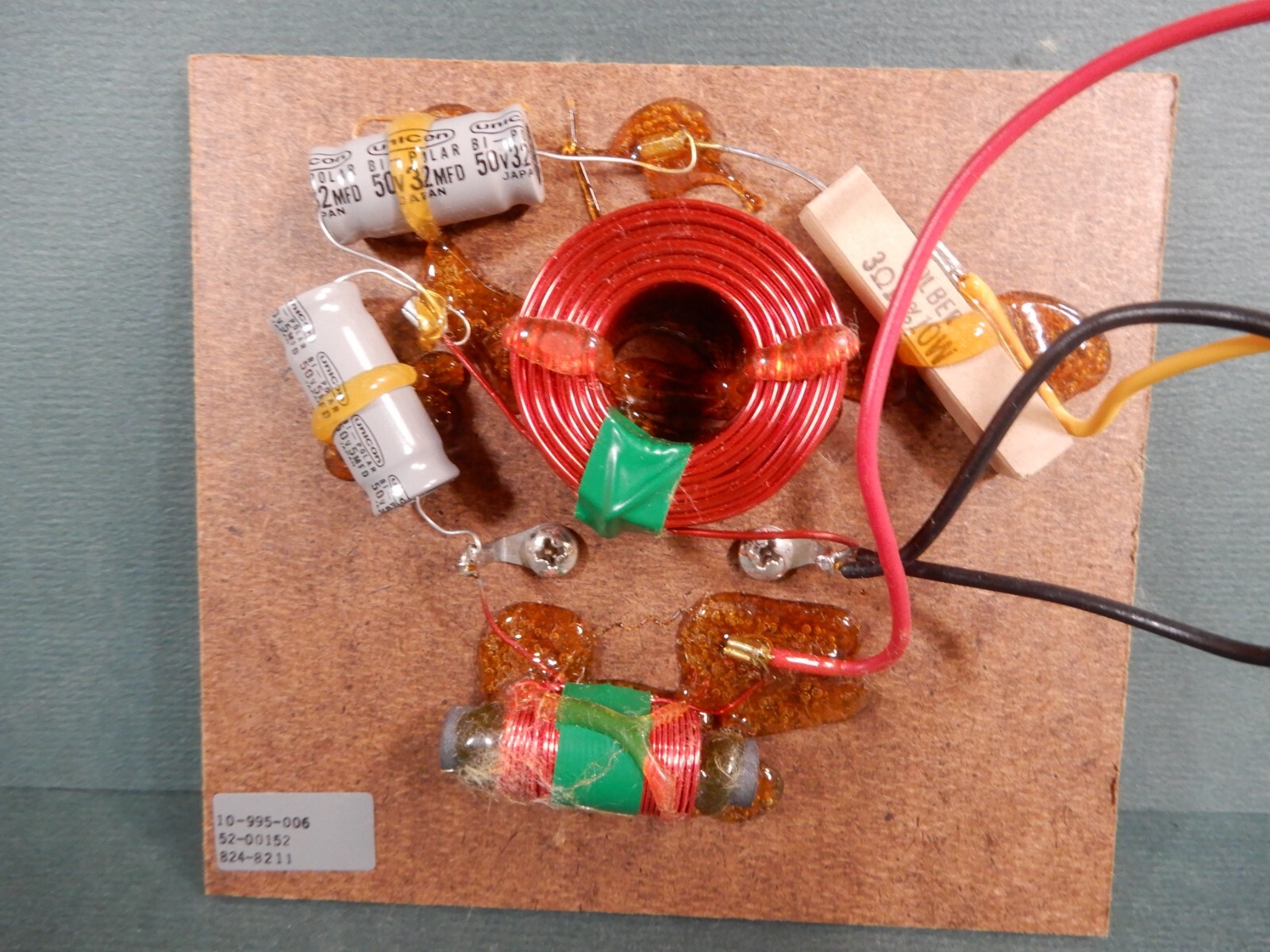
More insidious is the crossover. The capacitors, especially the electrolytics, dry out over time, leading to dull highs, weak mids, and imbalance. Recapping the crossover is strongly recommended, and while it’s not difficult, it does require soldering and basic electronics knowledge. Service technicians observe that many 3002s have already been recapped—sometimes poorly—so buyers should inspect the crossover board for mismatched parts or botched joints.
In terms of value, unrestored pairs sell for $75–$150 on eBay, often marketed as “for parts or restoration.” Fully restored pairs—with new foam, recapped crossovers, and clean cabinets—command $250–$400. Exceptional examples with original parts intact (a near impossibility) might fetch more, but they’re vanishingly rare. The walnut grain vinyl finish is not highly prized, so refinishing or painting doesn’t hurt value—unlike with vintage wood-veneer models.
Buyers should also check for cabinet integrity. The composition board can swell if exposed to moisture, and the rear terminal plates sometimes corrode. Original grilles are often missing or damaged, but replacements are available. Overall, the 3002 is not a “set and forget” vintage speaker. It’s a project—one that rewards effort with a listen that’s still competitive with modern budget monitors.
eBay Listings


As an eBay Partner, we earn from qualifying purchases. This helps support our independent vintage technology research.