Advent /2 (1973–1977)
They promised “Large Advent sound in a small box” — instead, they delivered a bright, brittle curiosity with a cult following among collectors who love flawed classics.
Overview
Plug in a pair of Advent /2s, fire up some Ella Fitzgerald, and you’ll hear exactly why this model still sparks debate: one ear notices the crisp, forward treble slicing through like a freshly sharpened knife, while the other flinches at how that same sparkle can turn into glare when the volume climbs. These aren’t the warm, balanced bookshelves Henry Kloss designed for the original Large Advents — they’re something else entirely. Marketed as a budget-friendly alternative, the /2 was supposed to distill that legendary Advent magic into a smaller, cheaper cabinet. In practice, it’s more of a cautionary tale about what happens when cost-cutting meets high expectations. The soundstage is wide, sometimes to a fault, and the bass — while punchy for a 10” basket with an 8.5” cone — never quite settles with authority. It’s not inaccurate to say the /2 sounds like someone took the DNA of the Large Advent and ran it through a slightly warped photocopier.
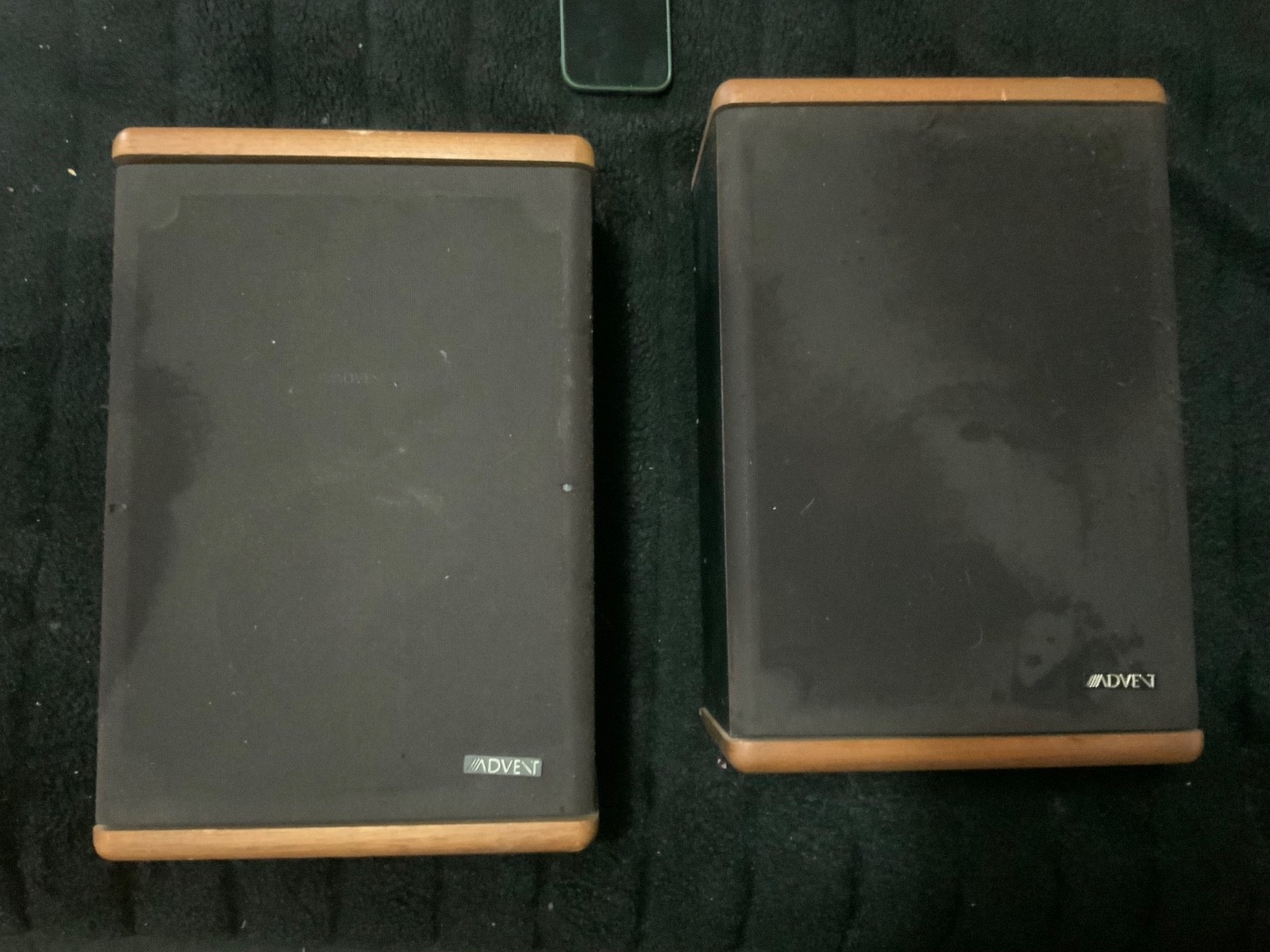
There are two versions of the /2: one in the familiar utility-style cabinet with vinyl woodgrain covering, and another in a plastic-and-steel enclosure that collectors often mistake for an outdoor speaker. The utility version is more common and generally preferred, not because it sounds better, but because it’s actually serviceable. The plastic variant, with its permanently affixed grills and inaccessible drivers, is essentially a dead end for restoration. Despite their reputation, /2s do have fans — particularly among tinkerers who enjoy the challenge of taming their aggressive highs or swapping in modern tweeters. But even at their best, they don’t fool anyone into thinking they’re listening to the real Large Advents. What they do offer is a time capsule of early ’70s speaker design, when manufacturers were chasing efficiency and modern aesthetics, sometimes at the expense of musicality.
Specifications
| Manufacturer | Advent Corporation |
| Production Years | 1973–1977 |
| Original Price | $129.95 per pair (1973) |
| Speaker Type | 2-way bookshelf |
| Woofer | 8.5" cone in 10" basket with Masonite support ring |
| Tweeter | Dual paper cone “flying saucer” array |
| Crossover Frequency | ~2.5 kHz |
| Impedance | 8 ohms nominal |
| Sensitivity | 88 dB / 1W / 1m |
| Frequency Response | 55 Hz – 18 kHz |
| Cabinet Type | Sealed (acoustic suspension) |
| Cabinet Finish | Vinyl woodgrain (utility), molded plastic with steel grille (2W variant) |
| Dimensions (H×W×D) | 13" × 8.5" × 8" |
| Weight | 18 lbs per speaker |
| Inputs | Single binding posts (no bi-wiring) |
| Grille | Fabric-covered wood frame (utility), fixed metal mesh (2W) |
| Design Origin | Henry Kloss (concept), Advent engineering team |
| Country of Manufacture | USA |
Key Features
The Dual “Flying Saucer” Tweeter Array
Staring at the front of an Advent /2, your eyes go straight to the twin paper-cone tweeters mounted in a shallow arc above the woofer — a design Advent called the “flying saucer” array. It was supposed to widen the dispersion and mimic the spaciousness of the Large Advents’ single dome tweeter. In reality, it creates a hot spot in the upper mids and lower treble, especially when the speakers are placed at ear level. The paper cones age unpredictably: some stay crisp, others turn dull or even disintegrate. Replacement is tricky, since modern equivalents don’t match the original dispersion pattern. Some owners replace them with single silk dome tweeters and modify the crossover, but purists argue that defeats the point of owning a /2 in the first place.
Compromised Woofer Design
The /2’s woofer hides a clever but flawed workaround: an 8.5” cone mounted in a 10” basket, held in place by a Masonite ring. This allowed Advent to use existing tooling while shrinking the cabinet. But unlike the Large Advent’s 10” cone in a 12” frame — which gave it legendary bass extension — the /2’s smaller cone and reduced excursion limit low-end authority. The rubber surrounds degrade over time, and because the /2 wasn’t a high-volume seller, replacement foam kits are rare. Technicians report having to modify surrounds from the Smaller Advent or even the /3 to make them fit. Once re-foamed, the woofer can sound tight and punchy, but it still lacks the weight and control of its bigger siblings.
Utility vs. Plastic Cabinet Variants
The /2 came in two distinct forms: the more common utility cabinet with vinyl-laminated MDF and removable grills, and the futuristic-looking 2W with injection-molded plastic and a fixed steel grille. The utility version wins on serviceability — you can pull the grill, access the crossover, and replace drivers without destroying the cabinet. The 2W, while visually striking, is a restoration nightmare. The grille is riveted on, and the woofer mounts behind the front baffle, making re-coning nearly impossible. Yellowing and UV damage are common in surviving 2W units, and their scarcity has made them slightly more valuable to collectors, despite their impracticality.
Historical Context
The Advent /2 arrived in 1973, just as the original Large Advents were cementing their reputation as one of the best-sounding bookshelf speakers of the era. Henry Kloss had left the company by then, but his legacy loomed large — and Advent’s marketing leaned hard into it, promising “Large Advent sound in a small box.” That claim didn’t hold up. The /2 was clearly a cost-reduced model: cheaper materials, simplified crossover, and a design that prioritized compact size over acoustic performance. Competitors like AR and KLH were also pushing smaller acoustic suspension speakers, but most stuck to single tweeters and more conservative voicing. Advent, meanwhile, doubled down on the dual tweeter gimmick, likely hoping to stand out in crowded stereo shops. The /2 shared the market with the slightly better-regarded /3, which used a single tweeter and had deeper bass, but the /2’s aggressive sound and odd dispersion made it a harder sell. By 1977, it was quietly phased out, replaced by the /4, which returned to a more conventional single-tweeter layout.
Collectibility & Value
Today, the Advent /2 is a niche collectible — not because it sounds great, but because it’s a fascinating misstep from a revered brand. Complete, working pairs in utility cabinets sell for $75 to $150 on the secondary market, with plastic 2W models fetching $125 to $200 due to their rarity. Fully restored units — recapped crossover, re-foamed woofers, cleaned grills — can go for $250 or more, especially if sold as part of a matched Advent collection. The biggest red flag for buyers is the crossover: original capacitors often leak or short, and the cheap paper cones in the tweeters are prone to delamination. If you’re buying untested, assume you’ll need to re-foam and recap — a $100–$150 investment. There are no factory replacement surrounds for the /2’s unique woofer, so restorers must adapt parts from other Advent models. Because of this, many collectors keep /2s as display pieces rather than daily drivers. They’re best suited for low-volume listening in small rooms, where their brightness can be managed with careful placement — ideally, angled down and away from reflective surfaces.
eBay Listings


As an eBay Partner, we earn from qualifying purchases. This helps support our independent vintage technology research.