Advent Large Advent (1968–1970s)
The floor-standing speaker that made high-fidelity affordable—deep, honest bass and a cult following, but only if you're ready to refoam.
Overview
Crack open the back panel of a pair of original Large Advents, and you’ll find dust, maybe a forgotten cigarette butt from a 1973 listening party, and a crossover that hasn’t aged a day—because it was built like a tank from the start. These aren’t delicate museum pieces; they’re workhorses that helped democratize hi-fi at a time when most decent speakers cost a month’s rent. When Henry Kloss launched Advent Corporation in 1967, fresh off his success with Acoustic Research, he wasn’t chasing prestige. He wanted to build a speaker that punched way above its price, and in 1968, he did: The Advent Loudspeaker—later retroactively dubbed the "Large Advent" after the Smaller Advent arrived—was a dual-driver floorstander that delivered near-AR-level performance for half the cost.
At $169.50 a pair in 1968 (about $1,400 today), the Large Advent undercut the AR-3a while matching it in bass extension and coherence. That price, combined with a no-nonsense design—walnut veneer or utilitarian vinyl wrap, 10-inch woofer, 1-inch dome tweeter—made it an instant hit with college students, young professionals, and anyone who wanted real sound without selling a kidney. They were heavy—over 50 pounds each—and shipped in massive crates, but once set up, they disappeared into the music. The bass was deep and uncolored for a ported design of its era, the midrange was clear without being bright, and the tweeter, while not silky smooth by modern standards, stayed out of the way. It wasn’t a neutral monitor, but it was honest—telling you what the recording was, not what it could be.
Three main versions emerged: the original Large Advent (OLA), the "New Large Advent" (NLA) introduced around 1978, and the later 5002/5012 models under Recoton ownership. The OLA is the one that started it all—the one found in dorm rooms, starter apartments, and estate sales across America. It defined the brand’s reputation. While later versions updated cosmetics and minor components, collectors and enthusiasts still regard the OLA as the purest expression of Kloss’s vision: a high-performance speaker built for real people.
Specifications
| Manufacturer | Advent Corporation |
| Production Years | 1968–1970s |
| Original Price | $169.50 per pair (1968) |
| Model Name | Advent Loudspeaker (later known as Large Advent) |
| Enclosure Type | Bass reflex (ported) |
| Woofer | 10-inch (25 cm) paper cone |
| Tweeter | 1-inch (2.5 cm) dome |
| Crossover | Passive, 2nd-order at 2.5 kHz |
| Impedance | 8 ohms nominal |
| Sensitivity | 89 dB (1W/1m) |
| Frequency Response | 45 Hz – 18 kHz (±3 dB) |
| Power Handling | 100 watts (peak) |
| Dimensions (H×W×D) | 24.5 × 13.5 × 11.5 inches |
| Weight | 52 lbs (23.6 kg) per speaker |
| Cabinet Finish | Walnut veneer or vinyl-covered "utility" cabinet |
| Inputs | Single pair of 5-way binding posts |
| Recommended Amplifier Power | 20–100 watts |
| Design Origin | Henry Kloss |
Key Features
The Kloss Touch: Engineering for the Masses
Henry Kloss didn’t invent acoustic suspension—that was his earlier work at AR—but with the Large Advent, he perfected the art of value engineering. The speaker used a 10-inch woofer in a carefully tuned ported cabinet, a departure from AR’s sealed designs. This allowed deeper bass extension without the massive cabinet size, making it more practical for average living rooms. The crossover was minimalist but effective: a second-order design that kept the drivers well-behaved without overcomplicating the signal path. Kloss understood that most buyers wouldn’t have exotic tube amps or isolation platforms, so he built a speaker that worked with what people actually owned—solid-state receivers, turntables with moving-magnet cartridges, and modest rooms. It wasn’t fussy. It just played.
Build and Cabinet Design
The Large Advent’s cabinet was overbuilt by necessity. The ported design required rigidity to avoid resonance, and the thick MDF-like particle board (unusual for the time) delivered. The front baffle was wide and flat, minimizing diffraction, and the grille—held on by hidden clips—was acoustically transparent. Two finishes were offered: a real walnut veneer for those who wanted furniture-grade looks, and a black or brown vinyl-wrapped “utility” version that was cheaper and more durable. Despite the different skins, the sound was identical—Advent didn’t cut corners on internals to save money on the budget model. That honesty won trust.
Bass That Earns Its Weight
At 52 pounds, these speakers aren’t light, and that mass is partly why they sound so grounded. The bass reaches down to 45 Hz with authority, a rare feat for a two-way in the late '60s. It’s not the tight, controlled slam of a modern sealed sub, but it’s natural and room-filling—perfect for jazz, rock, and orchestral recordings where warmth matters more than precision. In a decent-sized room, they can disappear sonically, leaving only the music. Some owners stack pairs for stereo imaging that rivals much more expensive systems, though that’s as much about cumulative output as true fidelity. Still, the sheer physical presence of the sound—especially on vinyl—remains compelling today.
Historical Context
The late 1960s were a turning point for consumer audio. Transistor receivers were replacing tubes, stereo was finally mainstream, and young buyers wanted gear that sounded good without costing a fortune. Klipsch, JBL, and AR dominated the high end, but their speakers were expensive and often required careful setup. Kloss saw a gap: a well-engineered, mass-producible speaker that didn’t compromise on core performance. The Large Advent wasn’t just a product—it was a statement that good sound shouldn’t be a luxury.
It arrived just as home audio exploded. The LP was king, FM radio was gaining fidelity, and stereo consoles were in living rooms everywhere. Advent capitalized on this wave, selling hundreds of thousands of pairs. Its success funded Kloss’s next ventures, including the Advent 201 cassette deck and the VideoBeam projector. But it was the speaker that defined the brand. Even after Kloss left in the mid-'70s, the Large Advent remained in production in various forms, a testament to its enduring design. Competitors like KLH and Sony offered alternatives, but none matched the Advent’s combination of depth, clarity, and price.
Collectibility & Value
Today, original Large Advents are common on the used market, but condition varies wildly. Unmodified pairs in good cosmetic shape sell for $200–$400, with walnut veneer models commanding a slight premium. The vinyl-wrapped “utility” versions are more plentiful and often cheaper, but acoustically identical—smart buyers skip the markup. Fully restored pairs with refoamed woofers and recapped crossovers can fetch $500–$700, especially if sold with original grilles and documentation.
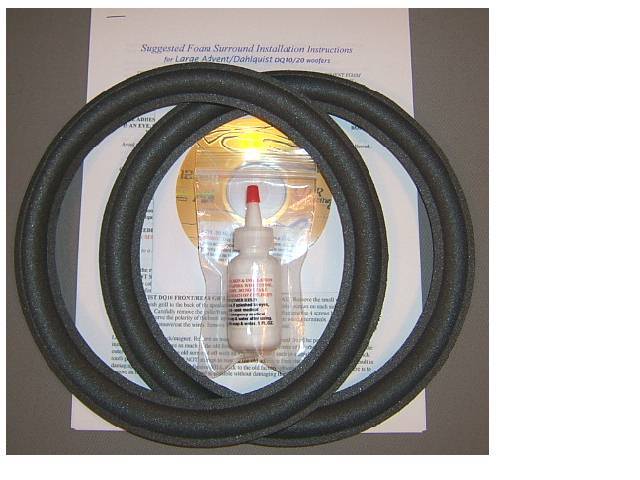
But here’s the catch: nearly every original Large Advent needs refoaming. The rubber surrounds degrade after 40+ years, leading to flapping, distortion, or complete failure. It’s not a repair for beginners—removing the 10-inch driver risks tearing the fragile cone—but DIY kits are available, and many speaker rebuilders specialize in these. The crossover capacitors, typically electrolytic, should also be replaced with film types (Solen or Mundorf) for improved clarity and reliability. Neglecting this can result in dull highs or, worse, tweeter damage.
When buying, check for cabinet integrity—water damage or pet scratches can compromise structural rigidity. Look for original drivers; replacements may not match the voicing. And avoid “modified” pairs unless you know exactly what was changed. These speakers were designed as a system—their magic is in the balance. A clean, unmodified pair that hasn’t been refoamed yet is often a better starting point than a poorly “upgraded” one.
eBay Listings



As an eBay Partner, we earn from qualifying purchases. This helps support our independent vintage technology research.