ADC ZLM (1977–1984)
When you drop the needle and the room fills with silence so deep you can hear the space between the notes—then the music starts, and it feels like it was never gone.
Overview
The ADC ZLM doesn’t announce itself with flash or bravado. It slips into the groove like a secret, revealing its depth only when the system is dialed in just right. Born in 1977 at the peak of analog’s golden age, it wasn’t just another moving-magnet cartridge—it was a statement. Audio Dynamics Corporation, led by Peter Pritchard, had already shaken things up with the XLM series, but the ZLM was the refinement, the culmination. It carried forward the “Induced Magnet” design—a lineage tracing back to Pritchard’s days at General Electric—and refined it with obsessive attention to tip mass, compliance, and record wear. This wasn’t just about sounding good; it was about preserving the artifact while extracting every last whisper of information from the groove.
At a time when many cartridges still clung to spherical tips and higher tracking forces, the ZLM arrived with a radical proposition: track lighter, wear less, resolve more. Its nude aliption diamond—0.0002" scanning radius, 0.0015" bearing radius—was a marvel of micro-engineering, blending the vertical reach of a Shibata with the lateral precision of an elliptical. Mounted on a tapered cantilever and polished with a proprietary method, it promised not only extended high-frequency response but also dramatically reduced record wear. ADC backed this up with real data: each ZLM shipped with its own signed frequency response curve, a rare touch that told buyers this wasn’t mass-produced guesswork—it was calibrated performance.
But here’s the catch: the ZLM doesn’t forgive mismatched partners. With a compliance rating that borders on hyperactive and a recommended tracking force of just 0.5 to 1.25 grams, it demands a low-mass tonearm. Pair it with something heavy or stiff—a common Rega or SME setup of the era—and it’ll skip, bounce, or worse, mistrack on warps. But mate it with the right arm—say, the Grace 707 or ADC’s own Infinity Black Widow—and suddenly the veil lifts. Instruments separate with surgical clarity, soundstage depth becomes three-dimensional, and transients snap with a speed that still feels modern. It’s not warm or romantic; it’s neutral, open, and startlingly detailed—closer to what some might call “transparency” than mere “fidelity.”
And yet, for all its technical prowess, the ZLM never feels clinical. There’s a liquidity to the midrange, a way it handles vocal textures and acoustic decay that keeps it from sounding sterile. It pulls you in not with exaggeration but with absence—of coloration, of grain, of anything that shouldn’t be there.
Specifications
| Manufacturer | Audio Dynamics Corporation (ADC) |
| Production Years | 1977–1984 |
| Original Price | $399 (equivalent to ~$1,900 today) |
| Type | Moving Magnet (Induced Magnet design) |
| Output Voltage | 3.5 mV nominal |
| Frequency Response | 20Hz – 20kHz ±1.0dB; 20Hz – 26kHz ±1.5dB |
| Channel Separation | 25 dB minimum at 1kHz |
| Channel Balance | Within 1dB at 1kHz |
| Tracking Force | 0.5 – 1.25 grams |
| Compliance | High (exact figure not published, but consistently described as very high) |
| Stylus Type | Nude Aliptic diamond |
| Stylus Tip Dimensions | 0.0002" scanning radius × 0.0015" bearing radius |
| Cantilever | Aluminum, tapered design |
| Weight | 5.75 grams |
| Load Impedance | 47kΩ recommended |
| Capacitance | 100–200pF recommended |
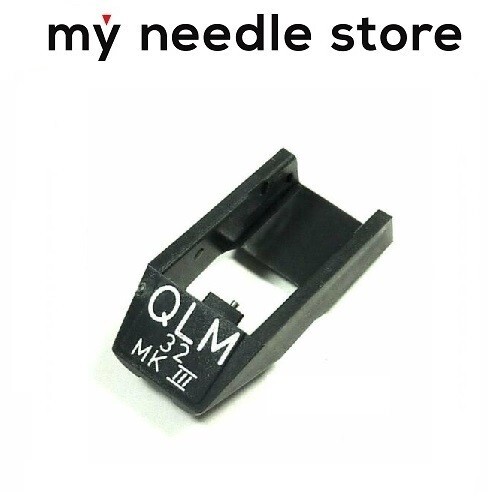
| Replacement Stylus | Available (ZLM-RS) |
| Mounting | ½-inch standard |
| Made In | USA |
Key Features
The Aliptic Stylus: A Shape Ahead of Its Time
The ZLM’s defining innovation was its aliption stylus—a hybrid profile that combined the best traits of elliptical and Shibata shapes. While elliptical tips improved stereo channel separation over spherical ones, they still struggled with high-frequency extension and inner groove distortion. Shibata profiles offered better contact but required precise alignment and often wore down faster. The aliption tip split the difference: a narrow, elongated contact line that traced the groove walls with exceptional fidelity, especially in the treble. Its 0.0002" scanning radius allowed it to read modulations that most contemporary cartridges simply glossed over. More than just a shape, it was a philosophy—ADC believed that lower tip mass and better geometry could reduce wear while increasing resolution. Independent tests at the time, including those cited in High Fidelity magazine, supported this claim, showing significantly less record degradation after repeated plays compared to leading competitors.
Induced Magnet Design: The ADC Signature
Unlike conventional moving magnet designs where tiny magnets are attached to the cantilever, ADC’s “Induced Magnet” system used a fixed magnet and a moving iron armature. This reversed the typical arrangement, reducing moving mass and improving transient response. The result was a cartridge that felt more dynamically alive—percussion had snap, plucked strings had bite, and piano hammers struck with palpable force. Because the magnet wasn’t moving, there was less magnetic hysteresis, contributing to lower distortion and a cleaner signal path. This design also made the ZLM more consistent across production units, as the fixed magnet could be precisely aligned during assembly. It wasn’t a gimmick; it was a fundamental rethinking of how a cartridge should generate signal, and it gave the ZLM a distinct character—fast, clean, and dynamically expressive.
Individual Calibration and Testing
Few cartridges of the era came with their own frequency response curve, signed by the technician who tested it. The ZLM did. Each unit was individually evaluated across the audible spectrum, ensuring that what left the factory met ADC’s tight tolerances. This wasn’t marketing theater—it was quality control taken seriously. Collectors today report finding original boxes with these curves still attached, some showing deviations as small as ±0.5dB across 20Hz–20kHz. That level of consistency was rare in an age when many high-end cartridges were hand-assembled with variable results. It also meant that when a ZLM performed well, you could trust it wasn’t a fluke—it was engineered that way.
Historical Context
The late 1970s were a turning point for high-end audio. Audiophiles were no longer satisfied with “good enough” stereo; they wanted transparency, detail, and realism. The rise of publications like The Absolute Sound and Stereo Review fueled demand for reference-grade components, and phono cartridges became a battleground for technological supremacy. In this climate, ADC positioned the ZLM as the successor to the critically acclaimed XLM series—a cartridge that had already earned praise for its low record wear and neutral sound. The ZLM wasn’t just an incremental upgrade; it was a response to real-world feedback. After observing how the XLM MK II performed in long-term record wear tests, ADC engineers focused on reducing tip mass and refining stylus geometry. The aliption tip was the result.
Competitors at the time included the Shure V15 series, the Denon DL-103, and the Grado Supreme. The Shure offered replaceable styli and rugged build, but with a slightly more colored tonal balance. The Denon, a moving coil, had exceptional detail but required a high-gain preamp and careful loading. The Grado, while dynamic, leaned warm and lacked the ZLM’s treble extension. ADC carved its niche by appealing to purists who valued accuracy and record preservation equally. It found favor among reviewers and serious listeners—Harry Pearson, founder of The Absolute Sound, reportedly used ADC cartridges in his early reference systems.
But the ZLM also arrived at a precarious time. By the early 1980s, the vinyl market was beginning to wane under pressure from the CD. High-end analog gear remained a niche, and ADC, despite its engineering pedigree, struggled to maintain momentum. The company was sold in the late 1970s, and while the ZLM remained in production until 1984, it never received the kind of ongoing development seen from Japanese rivals. Still, its reputation endured—discussed in forums, praised in vintage reviews, and sought after by those who understood its strengths.
Collectibility & Value
Today, the ADC ZLM occupies a curious space: revered by those who know it, overlooked by many who don’t. On the open market, prices vary widely based on condition, originality, and whether the aliption stylus is still intact. A fully functional ZLM with original stylus typically sells for $300–$500, while NOS (New Old Stock) units with documentation and calibration curves can fetch $700 or more. Given its original $399 price tag—already premium in 1977—that’s a modest appreciation, especially compared to cartridges like the Koetsu or Denon that command several times their original cost.
The biggest risk in buying a used ZLM isn’t electrical failure—it’s stylus wear. The aliption tip, while durable for its size, is extremely fine. If the cartridge was tracked too heavily or used on warped records, the tip may be damaged or worn down, robbing it of its high-frequency clarity. Replacement styli (ZLM-RS) are available from specialty vendors like LP Gear, but they’re not cheap—running $150–$200. A full recertification, including alignment and output testing, can add another $100–$150.
Mechanically, the ZLM is robust. The aluminum body and fixed magnet design are less prone to failure than moving-magnet counterparts with delicate suspensions. However, the terminals can corrode over time, especially if stored in humid environments. Owners report that cleaning the contacts and checking coil continuity often resolves minor channel imbalance issues. The low mass and high compliance also mean that mounting hardware must be secure—loose screws or a warped headshell can throw off alignment and degrade performance.
For collectors, the ZLM is more than a playback tool—it’s a snapshot of a moment when analog engineering was pushing boundaries. It represents a philosophy: that accuracy doesn’t have to come at the expense of record longevity, that transparency is possible without sterility. It’s not the easiest cartridge to set up, nor the most forgiving, but for those willing to invest the time, it remains a revelation.
eBay Listings



As an eBay Partner, we earn from qualifying purchases. This helps support our independent vintage technology research.