ADC XLM MK II (1975–1978)
That moment when the bass tightens up, the highs breathe, and you swear your old records just got a second life—this is the Mk II magic.
Overview
If you've ever flipped through a stack of used cartridges at a flea market and felt that quiet pull toward one with gold trim and a black body, chances are it was an ADC XLM MK II. It’s not the flashiest, nor the most famous, but among those who’ve actually wired one up and tracked a side of Coltrane with it, the Mk II has earned a kind of quiet reverence. It’s not just a cartridge—it’s a statement in analog clarity, wrapped in a design that knew exactly what it was doing in the mid-70s. Manufactured by Audio Dynamics Corporation (ADC), the XLM MK II was built between 1975 and 1978, a narrow window that somehow captured the sweet spot of ADC’s engineering before ownership shifted and the sound changed.
What sets it apart isn’t just the specs—it’s the *sound*. Owners consistently refer to its “famous signature sound,” a phrase that pops up again and again in forums and reviews like a well-worn testimonial. It’s described as more musical than its successor, the Mk III, with a balance that feels neither hyped nor shy. It doesn’t shout; it tells the story. And while the XLM line includes the Mk I, Mk II, and Mk III, the Mk II stands as a kind of pivot point—literally and figuratively. It was a redesign of the Mk I, intended to be more accessible, a “Mk I for the masses,” as one Vinyl Engine user put it. Part of that refinement came from using a slightly lower compliant stylus to prevent suspension collapse, a tweak that made it more reliable without sacrificing performance.
The cartridge is technically a moving magnet (MM) stereo pickup, but calling it just that feels like calling a Stradivarius a “wooden instrument.” It’s the details that matter: the nude Diasa stylus, the hollow cantilever, the Omni-Pivot System—all working together to keep the tip mass low and the tracking true. And true it is. Whether you’re spinning jazz, classical, or punk, the Mk II handles transients with a poise that makes you forget you’re listening to a 5-gram cartridge from the 70s. It’s not perfect—no vintage gear is—but when it’s aligned right and the stylus is fresh, it delivers a listening experience that feels less like playback and more like presence.
Specifications
| Manufacturer | ADC (Audio Dynamics Corporation) |
| Phono input type | MM (Moving Magnet) |
| Stereo / Mono | Stereo |
| Frequency Response | 15 Hz - 24 kHz ±1,5dB |
| Sensitivity/Output Voltage | 0,9 mV/cm/sec. |
| Channel Balance | 1 dB |
| Channel Separation | 26 dB at 1 kHz; 15 dB at 10 kHz |
| Inductance | 350 mHy |
| Resistance | 625 ohms |
| Load Resistance | 47 kohms |
| Tracking Force | ¾ - 1 ½ grams |
| Stylus Assembly | Nude Diasa, Elliptical .0003" x .0007" Diamond, mounted to a hollow cantilever. |
| Cartridge Body Color | Black and Gold |
| Stylus Color | Black |
| Shielding | Annealed MuMetal Case |
| Cartridge Weight | 5,75 grams |
| Stylus model designation | RXM-II |
Key Features
The Omni-Pivot System
At the heart of the Mk II’s performance is the Omni-Pivot System—a design meant to minimize friction and maximize freedom of movement in the stylus assembly. This wasn’t just marketing fluff; it translated into real-world tracking ability, especially on worn or eccentric pressings. The idea was to let the stylus pivot with near-ideal neutrality, reducing distortion and inner-groove smearing. Combined with the low effective tip mass, it gave the Mk II an agility that many contemporaries lacked. It’s one reason users report such high definition in musical passages, even at lower tracking forces.
Diasa Stylus and Hollow Cantilever
The RXM-II stylus is where the magic really happens. It uses a Diasa stone—a diamond tip fused to a sapphire base, highly polished and elliptical in shape, with scanning radii of .0003" x .0007". This wasn’t just a fancy name; the Diasa construction improved wear resistance and high-frequency response. Mounted on a non-tapered hollow cantilever made of thin-wall alloy tube, the assembly achieves a remarkably low tip mass, which helps it follow groove walls with precision. The result? Cleaner highs, better separation, and less record wear over time—something owners appreciate, especially if they’re spinning original pressings they don’t want to degrade.
Induced Magnet Design
While classified as a moving magnet (MM) cartridge, the Mk II uses an induced magnet approach to reduce mass in the moving system. This subtle distinction meant that instead of carrying the magnet with the stylus, the design used a lightweight coil setup influenced by a fixed magnet, improving responsiveness. It’s a clever workaround that helped ADC balance output and agility—delivering a respectable 0.9 mV/cm/sec output without the sluggishness that sometimes plagued higher-output MM carts.
Build and Shielding
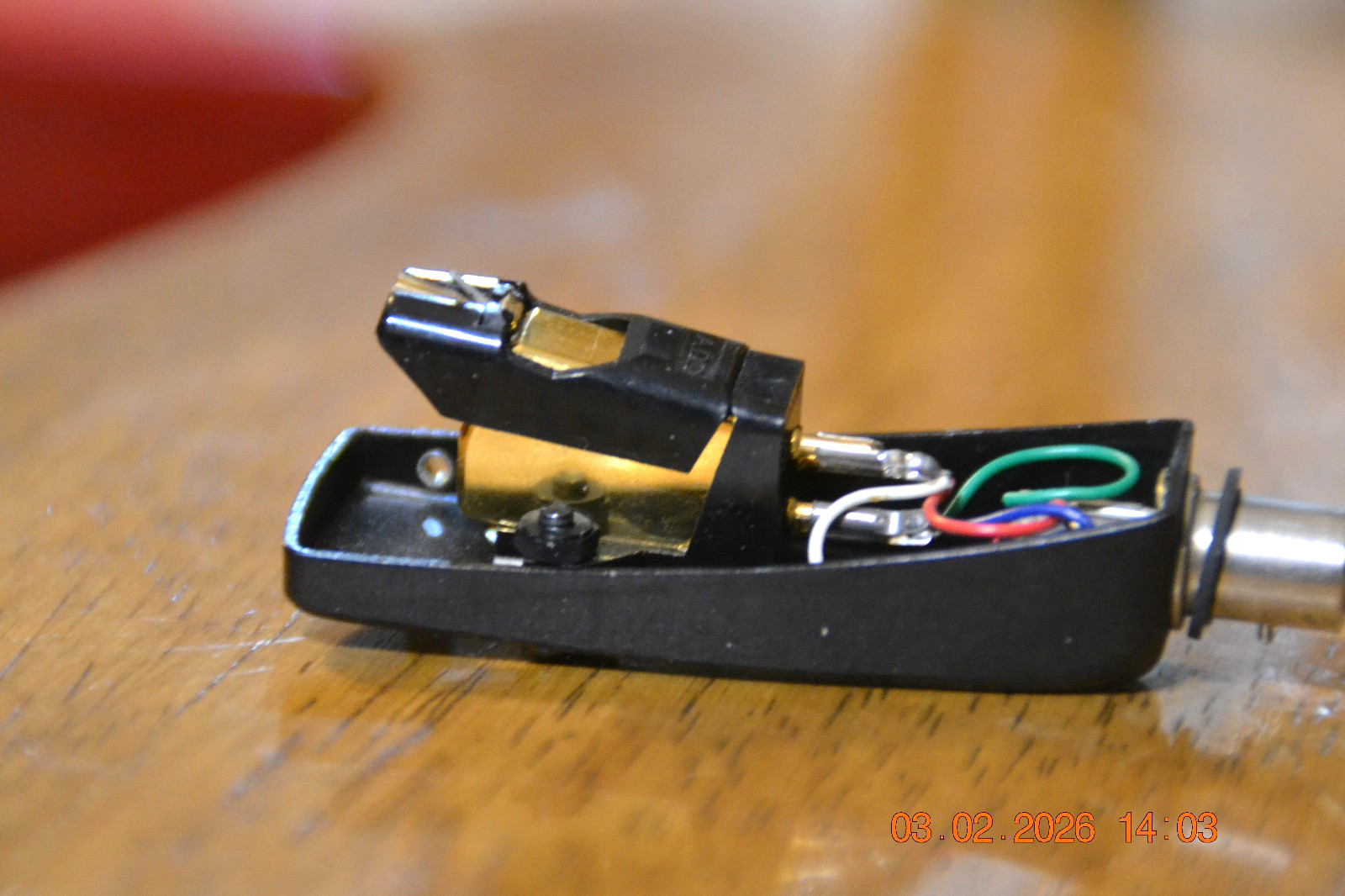
The cartridge body, a mix of metal and plastic, wears its 70s lineage proudly: black with gold accents, understated but not invisible. It’s not the most rugged-looking thing out there, but the annealed MuMetal case provides effective shielding against stray magnetic fields, a real concern in crowded audio racks. At 5.75 grams, it’s light enough to work with a wide range of tonearms, though proper alignment is non-negotiable. The black stylus assembly blends in, but it’s the engineering underneath that counts—and that’s where the Mk II shines.
Historical Context
The ADC XLM MK II arrived in 1975 as part of a lineage that included the Mk I and would later be followed by the Mk III. It was positioned as a refined, more accessible version of the original Mk I—some called it the “Mk I for the masses”—with a slightly stiffer suspension to avoid the risk of collapse under improper setup. This wasn’t just a minor tweak; it reflected ADC’s effort to make a high-performance cartridge that could survive real-world use.
But the era didn’t last. By the time the Mk III was introduced, ADC had been newly acquired by BSR, and the design philosophy shifted. The Mk III departed from the “famous signature sound” of the Mk II, moving toward a different voicing that some found less musical. That shift cemented the Mk II’s reputation as the last word in the classic ADC sound—a cartridge that balanced precision with soul, before corporate changes steered the brand in another direction. It was discontinued shortly after production ended in 1978, and while variants like the XLM MK II Improved and XLM Super MK II followed, the original Mk II remains the benchmark for many.
Collectibility & Value
Today, the ADC XLM MK II is discontinued and no longer available new, making it a sought-after piece for analog enthusiasts. The market is fragmented, with prices all over the map depending on condition and completeness. A bare cartridge body can go for as little as $50, while a full unit with a new Improved MKII stylus and case has sold for $243.74. Curated listings show prices ranging from €35 to €280, with US Audio Mart asking $195 and an eBay listing from August 2025 showing $149.99—so condition, provenance, and whether the stylus is original or replaced make a huge difference.
One thing owners warn about: replacement styli aren’t cheap. The RXM-II stylus, critical to maintaining the cartridge’s performance, is described as “not inexpensive,” and while third-party replacements exist, purists insist on original or high-grade equivalents to preserve the sound. That said, many consider the Mk II “a sound investment,” especially given its excellent tracking, channel separation, and low record wear—qualities it shares with the more advanced XLM MkIII Improved. If you find one in good shape with a fresh stylus, it’s not just a nostalgic buy; it’s a working tool that can still outperform modern mid-tier cartridges.
eBay Listings



As an eBay Partner, we earn from qualifying purchases. This helps support our independent vintage technology research.