ADC XLM Improved MKII
That moment when the bass locks in, the soundstage opens wide, and you forget you're listening to vinyl—this is why people chase the ADC XLM Improved MKII.
Overview
There’s a reason old-school analog heads still whisper the name “ADC XLM Improved MKII” like it’s a secret handshake. This isn’t just another moving magnet cartridge from the golden age of vinyl—it’s one of the few that didn’t just keep up with the Shure V15 Type III, it went head-to-head with it. Built by Audio Dynamics Corporation, the XLM Improved MKII carved its reputation in the late '70s and early '80s as a high-compliance, low-mass contender that brought a spacious, dynamic presence to the groove. It wasn’t the cheapest option—costing $100 in 1980, a full 25% more than the Shure M91ED—but those who bought it weren’t shopping on price alone.
What set it apart wasn’t just the specs, but the experience. Owners report a balance of warmth and precision that feels alive—bass that’s tight without being lean, mids that breathe, and highs that shimmer without etch. It was optimized for tonearms that could handle high compliance, like the SME Series III or the legendary Infinity Black Widow, where its 65 x 10⁻⁶ cm/dyne compliance could really sing. And while it didn’t have the replaceable stylus modules of the V15, the “Improved” designation marked a meaningful upgrade in suspension and tracking refinement over earlier XLM models.
The XLM Improved MKII wasn’t a mass-market player, but it was respected. The Boston Audio Society tested the 1975 XLM II and found it quieter than the Shure V15 Type III—no small feat—and while that wasn’t the Improved MKII specifically, it speaks to the engineering pedigree flowing through the line. This was a cartridge built for those who wanted more than just fidelity: they wanted engagement, texture, and a sense that the music was happening in the room.
Specifications
| Manufacturer | ADC (Audio Dynamics Corporation) |
| Technology | Induced Magnet |
| Product type | Moving Magnet (MM) Phono Cartridge |
| Tracking force range | 0.75 - 1.5 g |
| Output voltage | 5.5 mV per cm/S |
| Compliance | 65 x 10^-6 cm/Dyne |
| Stylus tip shape | Nude Elliptical Diamond |
| Stylus tip dimensions | 0.0003 x 0.0007 inch (0.3 x 0.7 mil) |
| Cantilever | Thin-wall alloy tube |
| Frequency response | 10Hz - 20kHz ±1dB, 20kHz - 24kHz ±1.5dB |
| Channel separation | 28 dB at 1kHz, 18 dB at 10kHz |
| Inductance | 580 μH (1kHz) |
| Resistance | 820 Ohms |
| Recommended load resistance | 47,000 Ohms |
| Recommended load capacitance | 275 pF |
| Weight | 5.75 g |
| Output balance | 1.5 dB max. difference |
Key Features
Patented Low-Mass Induced Magnet Design
ADC didn’t just clone the competition—they engineered around it. The XLM Improved MKII uses a patented induced magnet system that keeps moving mass exceptionally low, which helps with tracking and transient response. Unlike some moving magnets that feel sluggish in the upper mids, this one stays nimble, translating to a sense of speed and clarity that feels more “moving coil” than MM. The 580 μH inductance places it in a sweet spot for compatibility with standard MM inputs, especially when paired with the recommended 275 pF loading.
Improved Suspension System
The “Improved” in the name isn’t marketing fluff—it refers to a real upgrade in the suspension. This tweak enhanced tracking stability and reduced resonance issues that plagued earlier versions. Combined with the 65 x 10⁻⁶ cm/dyne compliance, it meant the cartridge could ride the groove with authority without bottoming out, even on warped pressings. But that high compliance demands respect: it needs a tonearm that can handle it. Pair it with a low-mass arm, and it sings. Stick it on something too stiff, and you’ll lose the magic.
Nude Elliptical Stylus on a Thin-Wall Alloy Cantilever
The stylus is a nude elliptical diamond with precise 0.3 x 0.7 mil tip dimensions—small enough to dig deep into the groove, shaped to trace both vertical and lateral modulations with confidence. Being “nude” means the diamond is mounted directly to the cantilever without a metal shank, reducing mass and improving high-frequency response. The thin-wall alloy tube cantilever further cuts weight while maintaining rigidity, a combo that pays off in detail retrieval and smoothness. Users have praised the “bass/mids/treble/detail/texture/smoothness” balance, and this construction is a big reason why.
Headshell-Ready Body with Threaded Mounting
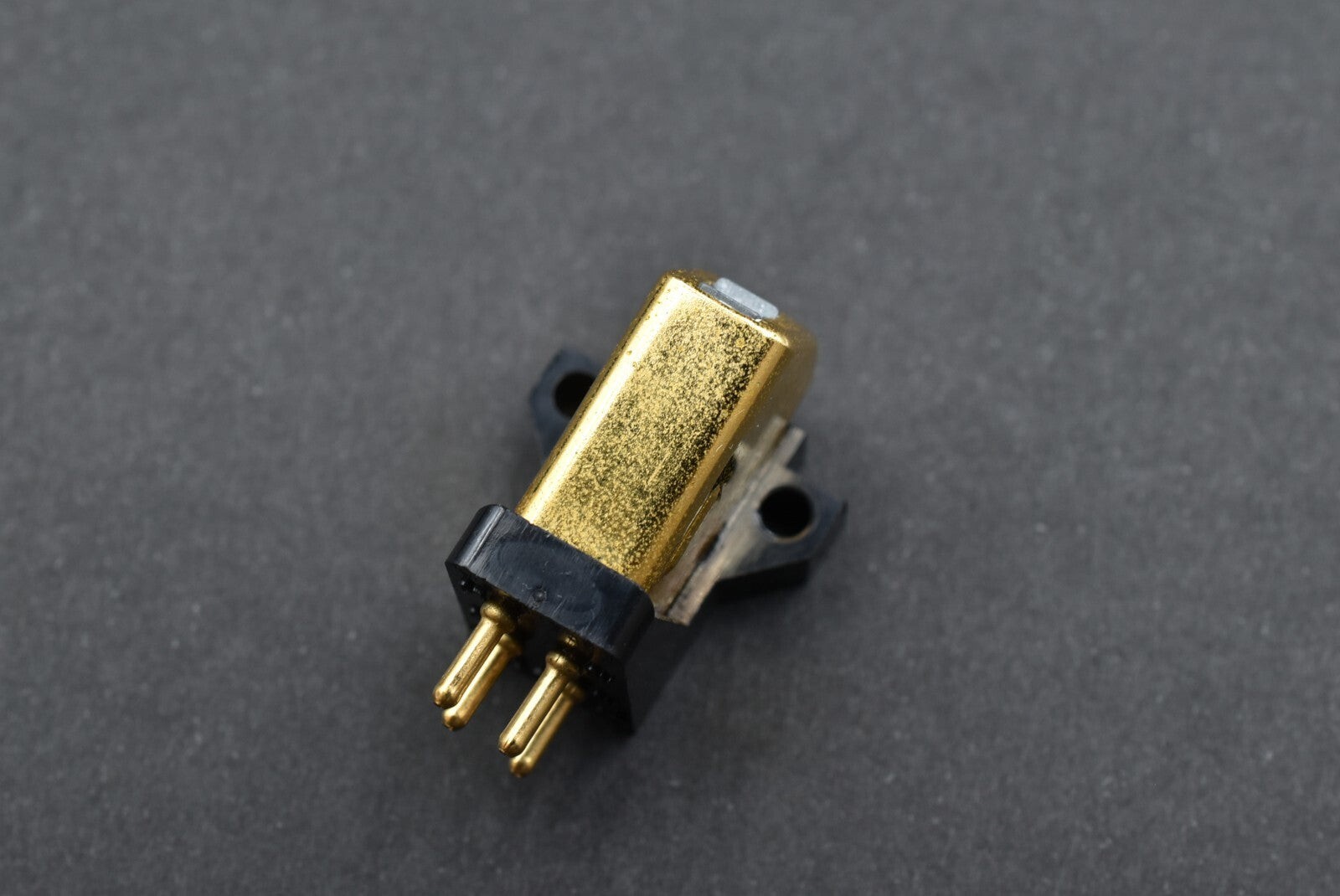
The cartridge body includes threaded holes for direct headshell attachment—no screws through the top, no wobble. It’s a small thing, but it speaks to the build quality. At 5.75 grams, it’s light enough for high-compliance arms but substantial enough to feel solid. There’s no fancy housing or exotic materials, just a clean, functional design that gets out of the way of the music.
Historical Context
The ADC XLM Improved MKII existed in the shadow of the Shure V15 series, but it wasn’t playing defense. It was positioned as a direct competitor to the V15 Type III, offering similar performance with a different engineering philosophy. While Shure leaned into replaceable styli and mass-market reliability, ADC focused on low-mass precision and compliance. In 1980, it carried a $100 price tag—25% more than the Shure M91ED—suggesting it was aimed at serious listeners willing to pay for refinement. The earlier XLM II, tested in 1975 by the Boston Audio Society, was found to be quieter than the V15 Type III, a notable achievement that likely paved the way for the Improved version. The “Improved” designation marked a generational update across the XLM line, including models like the XLM I, II, III, and Integra, offering better suspension and tracking for those who wanted to upgrade without replacing the entire cartridge body.
Collectibility & Value
The ADC XLM Improved MKII is long discontinued, and finding one in good condition requires patience. The biggest hurdle? The stylus. A new genuine replacement runs between $150 and $208, with one listing spotted at €85 in April 2025—still a steep cost for a single part. That makes used cartridges with the original stylus a better value, though prices vary widely: listings show used units with stylus ranging from $128.99 to a previous asking price of $324.99, with a typical market range now around $175 to $244. The cartridge body alone trades between $80 and $230, which might make sense if you’re pairing it with a new stylus, but given the cost, it’s rarely a bargain.
Stylus replacement isn’t just expensive—it’s a commitment. There’s no user-serviceable module; alignment and tracking force need precision. And since the Improved MKII is no longer in production, there’s no guarantee of future support. Collectors value it not as a daily driver, but as a period-correct high-end piece for systems that can do it justice. It’s not the easiest cartridge to live with, but for those who love its sound, it’s worth the trouble.
eBay Listings


As an eBay Partner, we earn from qualifying purchases. This helps support our independent vintage technology research.