ADC SS315 (1980–1990)
A fluorescent glow, a hiss of pink noise, and 20 sliders waiting to carve your room’s sonic soul—this is equalization as ritual.
Overview
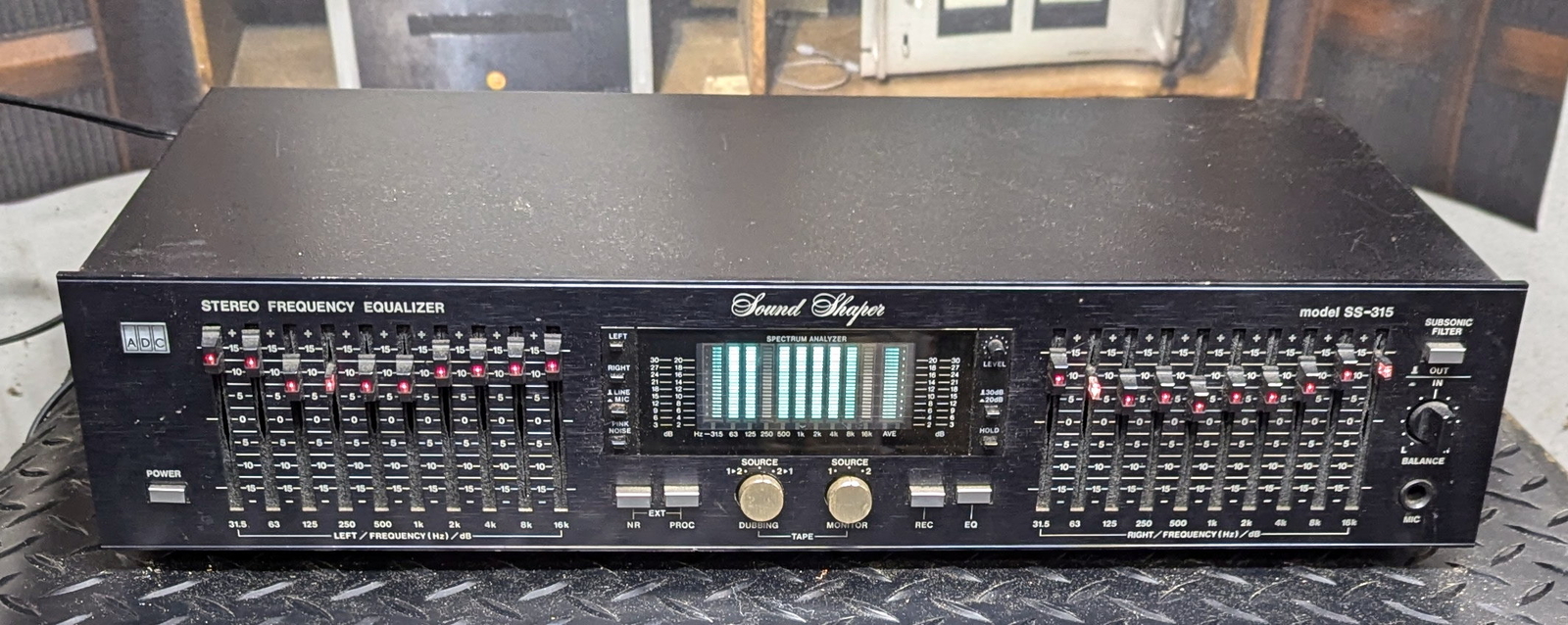
Turn the ADC SS315 on, and the front panel comes alive with a soft green phosphor glow—ten vertical bars per channel, flickering in response to sound like flames in a cathedral of acoustics. It’s not just an equalizer; it’s a diagnostic machine, a tuning fork for your entire system, wrapped in a brushed-black steel chassis that says “serious gear” before you even touch a knob. Built during that curious late analog era when consumer audio started borrowing pro tools, the SS315 was one of the first affordable dual 10-band graphic equalizers with a built-in real-time analyzer (RTA), complete with a pink noise generator and a matching electret condenser microphone. That means, in theory, you could calibrate your speakers to your room and flatten the frequency response with scientific precision. In practice? It’s a love letter to obsession—one that demands patience, a good pair of ears, and a tolerance for neighbors who might eventually plot your demise after hours of test tones.
ADC, or Audio Dynamics Corporation, had already built a reputation in the 1960s and ’70s for high-quality MM cartridges and the cult-favorite Accutrac turntable before pivoting into equalizers in the 1980s. The SS315 landed right when home audiophiles were starting to care about room acoustics, but lacked the tools to do anything about it. This unit filled that gap—cheap enough for serious hobbyists, sophisticated enough to feel like pro gear. It wasn’t flashy, but it was functional, rugged, and packed with features that were still rare outside broadcast studios. The dual 10-band EQ offers ±15 dB of cut and boost across standard ISO frequencies (31Hz to 16kHz), with left and right channels fully independent. That alone made it a favorite for tweaking stereo imaging or compensating for mismatched speakers. But the real draw—the thing that turns casual users into midnight tinkerers—is the RTA display. Plug in the mic, hit the noise button, and watch the fluorescent bars dance, revealing every peak and dip in your listening space.
And then there’s the sound. Despite its clinical purpose, the SS315 doesn’t neuter music. It’s transparent in a way that few budget EQs manage, with a measured THD of just 0.008%—astonishing for a consumer-grade unit in the 1980s. When you bypass the EQ, the signal path stays clean. When you engage it, the changes are surgical but not sterile. It won’t add warmth like a tube preamp, nor will it color your sound unless you push the sliders hard. That neutrality is its strength: it’s a tool, not a toy. But let’s be honest—most people didn’t buy this to achieve textbook flat response. They bought it to fix boomy bass in a shoebox apartment, to tame a pair of bright bookshelf speakers, or to make a vintage receiver sound like it belonged in a modern setup. And for that, the SS315 delivers. It’s the kind of gear that makes you listen differently—not just to your music, but to your room, your speakers, your entire chain.
Specifications
| Manufacturer | ADC (Audio Dynamics Corporation) |
| Production Years | 1980–1990 |
| Original Price | $299 (estimated) |
| Equalizer Type | Analog graphic equalizer with real-time analyzer |
| Number of Bands | 10 per channel (stereo) |
| Frequency Bands | 31Hz, 63Hz, 125Hz, 250Hz, 500Hz, 1kHz, 2kHz, 4kHz, 8kHz, 16kHz |
| Adjustment Range | ±15 dB per band |
| THD (Total Harmonic Distortion) | 0.008% |
| Frequency Response | 20Hz – 20kHz (±0.5dB) |
| Signal-to-Noise Ratio | 90 dB |
| Input Sensitivity | 300 mV for rated output |
| Input Impedance | 47 kΩ |
| Output Impedance | 600 Ω |
| Inputs | Stereo RCA (L/R), Mic Input (3.5mm mini-jack) |
| Outputs | Stereo RCA (L/R), Headphone Jack (1/4") |
| Pink Noise Generator | Integrated, switchable |
| Real-Time Analyzer (RTA) | Fluorescent dual-column display (10-segment per channel) |
| Microphone Included | Electret condenser microphone (3.5mm plug) |
| Power Requirements | 120V AC, 60 Hz |
| Weight | 9.5 lbs (4.3 kg) |
| Dimensions | 19" x 1.75" x 10" (W x H x D) |
Key Features
The Fluorescent RTA Display: A Window Into Your Room’s Soul
That glowing green display isn’t just for show—it’s the heart of the SS315’s diagnostic capability. Each vertical bar corresponds to one of the ten frequency bands, lighting up in real time as the microphone picks up sound. When you engage the pink noise generator, the unit floods your room with a flat spectral signal, and the RTA shows you exactly how your space responds. A spike at 63Hz? That’s your room’s bass resonance chewing up the low end. A dip at 2kHz? Maybe your speakers are beaming, or your couch is absorbing mids like a sponge. The display lets you see what your ears might miss, turning room correction from guesswork into something resembling science. But here’s the catch: the stock microphone is mediocre at best. Owners report it’s heavily rolled off at both extremes, making it unreliable for accurate measurements. Upgrading to a better electret mic—like the RCA clip-on models found on eBay—dramatically improves results. Just don’t plug in a dynamic mic; the SS315’s mic preamp can’t handle it and might fry the input stage.
Build and Layout: Honest, No-Nonsense Design
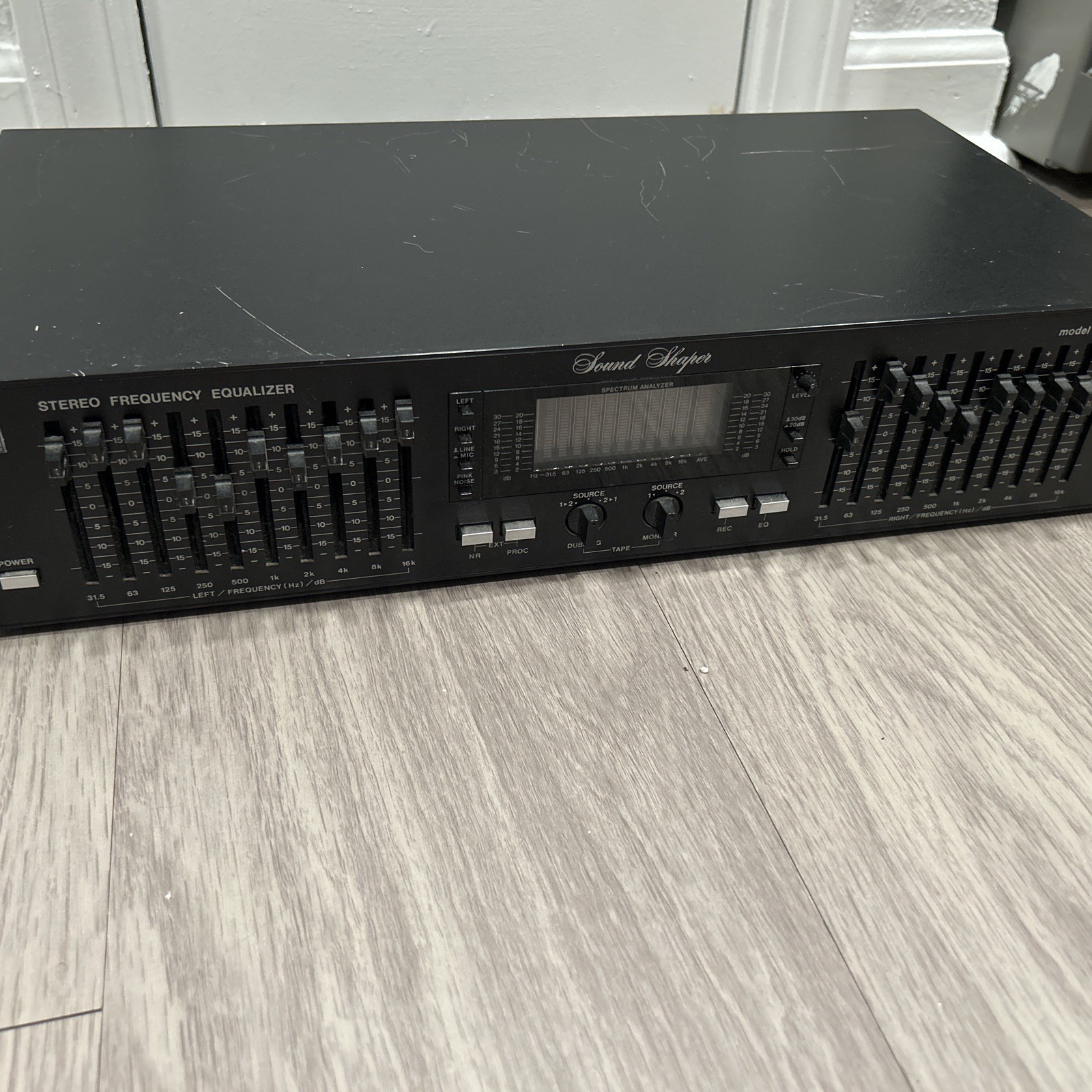
The SS315 doesn’t pretend to be luxurious. It’s a 19” rack-mountable unit with a utilitarian front panel: two rows of sliders, a few toggle switches, and that hypnotic fluorescent display. The sliders are smooth but not silky—more industrial than audiophile, but they hold their position well. The rear panel is simple: RCA inputs and outputs, AC inlet, and a fuse. No balanced connections, no remote control, no digital trickery. It’s all analog, all the time. The chassis is steel, the knobs are plastic, and the power transformer is tucked away in the back, where it belongs. This is gear that was meant to be used, not displayed. And yet, there’s a charm to its simplicity. Everything has a purpose. The headphone jack on the front lets you monitor the pink noise without blasting it into the room. The “Bypass” switch is big and tactile—satisfying to flip when you want to A/B your adjustments. It’s not pretty, but it’s honest.
Transparency vs. Utility: The EQ’s Dual Nature
Most graphic equalizers from this era either colored the sound or introduced noise when engaged. The SS315 avoids both pitfalls. With THD measured at 0.008%, it’s remarkably clean—cleaner than many preamps of the time. When you boost or cut, you’re not adding distortion or phase smear; you’re making direct adjustments to the frequency spectrum. That transparency makes it a favorite for critical listening environments, especially when used subtly. But it’s also capable of extreme settings, letting you carve out a 10dB notch at 1kHz to kill a speaker resonance or boost 16kHz to compensate for dull tweeters. Just don’t expect miracles. It won’t turn a $50 bookshelf speaker into a Wilson Audio, and pushing the sliders too far introduces audible artifacts. The sweet spot is ±6dB; beyond that, the signal starts to compress, and the magic fades.
Historical Context
The SS315 arrived at a time when audiophiles were beginning to realize that gear alone didn’t guarantee good sound—room acoustics mattered. Before the 1980s, EQs were mostly pro tools, used in studios and PA systems, priced out of reach for home users. ADC changed that by offering a feature-packed unit at a consumer-friendly price point. It competed with early offerings from Radio Shack (the Optimus 10-band) and BSR (who later acquired ADC and rebranded some models), but the SS315 stood out with its built-in RTA and superior build quality. It was heavily advertised in audiophile catalogs like DAK Industries, often bundled with other tuning tools. While purists dismissed EQs as “crutches for bad speakers,” a growing number of engineers and enthusiasts saw them as essential for room correction. The SS315 became a gateway drug for that philosophy—affordable enough to experiment with, effective enough to deliver real results. By the late 1980s, ADC was absorbed by BSR, and the SS315 faded from production, but its influence lingered in the rise of DSP-based room correction systems two decades later.
Collectibility & Value
Today, the ADC SS315 trades in the $150–$300 range depending on condition, with units that include the original microphone and manual commanding the higher end. Fully functional examples are still common on eBay and Reverb, but caution is warranted. The most common failure point is the power transformer—owners report burned-out primaries, likely due to age or voltage spikes. Replacing it requires careful matching of voltage and current specs, and DIY repairs aren’t for the faint of heart. The fluorescent display can also fail, either dimming over time or going dark entirely. While some units can be revived with new tubes or driver repairs, others are beyond economical repair. The pink noise generator and mic preamp are generally robust, but the 3.5mm mic input is fragile—bent pins or cold solder joints are frequent issues. When buying, always verify that the RTA responds to external audio and that the noise generator works. Avoid units with a dead display or no microphone, as replacements are scarce. For daily use, the SS315 holds up well, but for long-term ownership, consider a recap—electrolytic capacitors from the 1980s are nearing or past their lifespan. Despite its quirks, it remains a favorite among vintage audio tinkerers, not for nostalgia, but for utility. It’s one of the few vintage pieces that still outperforms modern budget EQs in transparency and feature set.
eBay Listings


As an eBay Partner, we earn from qualifying purchases. This helps support our independent vintage technology research.