ADC SS-525X (1980s)
A glowing orange analyzer, a room-filling hum of pink noise, and the quiet click of 12 servo-controlled sliders finding their place—this isn’t just an equalizer, it’s a ritual.
Overview
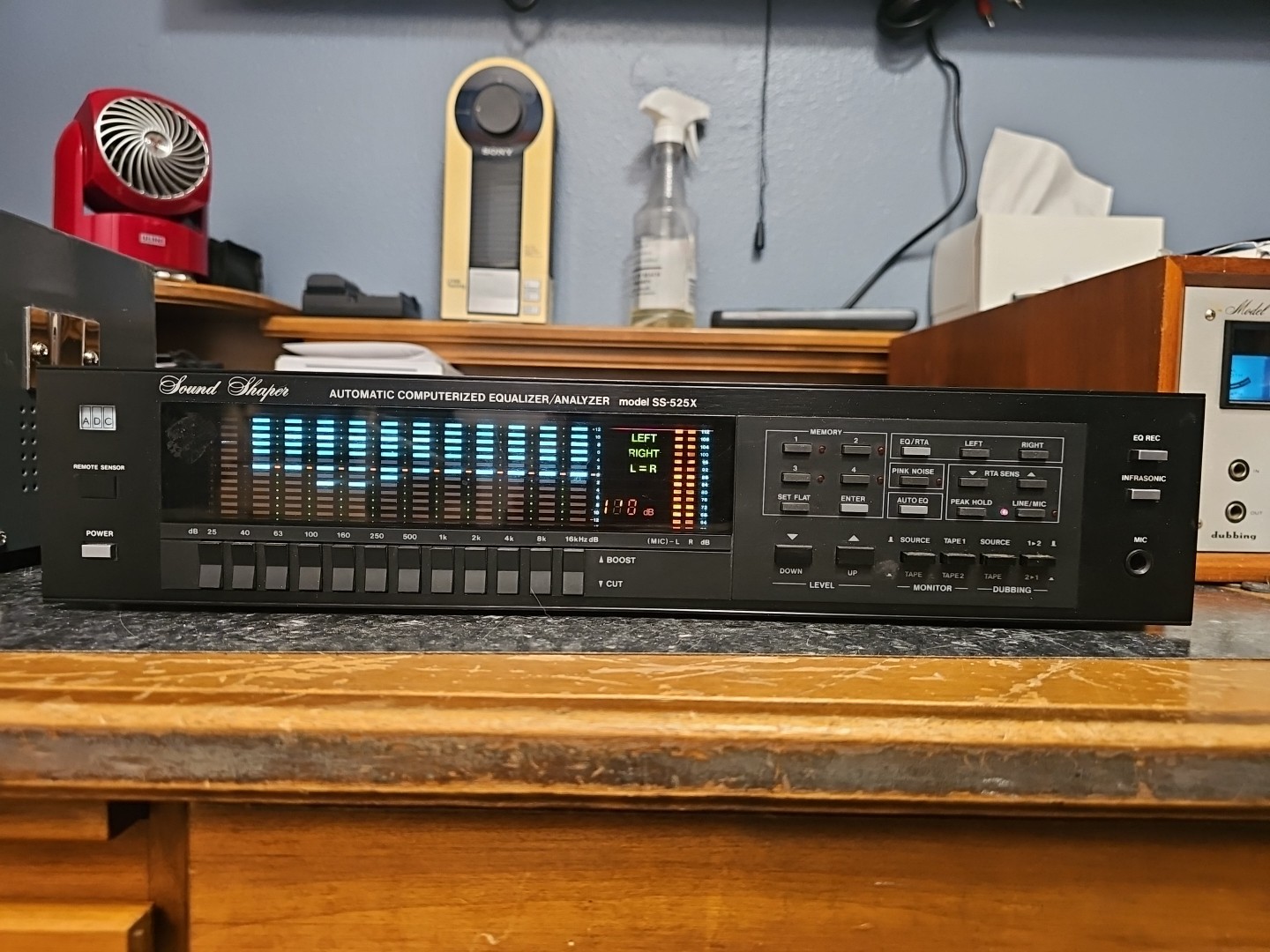
You don’t just plug in the ADC SS-525X and forget it. You set it up like a lab experiment: unbox the tiny calibrated condenser mic, clip it to your chair at ear height, run the RCA cables through the back of your preamp, and press “Auto EQ.” Then, for a full minute, your living room becomes an anechoic chamber as the unit floods the space with pink noise, listens, analyzes, and recalibrates—each of its 12 bands adjusting in real time to flatten your room’s response. It’s equal parts audio tool, theater piece, and forgotten artifact of 1980s audiophile futurism. And when it’s done, the difference isn’t subtle: boomy bass corners vanish, shrill highs soften, and the soundstage snaps into focus like a lens finally coming into clarity.
The SS-525X wasn’t just another graphic EQ. It was one of the first consumer-grade units to offer automatic equalization with a built-in real-time analyzer (RTA), a calibrated microphone, and a microprocessor brain—all wrapped in a brushed aluminum chassis with a mesmerizing orange LED display that scrolls like a heartbeat. For its time, it was borderline revolutionary, promising audiophiles a scientific path to sonic neutrality. And while later digital room correction systems like Audyssey or Dirac would surpass it in precision, the SS-525X remains a tactile, analog-digital hybrid that feels more like conducting an experiment than pressing a button. It’s not perfect—its algorithm is primitive by today’s standards, and it can overcorrect in complex rooms—but when it works, it works in a way that feels almost magical.
Specifications
| Manufacturer | ADC (Audio Dynamics Corporation) |
| Production Years | Mid-1980s |
| Original Price | $1,295 (approx.) |
| Control Range | ±12 dB |
| Frequency Response | 5 Hz – 100 kHz |
| Control Frequencies | 25, 40, 63, 100, 160, 250, 500, 1k, 2k, 4k, 8k, 16k Hz |
| Gain | ±1 dB unity |
| Maximum Input/Output Level | 4 V RMS |
| Harmonic Distortion | 0.008% |
| Hum and Noise | -90 dB (typical) |
| Inputs | 1 x RCA (stereo line in) |
| Outputs | 1 x RCA (stereo line out) |
| Microphone Input | 1/4" TRS (for included condenser mic) |
| Remote Control | Included (wired) |
| Weight | 12.5 lbs (5.7 kg) |
| Dimensions | 19" x 4.5" x 15" (W x H x D) |
| Power Requirements | 100–120 VAC, 60 Hz |
| Features | Real-time analyzer, pink noise generator, sound pressure level meter, auto-EQ, manual EQ, remote control |
Key Features
The Brains Behind the Beep
At the heart of the SS-525X is a microprocessor-driven system that was rare in consumer audio gear at the time. Unlike passive EQs or even manual graphic units, this thing thinks. It generates its own pink noise signal, routes it through your system, listens via the calibrated mic, and then calculates corrections across 12 precise frequency bands. The result isn’t just a preset—it’s a custom EQ curve tailored to your room’s acoustics. The real-time analyzer displays the frequency response in real time, letting you see peaks and dips as they happen. It’s not a high-resolution display by modern standards, but the orange LED bar graph is hypnotic, pulsing with the music or noise, giving you a visual sense of your soundfield that few vintage units can match.
Analog Meets Digital Control
The SS-525X uses analog filter circuits for the actual EQ shaping—meaning the sound path remains analog, which audiophiles will appreciate—but the control is digital. Each of the 12 sliders is motorized, moving automatically during calibration or manually via the remote. This hybrid design avoids the early digital artifacts of full-DSP units while still offering the precision of computerized adjustment. The unit also includes a manual mode, so you can tweak bands by hand if you disagree with the auto-correction. And yes, it sounds different than modern digital room correction: warmer, slightly softer in the highs, with a subtle analog thickness that some might call “colored”—but in a way that doesn’t distract, just cushions.
The Missing Mic Problem
The calibrated condenser microphone is essential—and often missing. Without it, the auto-EQ and RTA functions are dead. The mic is small, about the size of a large pencil eraser, with a 1/4" plug and a tiny foam windscreen. It’s not just any mic; it’s specifically calibrated to the unit’s circuitry, so substitutes rarely work correctly. Owners report that even modern measurement mics like the MiniDSP UMIK-1 require recalibration curves to function properly, and the original ADC mic is now a rare find. If you’re buying an SS-525X, verify the mic is included. Replacements, when they appear, can cost $150–$300 on their own.
Historical Context
The SS-525X arrived in the mid-1980s, when high-end audio was flirting with digital technology but still deeply rooted in analog purity. Companies like Sony and Denon were pushing digital frontiers, but audiophiles remained skeptical of anything that touched their signal path with a microchip. ADC, a lesser-known but technically ambitious brand, positioned the SS-525X as a scientific solution to a persistent problem: room acoustics. At a time when most listeners accepted boomy bass or reflective highs as inevitable, the SS-525X said, “Not anymore.” It competed with high-end manual EQs from brands like Rane and Drawmer, but few offered automation. Its closest rival might have been the UREI 560A, but that was a pro-studio unit without auto-correction. The SS-525X was unique in bringing lab-grade measurement to the living room, even if it was more novelty than necessity for most.
It also arrived just before the digital signal processing wave that would later dominate home theater. By the 1990s, automatic room correction would become standard in AV receivers, but the SS-525X was an early pioneer—bulky, expensive, and finicky, but undeniably forward-thinking. It was the kind of gear that graced the racks of engineers and obsessive audiophiles, not casual listeners. And while it never achieved mass-market success, it developed a cult following among those who valued measurable results over marketing hype.
Collectibility & Value
Today, the SS-525X trades in a narrow but passionate niche. Units in excellent condition with all accessories—especially the mic and remote—fetch $400–$700 on the used market. Missing the mic? That drops to $200–$300, and many buyers won’t touch it without verification. The unit’s value hinges on completeness and functionality: those rare “new old stock” finds with original packaging and manuals can break $800, but they’re increasingly scarce. Condition matters—cosmetic wear is expected, but cracked LED displays or sluggish sliders are red flags.
Reliability is a mixed bag. The motorized sliders can gum up over decades of inactivity, and the internal relays may stick. Capacitors, especially in the power supply, should be checked—recapping is common in units that haven’t been serviced. The microprocessor itself is generally robust, but the ribbon cables connecting the front panel can degrade. Service technicians observe that most failures are mechanical (stuck sliders) or power-related, not circuit-level. If you’re buying, power it on and run the auto-EQ cycle: watch the sliders move smoothly, listen for grinding, and verify the display updates in real time. Also test the remote—its membrane buttons often fail.
It’s not a daily driver for most, but for vintage audio tinkerers, it’s a fascinating piece of measurement history. It won’t replace a modern DSP system, but it offers a hands-on, visual, almost meditative approach to room tuning that digital black boxes can’t replicate. And when that orange display scrolls across 16kHz while pink noise fills the room, you’re not just fixing acoustics—you’re stepping into a time capsule of analog-digital optimism.
eBay Listings


As an eBay Partner, we earn from qualifying purchases. This helps support our independent vintage technology research.