ADC SS-412X (1985–1990s)
A glowing wall of light that doesn’t just tweak your sound—it shows you what you’re missing.
Overview
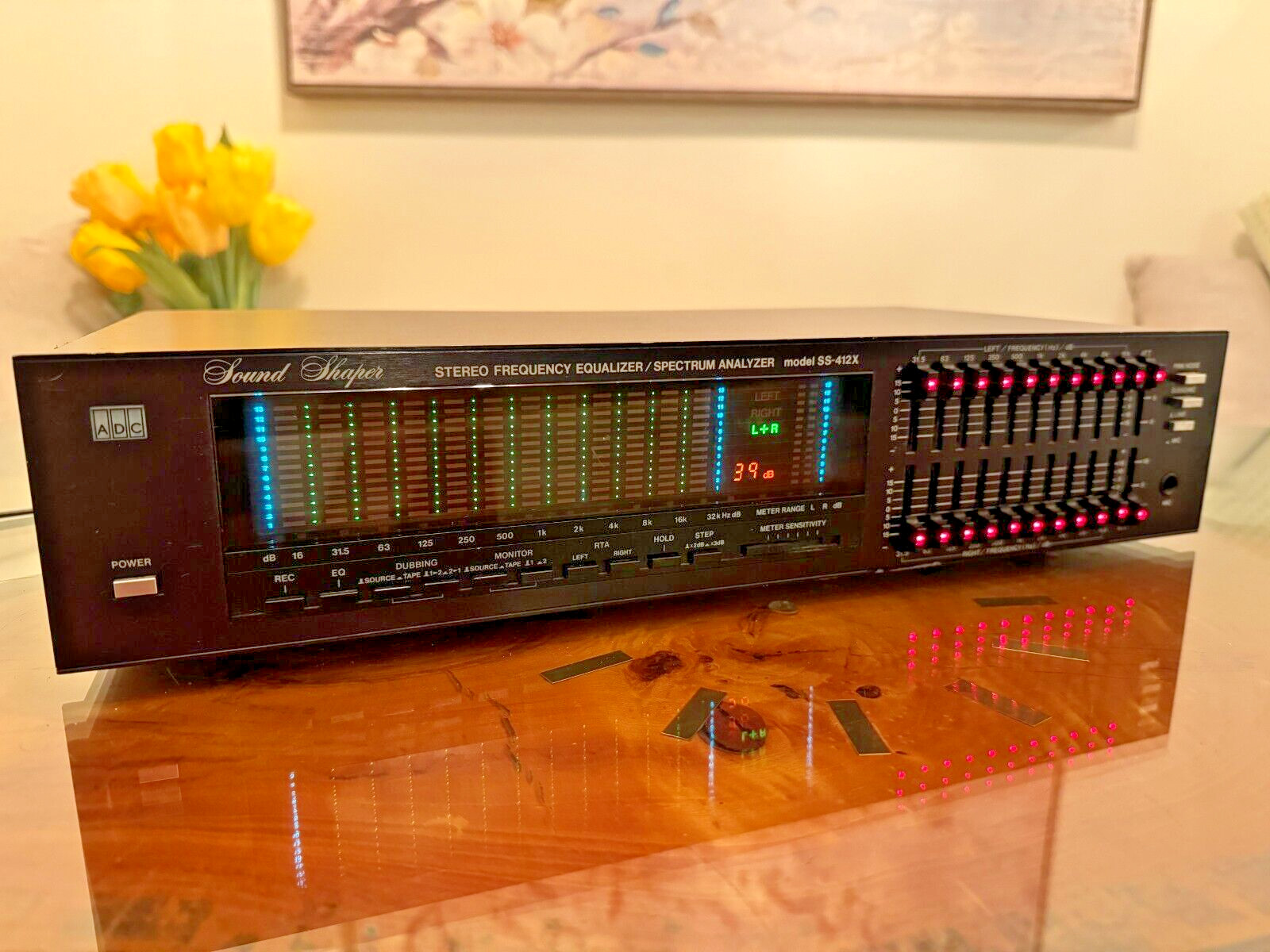
That first flicker of the fluorescent display in a dim room—156 pulsing green bars dancing in real time—tells you this isn’t just another box of sliders. The ADC SS-412X is a rare breed: a graphic equalizer that doubles as a spectrum analyzer, built when audiophiles still believed in both precision and theater. It doesn’t whisper adjustments; it broadcasts them, lighting up the frequency spectrum like a control room in a 1980s sci-fi film. You don’t just hear the room’s resonances or the recording’s flaws—you see them, in high-resolution neon, before you even touch a knob. For purists, that might seem gimmicky. But for anyone who’s ever wrestled with muddy bass or brittle highs in a real-world listening space, the SS-412X isn’t a toy. It’s a diagnostic tool disguised as a rack unit.
Manufactured in Japan during the mid-to-late 1980s—though some units trickled into the early '90s—the SS-412X emerged when home audio systems were hitting a sweet spot: powerful amplifiers, high-resolution sources, and increasingly sophisticated room acoustics. ADC, or Audio Dynamics Corporation, wasn’t a household name like Pioneer or Sony, but they carved out a niche with gear that prioritized measurement, control, and transparency. The SS-412X sits at the top of their equalizer line, a significant step up from basic tone controls or passive filters. With 10 fully adjustable bands per channel, it gives the user surgical control over the tonal balance, but the real magic lies in the display. That fluorescent tube isn’t just for show; it averages and visualizes the incoming signal across the spectrum, letting you match the EQ curve to the room’s response or flatten out a problematic recording.
It’s also a machine of its time—bulky, power-hungry, and unapologetically analog in its signal path, despite the digital-like precision of its display. The build is industrial: thick steel chassis, heavy-duty potentiometers, and a faceplate that manages to feel both clinical and dramatic. The sliders are smooth but deliberate, requiring a firm nudge. There’s no remote, no presets, no memory—just you, the music, and a glowing wall of data. And while it lacks the automation of later DSP units, that hands-on immediacy is part of its charm. You’re not programming a correction; you’re sculpting sound in real time, guided by what the machine reveals.
Specifications
| Manufacturer | Audio Dynamics Corporation (ADC) |
| Production Years | 1985–1990s |
| Original Price | Not listed (estimated $800–$1,200 at launch) |
| Model Name | SS-412X |
| Type | Stereo Frequency Equalizer / Spectrum Analyzer |
| Number of Channels | 2 (Stereo) |
| Equalization Bands | 10 bands per channel |
| Frequency Response Display | 156-segment fluorescent tube + 26-segment average response indicator |
| Audio Inputs | 3 stereo RCA (L/R), AUX |
| Audio Outputs | 3 stereo RCA (L/R) |
| Headphone Output | Yes |
| Signal Type | Analog (processing), Digital-like display (fluorescent tube) |
| Power Output | Not specified (line-level processor) |
| Power Consumption | 300 W |
| Dimensions | Standard 19-inch rack width (exact depth/height not listed) |
| Weight | Not listed (estimated 15–20 lbs based on build) |
| Color | Black |
| Country of Manufacture | Japan |
| Special Features | Real-time spectrum analysis, illuminated frequency display, manual EQ control |
Key Features
The Fluorescent Spectrum Display: Seeing Sound in Real Time
Most graphic EQs from the '80s offered a row of sliders and maybe a VU meter. The SS-412X goes further—much further. Its fluorescent display is the centerpiece, a long, bright green tube that breaks the audio spectrum into 156 individual segments, updating in real time. This isn’t a simulated LED bar graph; it’s a true analog display with persistence, meaning it holds the signal briefly, allowing the eye to track transients and sustained tones alike. The 26-segment average response overlay helps smooth out the chaos, giving a clearer picture of the dominant frequencies over time. When you play a kick drum, you see the low-end spike. When a violin soars, the upper mids flare up. It’s not just useful for EQ adjustments—it’s educational. Newcomers to room acoustics can instantly grasp how bass builds up in corners or how reflections smear the highs. Even experienced listeners use it to identify masking effects or track down resonant materials in the listening environment.
10-Band Precision with Analog Character
Ten bands may sound modest compared to the 31-band EQs used in studios, but in a home setting, it’s more than sufficient for meaningful tonal shaping. The bands are spaced logarithmically across the audible spectrum, with center frequencies likely targeting key problem areas: 31Hz, 62Hz, 125Hz, 250Hz, 500Hz, 1kHz, 2kHz, 4kHz, 8kHz, and 16kHz—standard for the era. The sliders offer ±12dB of cut or boost, giving wide latitude without encouraging extreme settings that could damage speakers or distort the signal. Unlike some budget EQs that use stepped controls or low-quality pots, the SS-412X uses smooth, continuous faders with a satisfying resistance. The analog circuitry preserves dynamics and phase coherence better than many digital units that came later, though it’s not entirely transparent—there’s a slight warmth added, particularly in the midrange, which some describe as “analog glue.” It won’t make a bad recording good, but it can make a good system sing in a room that wasn’t built for hi-fi.
Inputs, Outputs, and System Integration
With three stereo RCA inputs and three outputs, the SS-412X was designed to be a hub, not just an insert. You could route a turntable, CD player, and tape deck through it, switching sources without repatching. The inclusion of a headphone jack is a thoughtful touch—rare on pro-style EQs—allowing for private, real-time adjustments while others listen. The unit operates at line level, so it slots neatly between preamp and power amp, or inside a receiver’s tape loop. However, because it draws 300 watts—unusually high for a signal processor—owners report that it runs warm, sometimes hot. This isn’t a sign of malfunction, but it does mean ventilation matters. Stacking it under a power amp or in a closed cabinet risks overheating, which over time can degrade the fluorescent tube or stress internal components. It’s a reminder that this isn’t passive gear; it’s an active, power-hungry instrument that demands respect in system planning.
Historical Context
The mid-1980s were a turning point for consumer audio. Compact discs were gaining traction, offering flatter frequency response and lower noise than vinyl, but many listeners found them “cold” or “harsh.” At the same time, speaker design was advancing rapidly, but room acoustics remained the wild card. The ADC SS-412X arrived in this climate as a tool for reclaiming control. While graphic EQs had been around since the 1970s—popularized by brands like Rane and Ashly in pro audio—few brought real-time spectrum analysis to the home market. ADC didn’t invent the concept, but they executed it with rare clarity and build quality. Competitors like Sony’s TA-E9000ES or Pioneer’s EQ-6000 offered visual feedback, but none matched the SS-412X’s resolution or immediacy.
ADC, though not a mass-market brand, catered to a niche of technically minded audiophiles who valued measurement and precision. The SS-412X wasn’t marketed as a “tone enhancer” or “bass booster”—it was sold as a “Sound Shaper,” a diagnostic instrument for optimizing system performance. This put it at odds with the prevailing trend of sonic euphemism—where gear was described in emotional terms rather than technical ones. Instead, ADC leaned into engineering: the fluorescent display wasn’t just flashy, it was functional. It encouraged users to measure before they adjusted, to see before they believed. In an era when many “high-end” products were selling mystique, the SS-412X stood out by offering data.
Collectibility & Value
Finding a working SS-412X today is a minor victory. These units were never common, and time hasn’t been kind to their most distinctive feature: the fluorescent display. Owners report that the tubes degrade over decades, developing dim spots, flickering, or failing entirely. Replacement tubes are scarce, and retrofitting with modern LED arrays is possible but ruins the authenticity. Beyond the display, the potentiometers can become scratchy with age, especially if the unit sat unused for years. The high power draw also means capacitors and power supplies are under stress—recapping is often necessary for long-term reliability.
When shopping, look for units that power on with a bright, even glow across the entire display. Test all sliders for smooth operation and listen for channel imbalance or noise. Units with the original manual are more valuable—setup and calibration aren’t trivial, and the manual explains how to interpret the average response overlay and set input levels correctly. Some listings include the optional calibration microphone, which was used for automated room analysis in professional setups; if present, it’s a major plus.
Pricing varies wildly based on condition. Non-working units with dead displays sell for $100–$200 as restoration projects. Fully functional examples with bright displays and clean controls go for $600–$900, with outliers reaching $1,200 if they include accessories or are in mint, boxed condition. The eBay listing claiming “Made in USA” is likely incorrect—multiple sources, including Reverb and HifiShark, confirm Japan as the country of manufacture. Mislabeling is common with obscure gear, so verify before paying a premium.
For collectors, the SS-412X is more than a nostalgic curiosity. It represents a brief moment when consumer audio embraced measurement and transparency—when you could own a tool that didn’t just alter sound, but revealed it. It’s not essential in every system, but for those who care about room correction, analog character, and the sheer spectacle of glowing sound, it’s a crown jewel.
eBay Listings



As an eBay Partner, we earn from qualifying purchases. This helps support our independent vintage technology research.