ADC SS-315 (1970s–1990s)
A dual 10-band EQ with a built-in spectrum analyzer and pink noise generator that promised scientific tuning — but only if you could survive the noise and trust the display.
Overview
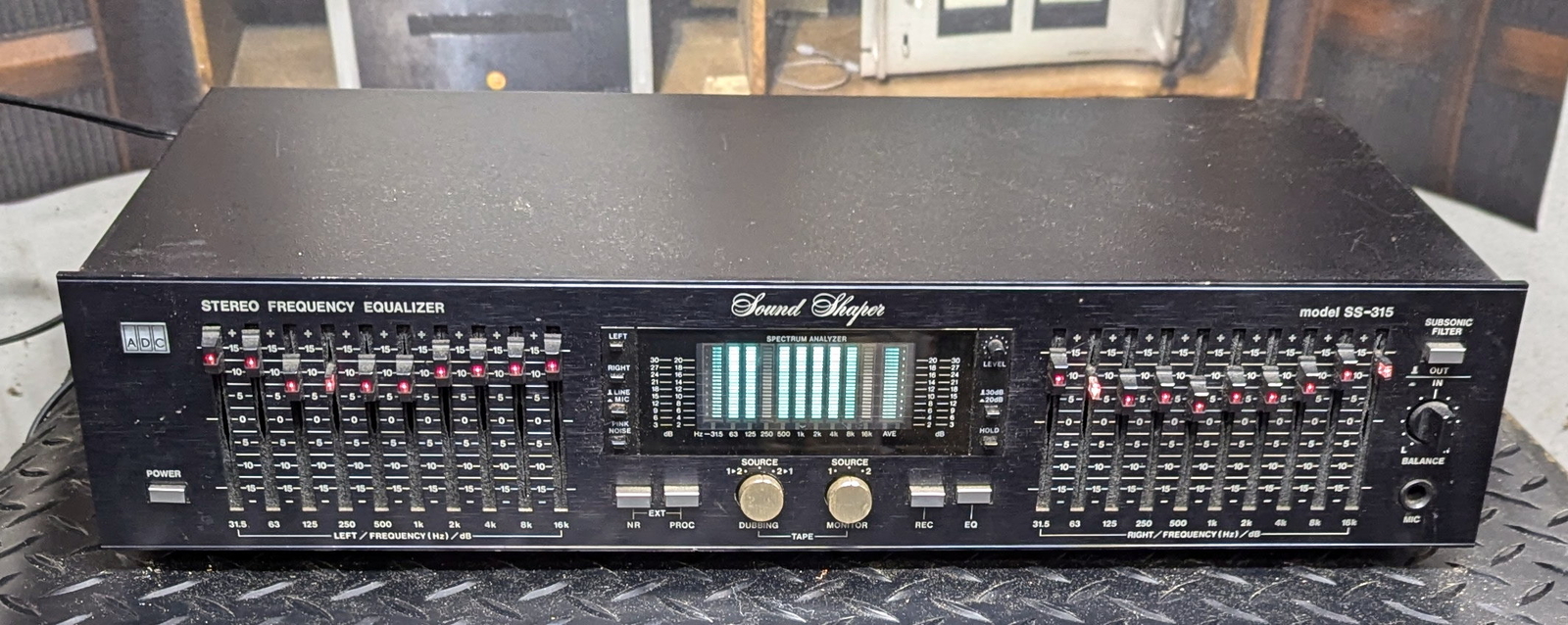
Flick the power switch on an SS-315 and the fluorescent spectrum display flickers to life like a Geiger counter in a reactor core — soft green bars twitching, waiting to judge your speakers. This isn’t just an equalizer; it’s a statement. ADC built the SS-315 for audiophiles who didn’t just want to tweak tone — they wanted to *measure* it, calibrate it, and believe they were optimizing it with something resembling science. Released during the late 1970s and produced into the 1990s, the SS-315 arrived when high-end audio was shifting from pure tube worship to a fascination with technical precision. It promised a rare feature set for its time: dual 10-band graphic EQs (one per channel), a real-time spectrum analyzer, a built-in pink noise generator, and a matched electret condenser microphone to close the loop. The idea was simple: play noise, measure the room, adjust the EQ until the display read flat, and voilà — perfect sound. In practice? It was equal parts revelation and frustration.
The SS-315 occupied a curious middle ground in ADC’s lineup. It wasn’t the entry-level toy — that was the stripped-down SS-115X — nor was it a professional studio beast. It sat squarely in the high-end consumer tier, aimed at serious listeners who wanted studio-style control without pro pricing. Compared to the competition — like the more refined (and expensive) Pultec or Bellari units — the SS-315 was a budget-conscious attempt to bring measurement-based tuning to the living room. It lacked the silky transformers and hand-wound inductors of high-end gear, relying instead on solid-state circuitry that prioritized function over sonic glamour. Yet for its price, it delivered an astonishing amount of hardware: 20 sliders, a working analyzer, and a noise generator that could, in theory, transform a boomy corner into a neutral listening space.
But here’s the catch: the stock microphone that came with it is widely regarded as a weak link. Owners report a response curve that’s rolled off at both ends — a classic “smile” shape — making it nearly blind to bass resonance and high-frequency air. One technician noted that using the factory mic often led to overcompensation in the mids, creating a harsh, fatiguing sound that was anything but flat. Some users bypassed the issue entirely, opting for third-party electret mics with flatter response, like the RCA models that occasionally surface on eBay. Still, the system only works if you treat it like a rough guide, not gospel. The analyzer’s display, while hypnotic, isn’t lab-grade accurate. Adjusting by ear after an initial pass often yields better results than blindly chasing green bars.
Sound-wise, the EQ section itself is clean and transparent — not colored, not warm, not aggressive. It does what a good graphic EQ should: it lets you surgically reduce a 250 Hz hump or lift presence around 3 kHz without adding its own sonic fingerprint. Total harmonic distortion is impressively low at 0.008%, a figure that holds up even today. But transparency cuts both ways: when the EQ is flat, you hear your system; when it’s not, you hear your mistakes. And because the SS-315 applies gain across 10 fixed bands, it’s easy to create phase issues or comb filtering if you’re heavy-handed. It rewards subtlety. Use it to tame room modes, not to turn bookshelf speakers into floor-standing monsters.
Specifications
| Manufacturer | ADC (Audio Dynamics Corporation) |
| Production Years | 1970s–1990s |
| Original Price | $249 (1990) |
| Equalizer Type | Stereo 10-band graphic equalizer (dual channels) |
| Frequency Bands | 31.5 Hz, 63 Hz, 125 Hz, 250 Hz, 500 Hz, 1 kHz, 2 kHz, 4 kHz, 8 kHz, 16 kHz |
| Adjustment Range | ±15 dB per band |
| THD (Total Harmonic Distortion) | 0.008% |
| Frequency Response | 20 Hz – 20 kHz (±0.5 dB) |
| Input Sensitivity | 200 mV for rated output |
| Input Impedance | 47 kΩ |
| Output Impedance | 600 Ω |
| Signal-to-Noise Ratio | 90 dB |
| Pink Noise Output | 200 mV |
| Microphone Input | Electret condenser microphone input with bias voltage |
| Display Type | Fluorescent 10-segment real-time spectrum analyzer |
| Power Requirements | 120 VAC, 60 Hz |
| Power Consumption | 25 watts |
| Weight | 12 lbs (5.4 kg) |
| Dimensions | 19" W × 4.5" H × 12" D (48.3 cm × 11.4 cm × 30.5 cm) |
| Rack Mountable | Yes (19-inch standard) |
Key Features
The All-in-One Tuning Station
What made the SS-315 stand out wasn’t just the EQ — it was the integration of tools. Most graphic equalizers of the era were dumb slabs of filters. The SS-315 tried to be smart. The built-in pink noise generator eliminated the need for a separate test source, and the spectrum analyzer gave immediate visual feedback. Paired with the included microphone, it formed a closed loop: generate noise, capture response, adjust EQ, repeat. For a generation of audiophiles raised on measurements in magazines, this was intoxicating. It turned room tuning from guesswork into something that felt scientific. The fluorescent display, with its glowing green bars, was mesmerizing — almost theatrical. In a dark room, it looked like a piece of diagnostic equipment from a 1970s medical drama.
But the system’s ambition outpaced its execution. The pink noise generator, while functional, isn’t calibrated to modern standards. It’s loud — painfully so — and running it for more than a few minutes at high volume risks ear fatigue for both the user and anyone within earshot. Service technicians observe that prolonged use at full output can even trigger protective shutdowns in sensitive preamps. And because the microphone input expects a specific sensitivity, substituting a modern measurement mic without level matching can overload the input or render the display useless. The manual explicitly warns against using dynamic mics, as they can damage the internal bias circuit — a quirk that still catches buyers off guard.
Build and Serviceability
The SS-315 is built like a 1980s consumer rack unit: thick steel chassis, rubberized side panels, and a front panel that’s all sliders and glowing indicators. It’s not elegant, but it’s durable. The sliders are linear potentiometers, not the sealed faders found on pro gear, which means they can wear out or get noisy over time — especially if left in extreme positions for years. Cleaning them with contact cleaner often restores smooth operation, but replacement parts are scarce. The internal layout is straightforward, with clearly labeled sections for EQ, analyzer, and power. However, the power transformer has proven to be a weak point. Documentation shows that several units failed in the 1990s due to overheated primaries, and replacements are no longer in production. Some technicians have retrofitted modern toroidal transformers, but this requires recalibrating the bias voltages for the microphone input and display.
Historical Context
ADC — originally Audio Dynamics Corporation — began in the 1960s as a maker of high-quality MM cartridges and bookshelf speakers. By the 1970s, they pivoted toward consumer electronics, capitalizing on the growing DIY audio movement. The SS-315 emerged during a time when home audio systems were becoming more powerful and complex, but room acoustics remained an afterthought. Most listeners had no way to measure how their speakers interacted with their space. ADC saw an opportunity: package professional concepts into an affordable box. They weren’t the first to make a graphic EQ, but they were among the first to bundle it with analysis tools for the mass market.
Their biggest competition came not from high-end brands but from value-oriented importers. BSR, the British turntable maker that later acquired ADC, sold rebadged versions of the SS-315 under their own name, often at lower prices. DAK Industries, a popular mail-order catalog, heavily advertised these units, helping them reach a wide audience. Unlike pro units from companies like API or Drawmer, the SS-315 wasn’t designed for tracking or mastering — it was for tweaking the final sound in the living room. It reflected a broader trend: the democratization of audio technology. Suddenly, anyone could own a piece of gear that *looked* and *acted* like it belonged in a studio.
Collectibility & Value
Today, the SS-315 trades in a narrow band: $150 to $300, depending on condition and completeness. Units with the original microphone and manual command a premium — sometimes double the price of a bare chassis. But collectors aren’t chasing rarity; they’re chasing functionality. A working SS-315 with a known-good mic is a usable tool, not just a retro display piece. The biggest red flag for buyers is the power transformer. If it’s been replaced or shows signs of overheating (discoloration, burnt smell), expect to spend $100–$150 on a repair if you’re not comfortable doing it yourself. The fluorescent display can also fail — either dimming over time or flickering erratically — and replacements are nearly impossible to source.
Another common failure point is the bias circuit for the microphone input. If the unit doesn’t respond to an electret mic, even a known-good one, the issue is often a dead transistor or failed capacitor in the preamp stage. Recapping the unit — replacing all electrolytic capacitors — is strongly advised for any machine that’s been powered on after decades of storage. Service logs indicate that old capacitors frequently leak and damage the PCB, especially near the power supply.
For those considering a purchase: test the sliders for smoothness, verify the spectrum display responds to input, and confirm the pink noise generator works at both outputs. If the seller doesn’t have the mic, budget extra to acquire a compatible one — and avoid dynamic mics at all costs. While the SS-315 isn’t rare, a fully functional unit with original accessories is increasingly hard to find. It’s not a showpiece like a vintage Revox or a Linn turntable, but for the tinkerer who wants to *use* vintage gear, not just admire it, the SS-315 still has purpose.
eBay Listings



As an eBay Partner, we earn from qualifying purchases. This helps support our independent vintage technology research.