ADC SS-300SL (1988)
A glowing wall of sound that doesn’t just shape your music — it shows you what you’re missing.
Overview
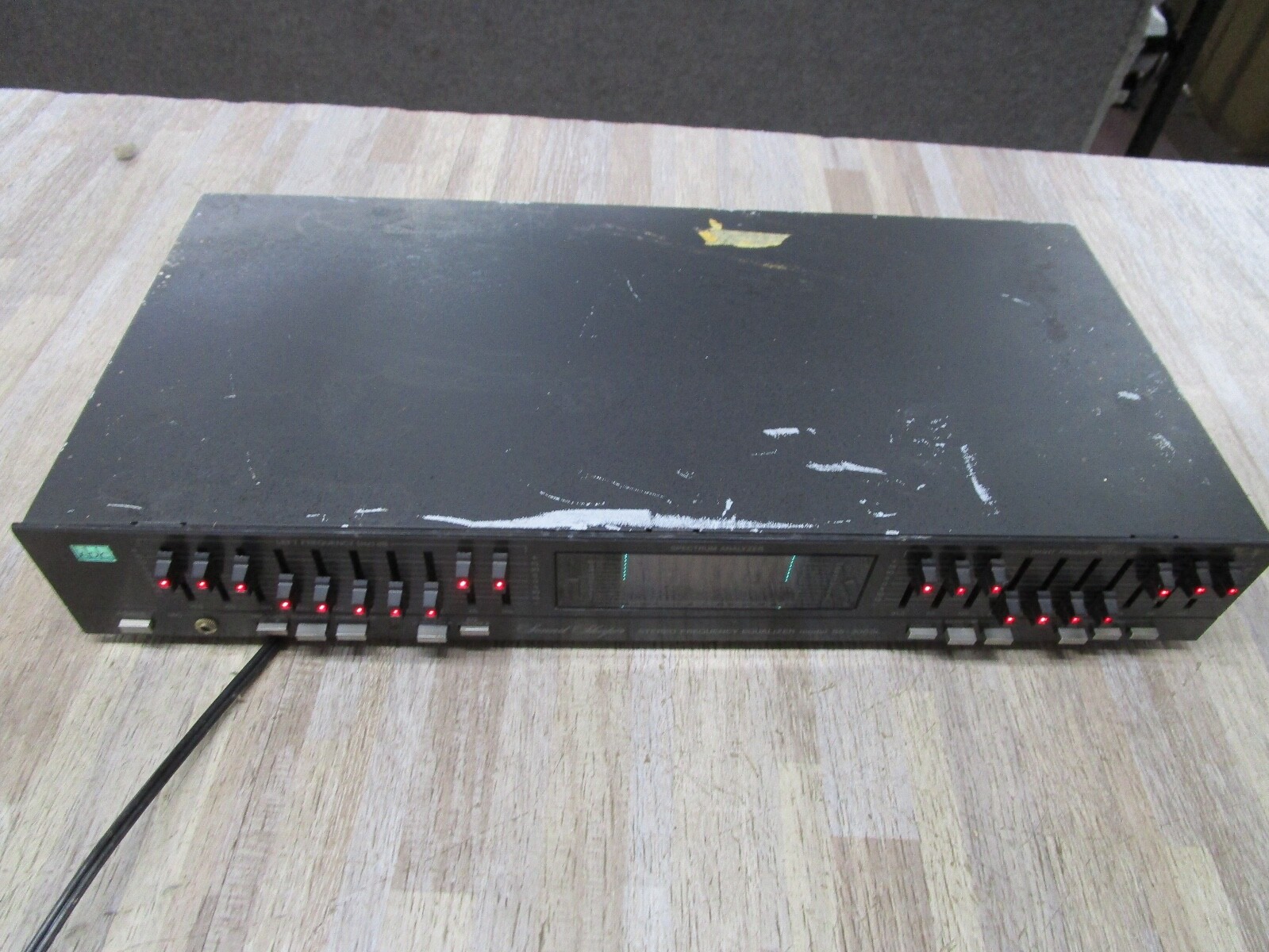
That first flicker of the FL display in a dark room—bands of emerald light pulsing like a heartbeat—is what pulls you in. The ADC SS-300SL isn’t just an equalizer; it’s a live sonogram of your stereo system, translating sound into something you can see, tweak, and obsess over. Built in Japan by Audio Dynamics Corporation during the golden era of high-end analog tweakery, this stereo graphic EQ was designed for people who didn’t just want better sound—they wanted to understand it. And it delivered, not with brute force, but with surgical clarity and a rare blend of utility and theater.
At its core, the SS-300SL is a 10-band per channel passive equalizer, each slider covering the full audible spectrum from 31.5 Hz to 16 kHz. That’s standard for a high-resolution graphic EQ of its time, but what sets it apart is the integration of a real-time analyzer (RTA) powered by an internal pink noise generator and a matched electret condenser microphone. This wasn’t a gimmick tacked on for show—it was a full room-correction system disguised as a rack unit. Run the calibration, point the mic at your listening position, and the FL display shows exactly how your speakers interact with your space, letting you flatten peaks and fill dips with a level of precision most audiophiles in the late '80s could only dream of.
It didn’t boost the signal—being passive, it actually attenuates slightly—but that’s part of its charm. There’s no added coloration from internal amplification stages, just clean, uncolored adjustment. The sound remains transparent when the sliders are flat, and when you do make cuts or boosts (up to ±15 dB), the changes feel surgical rather than splashy. It won’t make a bad system sound magical, but in a well-matched setup, it reveals room resonances and speaker quirks with startling honesty. You might not like what you hear at first—but you’ll know exactly what to fix.
Specifications
| Manufacturer | Audio Dynamics Corporation (ADC) |
| Production Years | 1988 |
| Original Price | ¥49,800 (Japan, circa 1988) |
| Type | Passive Stereo Graphic Equalizer with RTA |
| Number of Channels | 2 (Stereo, Left/Right Independent) |
| Equalizer Bands | 10 per channel |
| Center Frequencies | 31.5 Hz, 63 Hz, 125 Hz, 250 Hz, 500 Hz, 1 kHz, 2 kHz, 4 kHz, 8 kHz, 16 kHz |
| Adjustment Range | ±15 dB per band |
| Gain | ±1 dB |
| Maximum Input/Output Level | 4 V RMS or more |
| Frequency Response | 20 Hz – 20 kHz ±1 dB (sliders at center) |
| Total Harmonic Distortion (THD) | ≤ 0.1% |
| Cross Modulation Distortion | ≤ 0.1% |
| Signal-to-Noise Ratio | 100 dB (at 1 V or less, A-weighted) |
| Subsonic Filter | 20 Hz or below, -18 dB/octave |
| Pink Noise Generator | Yes, internal |
| Microphone | Electret condenser, non-directional, 20 Hz – 20 kHz |
| Inputs | 3 x RCA (Stereo L/R), including mic input |
| Outputs | 3 x RCA (Stereo L/R), 2 tape outputs |
| Display | FL (Fluorescent) Real-Time Analyzer, dual-channel spectrum display |
| Dimensions | 435 mm (W) × 70 mm (H) × 324 mm (D) |
| Weight | 3.5 kg |
| Country of Manufacture | Japan |
Key Features
The RTA That Changed the Game
Most graphic equalizers in the late '80s were tone tweakers—tools for boosting bass or cutting shrill highs. The SS-300SL was different. Its real-time analyzer wasn’t just a light show; it was a diagnostic instrument. By generating pink noise and analyzing the response via the included mic, it allowed users to perform actual acoustic room correction—a feature that wouldn’t become common in consumer gear for another two decades. The FL display, with its smooth, continuous glow across ten bands, gave a far more accurate picture than the segmented LED meters on competitors like the Sony or Technics units. It wasn’t perfect—calibration required patience and a quiet room—but for its time, it was astonishingly effective.
Precision Without Pretense
The SS-300SL doesn’t shout. It listens. Its passive design means no internal amplifiers to color the sound or introduce noise. That makes it a transparent tool—ideal for critical listening environments where fidelity matters more than flash. The ±15 dB range is generous but not excessive, discouraging the kind of over-EQ that turns music into a caricature. The sliders themselves are smooth and precise, with a satisfying mechanical feel that inspires confidence. And the inclusion of two tape loops means it can be patched into complex signal chains without breaking continuity—essential for integrations with preamps or processors that lack loop-through capability.
Build and Interface: Analog Elegance
From the brushed black front panel to the soft green glow of the FL display, the SS-300SL feels like a piece of lab equipment that wandered into a hi-fi system. The layout is logical: sliders on the left, mic input and pink noise controls on the right, tape I/O on the back. The microphone plugs into the front—a small but thoughtful touch for ease of use during calibration. The unit is compact by rack standards (just 70 mm tall), making it easy to fit into crowded setups. And despite its complexity, it runs cool and quiet, with no fan or hum to betray its inner workings.
Historical Context
The late 1980s were a turning point for home audio. Digital was creeping in—CDs had overtaken vinyl in sales, and DAT recorders loomed on the horizon—but high-end analog was still king in serious listening rooms. Companies like ADC, often overshadowed by giants like Sony, Yamaha, or Denon, carved niches by offering specialized tools for the technically inclined. The SS-300SL landed right in that sweet spot: not a mainstream accessory, but a serious instrument for enthusiasts who wanted to optimize their systems beyond component swaps.
At the time, room acoustics were still a black art for most consumers. Audiophiles might tweak speaker placement or add rugs, but few had access to tools that could measure the results. The SS-300SL changed that. While professional RTAs existed, they were expensive and complex. ADC brought that capability into the home at a relatively accessible price—¥49,800 in Japan was steep for a single-box processor, but a fraction of what a pro unit would cost. Competitors like the Sony STR-DB1000 offered built-in EQ, but nothing with real-time visual feedback. Even high-end brands like Technics or Pioneer offered graphic EQs without calibration mics. The SS-300SL wasn’t the first to try this—some pro units had done it earlier—but it was among the first to make it practical for home use.
Collectibility & Value
Today, the SS-300SL is a cult favorite among analog obsessives and vintage audio hunters. It’s not rare in the sense of being ultra-scarce—units still surface on eBay, Reverb, and Japanese auction sites—but working examples with a functioning FL display and included microphone are increasingly hard to find. The fluorescent display, while beautiful, is the unit’s Achilles’ heel. Over time, the FL tube can dim, flicker, or fail entirely, and replacements are nearly impossible to source. Service technicians note that when they do work, the high-voltage inverter driving the display is often the culprit, and repairing it requires specialized knowledge.
The pink noise generator and mic input circuitry are also failure points. Capacitors in the audio path can degrade, leading to channel imbalance or noise, especially if the unit has been stored in humid conditions. Recapping is often recommended for long-term reliability, and while not overly complex, it adds to ownership cost. The mic itself is fragile—owners report cracked capsules and broken cables—and replacements are not standardized. If you’re buying one, test the RTA function thoroughly: play pink noise, plug in the mic, and verify that the display responds dynamically and evenly across bands.
Prices vary widely based on condition. Non-working units with dead displays go for $100–$200. Fully tested, working models with mic in hand sell for $400–$700, with pristine, boxed examples occasionally hitting $900 on Reverb. That’s not cheap for a 35-year-old EQ, but for what it offers—a working RTA system in a compact, passive design—it’s still a relative bargain compared to modern digital room correction systems. For the right user, it’s not just nostalgia—it’s a functional tool that still holds up.
eBay Listings


As an eBay Partner, we earn from qualifying purchases. This helps support our independent vintage technology research.