ADC SS-300 (1986–1990)
That first sweep of the sliders sends a ripple through the room—not just in the sound, but in the light, as ten bands of neon glow to life beneath a glass faceplate like a living seismograph of bass and treble.
Overview
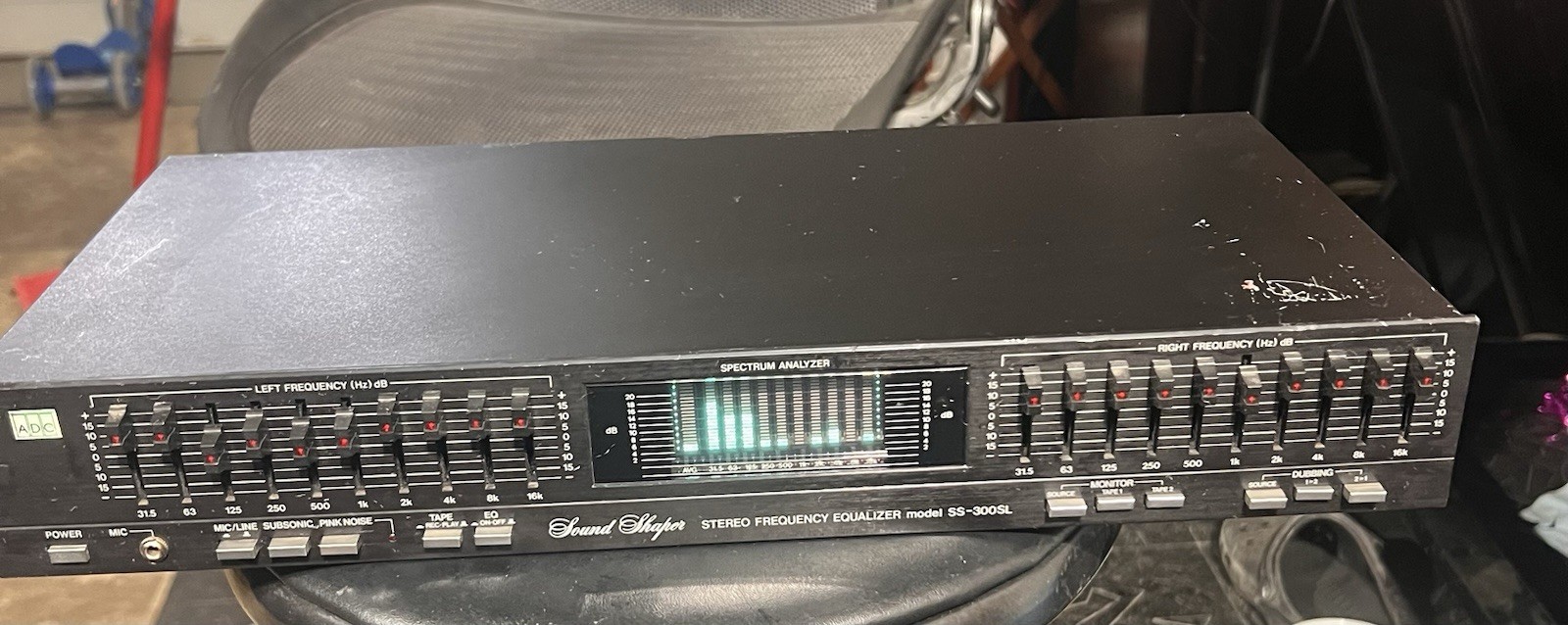
It doesn’t just shape sound—it stages it. The ADC SS-300 isn’t merely a graphic equalizer; it’s a command center for room acoustics, wrapped in the sleek black chassis of late-’80s Japanese precision and dressed with a real-time spectrum analyzer that turns audio correction into theater. You don’t just hear the difference when you tweak it—you watch it unfold. This was high-end voicing gear for audiophiles who wanted surgical control and visual feedback, not just tonal nudges. And unlike most EQs of its era that relied on guesswork and golden ears, the SS-300 came with a built-in pink noise generator and a tiny electret condenser mic, so you could actually measure and correct room response—something almost unheard of in consumer-grade gear at the time.
Built by Audio Dynamics Corporation (ADC), a niche but respected Japanese manufacturer that specialized in studio and high-fidelity test equipment, the SS-300 occupied a rare middle ground: sophisticated enough for critical listening environments, yet compact and styled for integration into a home system. It wasn’t cheap—priced around ¥49,800 in Japan (roughly $375 at 1988 exchange rates), which put it well above entry-level tone controls but below full professional rack units. It competed in spirit with the likes of the Sony STR-E885’s integrated EQ or the more modular Rane and Drawmer units, but with one major advantage: that glowing, 10-band RTA display that made tuning your room feel like conducting a symphony of light and frequency.
The unit is passive in signal path design, meaning it doesn’t amplify the source—what goes in comes out, just reshaped. That preserves signal integrity but demands a healthy input level and a preamp with enough drive to handle the slight insertion loss. It’s a trade-off: purity over power. And while it lacks the harmonic coloration of tube-driven EQs or even some of the warmer solid-state units from Sansui or Technics, its neutrality is part of the point. This isn’t a flavor enhancer; it’s a scalpel. The ±15 dB range across each of its ten octave-spaced bands (31.5 Hz to 16 kHz) gives serious corrective headroom, enough to tame a boomy corner or revive a dead listening position.
Specifications
| Manufacturer | Audio Dynamics Corporation (ADC) |
| Production Years | 1986–1990 |
| Original Price | ¥49,800 (Japan, ~$375 in 1988) |
| Type | Graphic Equalizer with Real-Time Analyzer (RTA) |
| Channels | Stereo (L/R independent) |
| Number of Bands | 10 per channel |
| Center Frequencies | 31.5 Hz, 63 Hz, 125 Hz, 250 Hz, 500 Hz, 1 kHz, 2 kHz, 4 kHz, 8 kHz, 16 kHz |
| Adjustment Range | ±15 dB per band |
| Gain Accuracy | ±1 dB |
| Maximum Input/Output Level | 4 V RMS or more |
| Frequency Response | 20 Hz – 20 kHz ±1 dB (sliders at center) |
| Total Harmonic Distortion | ≤0.1% |
| Cross Modulation Distortion | ≤0.1% |
| Signal-to-Noise Ratio | 100 dB at 1 V or less (A-weighted) |
| Subsonic Filter | 20 Hz or lower, -18 dB/octave |
| Pink Noise Generator | Yes, internal |
| Microphone Included | Electret condenser, omnidirectional, 20 Hz – 20 kHz |
| Inputs | 3 x RCA (including tape in, mic in) |
| Outputs | 3 x RCA (including 2 tape outs) |
| Display | 10-segment LED RTA (Real-Time Analyzer) |
| Dimensions | 435 mm (W) × 70 mm (H) × 324 mm (D) |
| Weight | 3.5 kg |
| Country of Manufacture | Japan |
Key Features
The RTA That Changed the Game
Most graphic EQs in the 1980s asked you to trust your ears—or worse, your ego. The SS-300 didn’t. It gave you proof. The real-time analyzer isn’t just a light show; it’s a calibrated display that responds to the pink noise signal pumped through your speakers and picked up by the included mic. You place the mic at the listening position, hit the test tone, and watch the room’s acoustic flaws flash across the front panel in glowing bars. Peaks in the bass? Dips in the mids? The RTA shows them instantly. Then you adjust the sliders to flatten the response, chasing that elusive “flat” curve that audiophiles whisper about like a holy grail. It’s one of the earliest consumer devices to put actual measurement tools in the hands of home listeners, and it still feels revolutionary decades later.
Pink Noise and Mic: The Calibration Kit in a Box
The inclusion of a calibrated pink noise generator and a matched microphone wasn’t just a gimmick—it was a complete room-tuning system. Most competitors either omitted this entirely or sold it as an add-on. ADC bundled it. The mic is basic by studio standards—an omnidirectional electret capsule—but it’s consistent and matched to the unit’s internal calibration. Used correctly, it lets you correct for standing waves, speaker placement issues, and room modes with surprising accuracy. It’s not a full acoustic treatment substitute, but for a living room setup in the ’80s, it was borderline magic. And because the noise generator is internal, you don’t need a separate test disc or external source, which means fewer variables and cleaner results.
Build and Layout: Function Meets Drama
The SS-300 doesn’t hide its purpose. The front is dominated by two banks of 10 sliders, each flanked by bright LED segments that dance in real time. The glass-covered display glows in deep reds and oranges, casting a warm halo across any rack it sits in. It’s theatrical, yes, but also functional—the LED response is fast enough to track dynamic music, so you’re not just seeing test tones but actual program material. The controls are smooth, with no gritty resistance in the sliders, and the unit runs cool under long use. The rear panel is tidy: three RCA inputs (one labeled for mic, one for tape, one for main), three outputs (including two tape loops), and the necessary jacks for the mic and power. No digital interfaces, no microprocessors—this is pure analog signal path with just enough smarts to drive the display.
Historical Context
The mid-to-late 1980s were a golden age for audio experimentation. CD players were gaining traction, but vinyl still ruled, and speaker design was in flux—some manufacturers chasing efficiency, others chasing accuracy. Room acoustics were often an afterthought, and tone controls were either crude bass/treble knobs or expensive studio gear. The SS-300 arrived at the perfect moment: when audiophiles had the gear to hear room flaws but lacked the tools to fix them. ADC, though not a household name like Sony or Pioneer, had a reputation among engineers and high-end installers for building reliable, measurement-grade equipment. The SS-300 brought that ethos to the living room.
It wasn’t the first graphic EQ with an RTA—pro units from companies like Crown and ART had done it earlier—but it was among the first to package it in a compact, consumer-friendly form. Competitors like the Sony EQ-300F or the Yamaha GE70 offered basic EQ functions but no real-time analysis. The SS-300’s closest peer might have been the UREI 941B, but that was a pro rack unit costing many times more. By offering lab-grade features in a black-box chassis with a price under $400, ADC carved out a niche for the technically minded listener who wanted more than just “presence” or “loudness” buttons.
Collectibility & Value
Today, the SS-300 is a cult favorite—rare enough to turn heads, functional enough to still be useful, and visually striking enough to justify a spot on display. On the used market, prices vary wildly. Units in excellent working condition with a bright, responsive display and included mic typically sell between $250 and $450. “Brand new old stock” listings sometimes ask $600 or more, though these are often overpriced unless sealed and fully tested. Units missing the mic or with dim or flickering LED segments drop to $150 or less, and non-working units go for under $100 as parts donors.
The biggest failure points are the LED display and the slide potentiometers. The RTA LEDs are prone to dimming over time, and if one segment dies, it can be a pain to replace due to the custom bar-graph arrays. The sliders themselves are generally reliable, but after decades, some develop scratchiness or channel imbalance. The internal power supply is simple but can suffer from aging capacitors, especially in units stored in humid environments. The pink noise generator and mic input circuitry are also sensitive—if the calibration is off, the RTA readings become unreliable, which defeats the whole purpose.
Before buying, test the unit with the pink noise function and a known-good mic. Watch the display response: it should be smooth and symmetrical across all bands. Check each slider for smooth travel and no crackling. Verify that the tape loops pass signal cleanly. And inspect the glass faceplate—some units have hairline cracks or clouding from age. Original boxes and manuals are scarce but add value, especially since the service manual (still available occasionally on eBay) is essential for serious repairs.
eBay Listings


As an eBay Partner, we earn from qualifying purchases. This helps support our independent vintage technology research.