ADC SS-100SL (1980s–1990s)
A 10-band equalizer with a hypnotic real-time analyzer that turns sound into light—tweak your room’s response while watching your music dance across the front panel.
Overview
That first flicker of the FL display when you power it up—green phosphor flaring to life like a heartbeat—tells you this isn’t just another box of sliders. The ADC SS-100SL pulls sound apart and lays it bare, letting you see every bump and dip in real time. It’s not subtle. It’s not quiet. It’s a command center for your stereo, built like a tank and wired for war against bad acoustics. Released in the late 1980s, the SS-100SL landed in a world where audiophiles were still arguing about cables, but a growing number of engineers and serious listeners were starting to realize that room modes and speaker placement mattered just as much as amplifier topology. This was ADC’s answer: a tool that didn’t just let you shape tone—it showed you exactly what you were doing.
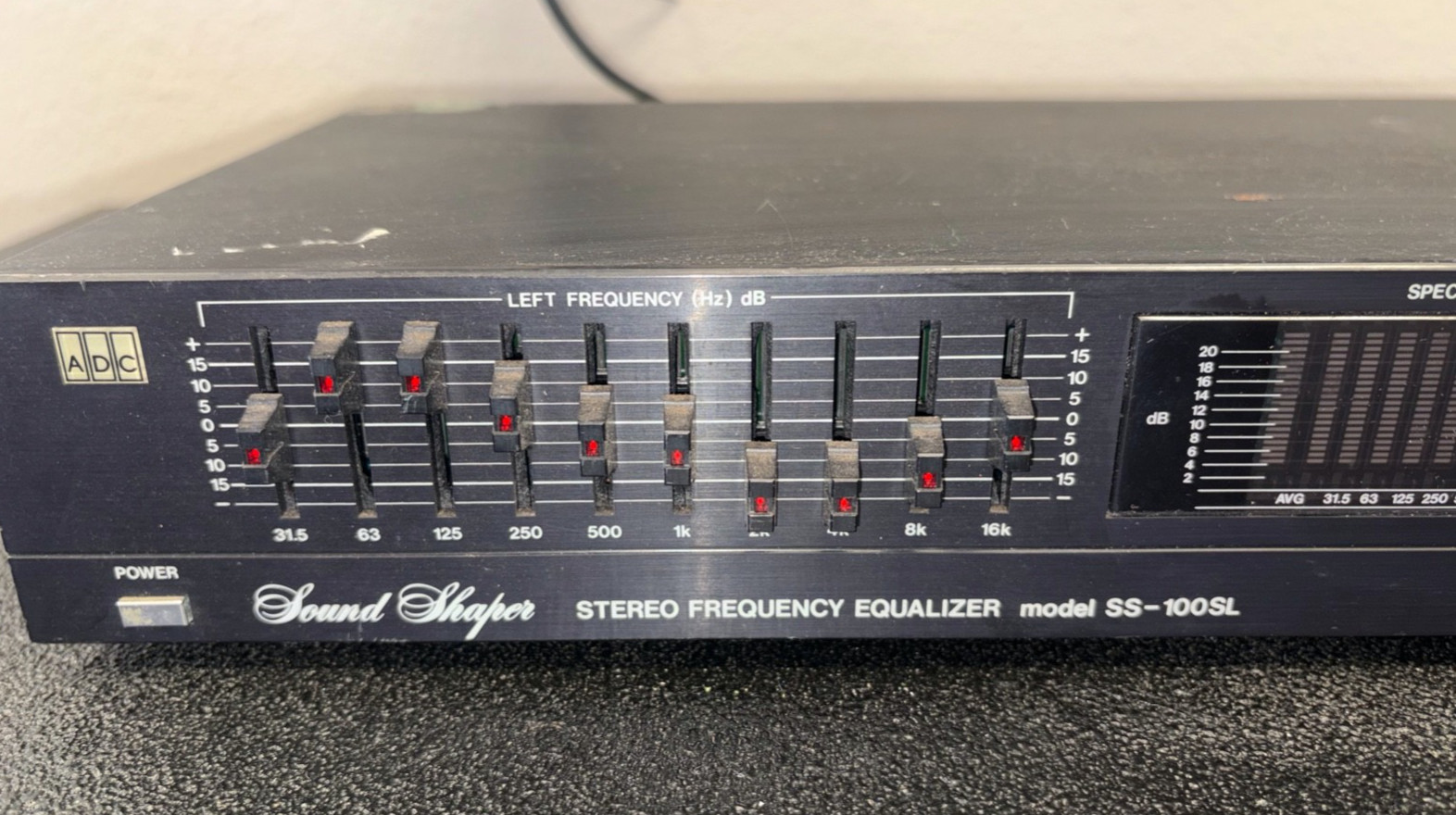
At its core, the SS-100SL is a stereo 10-band graphic equalizer with independent left and right channels, each offering ±15 dB of adjustment across a standard ISO frequency grid from 31.5 Hz to 16 kHz. That alone made it competitive with high-end units from Sony, Yamaha, and Technics. But what set it apart was the real-time analyzer (RTA) display dead center on the faceplate. Unlike cheaper EQs that slapped on a crude LED bar graph, the SS-100SL used a high-precision FL (fluorescent) display to show the actual frequency spectrum of the incoming signal. Pair that with a pink or white noise generator (either from an external source or your own test tones), and you could walk through your listening room, mic in hand, and flatten out resonant peaks with surgical precision. The display even included a bar meter on the left side to monitor average signal level—no guessing if you’re overdriving the input.
It wasn’t just for tuning, though. The SS-100SL was built to live in the signal path. The equalizer circuit includes a bypass switch, so you can A/B your adjustments on the fly, and the signal path is clean enough that you won’t feel guilty leaving it in line. With a frequency response flat from 20 Hz to 20 kHz (±0.5 dB at center detent), distortion below 0.05%, and a signal-to-noise ratio of 100 dB (A-weighted), it doesn’t color the sound when you’re not asking it to. That’s critical—many graphic EQs from the era added noticeable grain or phase smear, but the SS-100SL was engineered to stay transparent. It also includes a subsonic filter below 20 Hz, rolling off at -18 dB per octave, which is a quiet nod to its utility in both home and semi-pro environments where turntable rumble or HVAC noise might creep in.
Specifications
| Manufacturer | Audio Dynamics Corporation (ADC) |
| Production Years | Mid-1980s to early 1990s |
| Original Price | ¥36,000 (Japan, circa 1988) |
| Type | Stereo graphic equalizer with RTA display |
| Center Frequencies | 31.5, 63, 125, 250, 500, 1k, 2k, 4k, 8k, 16 kHz |
| Adjustment Range | ±15 dB per band |
| Gain Accuracy | ±1 dB |
| Maximum Input/Output Level | 4 V RMS or more |
| Frequency Response | 20 Hz – 20 kHz ± 0.5 dB (center position) |
| Total Harmonic Distortion | 0.05% |
| Cross Modulation Distortion | 0.05% |
| Signal-to-Noise Ratio | 100 dB (A-weighted, at 1 V or less) |
| Subsonic Filter | 20 Hz, -18 dB/octave |
| Equalizer Bypass | Yes, front-panel switch |
| Tape Loop | Line-level input and output for tape monitoring |
| Display Type | FL (fluorescent) real-time analyzer |
| Dimensions | 435 mm (W) × 70 mm (H) × 324 mm (D) |
| Weight | 3.3 kg |
Key Features
The RTA Display: Seeing Sound
The centerpiece of the SS-100SL is the FL-based real-time analyzer—a rare feature at this price point. Unlike the segmented LED arrays on consumer-grade units, the FL display offers smooth, continuous visual feedback across the frequency spectrum. It’s not just for show; it’s functional. When paired with a calibrated microphone and noise source, it becomes a room-tuning instrument. Collectors note that the display’s persistence and brightness make it easy to read in low-light environments, and the left-side bar meter gives an instant snapshot of overall level, preventing accidental clipping during setup. The display is driven directly by the incoming signal, so there’s no digital processing delay or sample-rate conversion—what you see is what you hear, in real time.
Independent Stereo Bands and Bypass Logic
Each channel’s 10 sliders operates independently, which is essential for addressing room asymmetries—something you can’t fix with a mono-linked EQ. The bypass switch is a simple but critical addition: it lets you toggle the EQ in and out without touching the settings, so you can instantly hear the effect of your adjustments. This wasn’t universal in the era; some competing models required you to return all sliders to center, which introduced human error. The SS-100SL avoids that by using relay-based switching that maintains signal integrity. Owners report that the relays are robust, though they can accumulate oxidation over decades of inactivity—something to check during restoration.
Signal Path and Build Quality
Inside, the SS-100SL follows a discrete, low-feedback design philosophy typical of ADC’s higher-end gear. The input and output stages are designed to handle up to 4 V RMS, making it compatible with both consumer and pro-level gear. The PCB layout is clean, with wide traces and minimal crosstalk between channels. The sliders themselves are long-throw potentiometers with detented center positions, providing tactile feedback when returning to flat. While not as silky as the Alps pots found in some Japanese receivers, they’re durable and precise. The front panel is aluminum, and the chassis is steel—overbuilt by modern standards, but reassuring when you slide it into a rack.
Historical Context
The SS-100SL arrived during a transitional period in audio—when high fidelity was no longer just about bigger amplifiers and fancier turntables, but about system integration and room acoustics. Companies like Sony and Technics were releasing their own EQs, but most were either basic tone controls or expensive professional units. ADC, a U.S.-based company known for its test equipment and pro audio tools, carved out a niche with the “Sound Shaper” line, targeting both serious home listeners and small studio engineers. The SS-100SL sat below the more advanced SS-300 and SS-412X models, which included built-in pink noise generators and microphone inputs for automated room correction. But unlike those models, the SS-100SL didn’t require proprietary mics or calibration routines—it was a manual tool for people who wanted control, not automation.
Competitors like the Sony EQ-800 and Yamaha EMX-5010 offered similar band counts, but few matched the SS-100SL’s combination of real-time visual feedback and high headroom. In Japan, where the unit retailed for ¥36,000 (roughly $250 at the time), it was positioned as a premium accessory for high-end separates systems. It wasn’t a mass-market product—more of a specialist’s tool—but it found a loyal following among audiophiles who were tired of guessing at room problems. The timing was right: as compact discs eliminated tape hiss and turntable wow, listeners started noticing the next bottleneck: the room itself. The SS-100SL gave them a way to do something about it.
Collectibility & Value
Today, the SS-100SL trades in the $150–$300 range on the used market, depending on condition and functionality. Units with a fully working FL display and responsive sliders command the higher end, especially if the tape loop and bypass switch are operational. Cosmetic condition matters less than function—this was never a showpiece, it was a tool. However, the fluorescent display is a known failure point. Over time, the FL tube can dim, flicker, or fail entirely, and replacements are scarce. Some technicians report success with NOS (new old stock) tubes from industrial suppliers, but sourcing and replacing them requires skill.
The sliders are another common issue. Decades of dust and oxidation can cause scratchy operation or channel imbalance. Cleaning with contact cleaner helps, but if the resistive elements are worn, replacement is the only fix—and the pots are not standard. Service technicians observe that the power supply, while simple, can suffer from capacitor aging, especially in units stored in humid environments. The subsonic filter and tape loop circuits are passive and rarely fail, but the input relays in the bypass circuit can stick if unused for years.
When buying, test every band independently, check both the main and tape outputs, and verify that the display responds to signal input. A unit with dead LEDs on the display isn’t necessarily broken—the SS-100SL uses the FL screen for spectrum and separate LEDs for level indication, so a dark LED bar doesn’t mean the EQ isn’t working. But if the FL screen stays blank, proceed with caution. Also, be aware that the original manuals are rare, though a PDF has surfaced online thanks to a user who digitized their personal copy—a small miracle for restorers.
eBay Listings


As an eBay Partner, we earn from qualifying purchases. This helps support our independent vintage technology research.