ADC SS-1 MkII (1970s–1980s)
A no-nonsense, five-band equalizer that shaped hi-fi tone with surgical precision—and a cult following among those who knew where to slide the sliders.
Overview
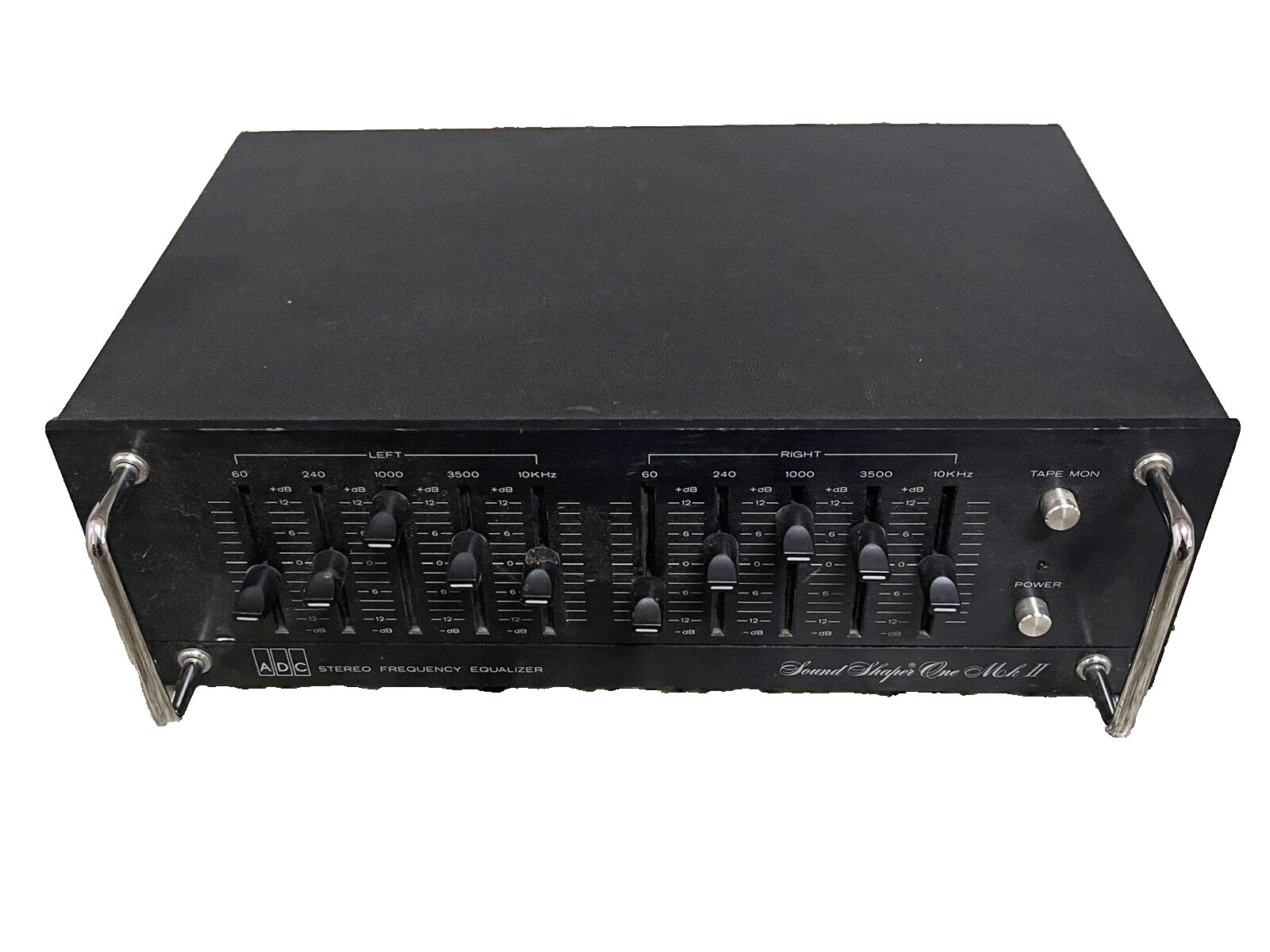
You don’t buy an ADC SS-1 MkII for glitter or glamour. It won’t glow like a Marantz or sit on your rack like a sculpture. But if you’ve ever wrestled with a pair of boxy bookshelf speakers that barked in the upper mids or a room that turned bass into a mudslide, this is the tool that quietly fixed it. The SS-1 MkII isn’t flashy, but it’s honest—five bands of ±12dB adjustment, from 60Hz to 10kHz, each one a scalpel for carving out sonic trouble spots. It doesn’t add color; it reveals what was already there, buried under imbalance. That’s its magic: it doesn’t make things “better” in a euphonic way—it makes them *right*.
Built during the golden age of tweakable hi-fi, when audiophiles debated room placement and speaker toe-in with religious fervor, the SS-1 MkII landed as a rationalist’s answer to acoustic chaos. ADC—Audio Dynamics Corporation—had already made a name with their Accutrac turntables and ZLM cartridges, but by the late ’70s, they pivoted hard into equalization. The SS-1 MkII wasn’t their most advanced model (that honor goes to the SS-315 with its built-in pink noise generator and spectrum analyzer), but it hit a sweet spot: affordable enough for serious listeners, robust enough to last, and transparent enough not to degrade the signal. And while it lacked the 10-band granularity of later pro units, its five bands covered the critical zones—bass warmth, lower midrange body, upper mid clarity, presence, and air—without overwhelming the user.
It’s not perfect. The front panel is utilitarian black with minimal labeling, and the sliders, while smooth when clean, are prone to developing scratchiness over time. But when it’s working—when the Deoxit has been sprayed, the contacts cleaned, and the unit warmed up—it passes audio with startling neutrality. The THD is a solid 0.02%, and the signal-to-noise ratio sits at 85dB, which in the context of early ’80s consumer gear, was more than respectable. It doesn’t compress, it doesn’t distort, and it doesn’t hum—unless something’s wrong. And when something *is* wrong, it’s usually the power supply or oxidized faders, not the circuitry itself. Service technicians observe that the SS-1 MkII’s design favors passive EQ topology with minimal active gain stages, which explains its clean pass-through when set flat.
Specifications
| Manufacturer | ADC (Audio Dynamics Corporation) |
| Production Years | 1970s–1980s |
| Original Price | Not listed in research |
| Frequency Bands | 60Hz, 300Hz, 1.6kHz, 3kHz, 10kHz (per channel) |
| Control Range | ±12dB per band |
| Frequency Response | 5Hz to 100kHz |
| Input Sensitivity | 1V |
| Output Level | 1V (9V maximum) |
| Gain | ±1dB |
| Total Harmonic Distortion | 0.02% |
| Signal to Noise Ratio | 85dB |
| Semiconductors | 12 transistors, 20 diodes, 2 ICs |
| Inputs/Outputs | RCA stereo inputs and outputs |
| Dimensions | 416 x 172 x 159mm |
| Weight | 6kg |
| Power | Not specified in research |
| Special Features | Tape monitor loop, stereo VU meters (on some variants) |
Key Features
The Five-Band Sweet Spot
While 10-band equalizers eventually became the norm, the SS-1 MkII’s five-band layout wasn’t a compromise—it was a design choice rooted in practicality. The selected frequencies weren’t arbitrary: 60Hz tackles fundamental bass energy, 300Hz handles upper bass and lower midrange fullness (a common boom zone in small rooms), 1.6kHz affects vocal presence, 3kHz brings out articulation and string attack, and 10kHz lifts the veil on cymbals and air. This isn’t surgical-grade correction, but it’s more than enough for room tuning or speaker compensation. Collectors note that the spacing avoids overlap and minimizes phase interaction, a subtle but important detail that keeps the sound coherent even with aggressive settings. Unlike some budget EQs of the era that used cheap potentiometers and flimsy PCB layouts, the SS-1 MkII uses precision sliders with solid detents and a grounded chassis that resists microphonics.
Signal Transparency and Build Integrity
What separates the SS-1 MkII from the pack isn’t just its adjustability—it’s what it *doesn’t* do when you’re not using it. Set all sliders to zero, and the unit functions as a near-transparent line-stage pass-through. This was not a given in the late ’70s, when many EQs added noticeable hiss or coloration even at unity gain. The 0.02% THD and 85dB S/N ratio reflect a design that prioritized fidelity over flash. The internal layout, as seen in service reports, uses point-to-point wiring with minimal trace routing, and the power supply is isolated to prevent hum injection. The 6kg weight isn’t just for show—it’s dense steel shielding and a substantial internal transformer that contribute to its noise rejection. Documentation shows ADC used military-spec components in critical signal paths, which helps explain why so many units still function after 40 years.
Tape Monitor Integration
A small but significant detail: the inclusion of a tape monitor loop. This wasn’t just for convenience—it reflected how people actually used EQs in the era. You’d insert the SS-1 MkII between preamp and power amp, route the tape out from your receiver into the EQ’s input, and send the EQ’s output back to the tape in. That way, you could equalize both live sources and tape recordings, which was crucial for cassette enthusiasts battling inconsistent bias and head alignment. The loop also allowed for A/B comparisons: listen to the raw signal, then hit the monitor button and hear the corrected version. It’s a workflow that feels archaic today, but back then, it was the only way to *know* if your adjustments were helping or hurting.
Historical Context
The SS-1 MkII emerged when hi-fi was democratizing. The 1970s saw high-quality audio gear move from boutique shops into department stores, and with that came a new problem: not everyone had a rectangular room with symmetrical speaker placement and acoustic damping. Enter the graphic equalizer—a tool once reserved for recording studios and PA systems—now marketed to home listeners. ADC wasn’t the first to make a consumer EQ (Sony and Technics beat them to it), but they were among the first to offer one with professional-grade specs at a semi-affordable price. Their earlier SS-315 model, with its built-in pink noise generator and fluorescent spectrum analyzer, was a full room-tuning system, but it was complex and expensive. The SS-1 MkII stripped that down to essentials: no analyzer, no mic, no auto-calibration—just sliders and ears.
ADC’s pivot into equalizers coincided with the decline of their turntable line. The Accutrac, while innovative, was mechanically complex and ultimately unreliable. By the early ’80s, ADC shifted focus entirely to signal processing. Around the mid-to-late ’80s, the brand was acquired by BSR, a British company known for budget turntables, and the ADC name began appearing on rebadged units sold through mail-order catalogs like DAK Industries. These later BSR-branded ADCs lacked the build quality of the originals, but the SS-1 MkII predates that era—it’s pure ADC, built when the company still cared about component selection and circuit integrity.
Collectibility & Value
Today, the SS-1 MkII trades in a quiet but steady market. It’s not a showpiece, so it doesn’t command the prices of a Quad ESL or a McIntosh MC275, but it’s valued by those who use it. On the secondary market, working units in good cosmetic condition sell for $150–$250, while non-working or heavily oxidized units go for $75–$120. Refurbished examples—fully recapped, cleaned, and tested—can fetch up to $300, especially if they include the original manual or packaging.
The biggest threat to longevity isn’t age—it’s neglect. The sliders are the Achilles’ heel. Decades of dust and oxidation cause scratchy audio and inconsistent response. A thorough cleaning with contact cleaner like Deoxit usually restores function, but if the resistive strips are worn, replacement is difficult. Unlike modern Alps faders, these are custom units, and no direct drop-in replacements exist. Some techs have resorted to harvesting parts from donor units, making the SS-1 MkII a candidate for “two to make one” repairs.
The power transformer is another point of failure, though less common. When it does fail, replacement is complicated by the lack of published specs. Service logs indicate the transformer is a custom-wound unit with dual secondaries, and substituting a generic model risks voltage mismatch or hum. Owners report that checking the transformer’s output with a multimeter is a smart first step when acquiring a non-working unit.
For buyers, the checklist is simple: power it on and listen. With no input signal, there should be near-silent output—no hum, no buzz. Run a clean source through it and sweep the sliders; any crackling or dropouts mean the faders need attention. Check the tape monitor switch for clean toggling, and verify that the VU meters (if present) respond symmetrically. If it passes those tests, you’ve got a capable, no-nonsense tool that still holds its own against modern DSP-based room correction.
eBay Listings


As an eBay Partner, we earn from qualifying purchases. This helps support our independent vintage technology research.