ADC Sound Shaper Two MKIII (1980–1989)
A 12-band EQ that doesn’t just shape sound—it reveals what your system was hiding all along.
Overview
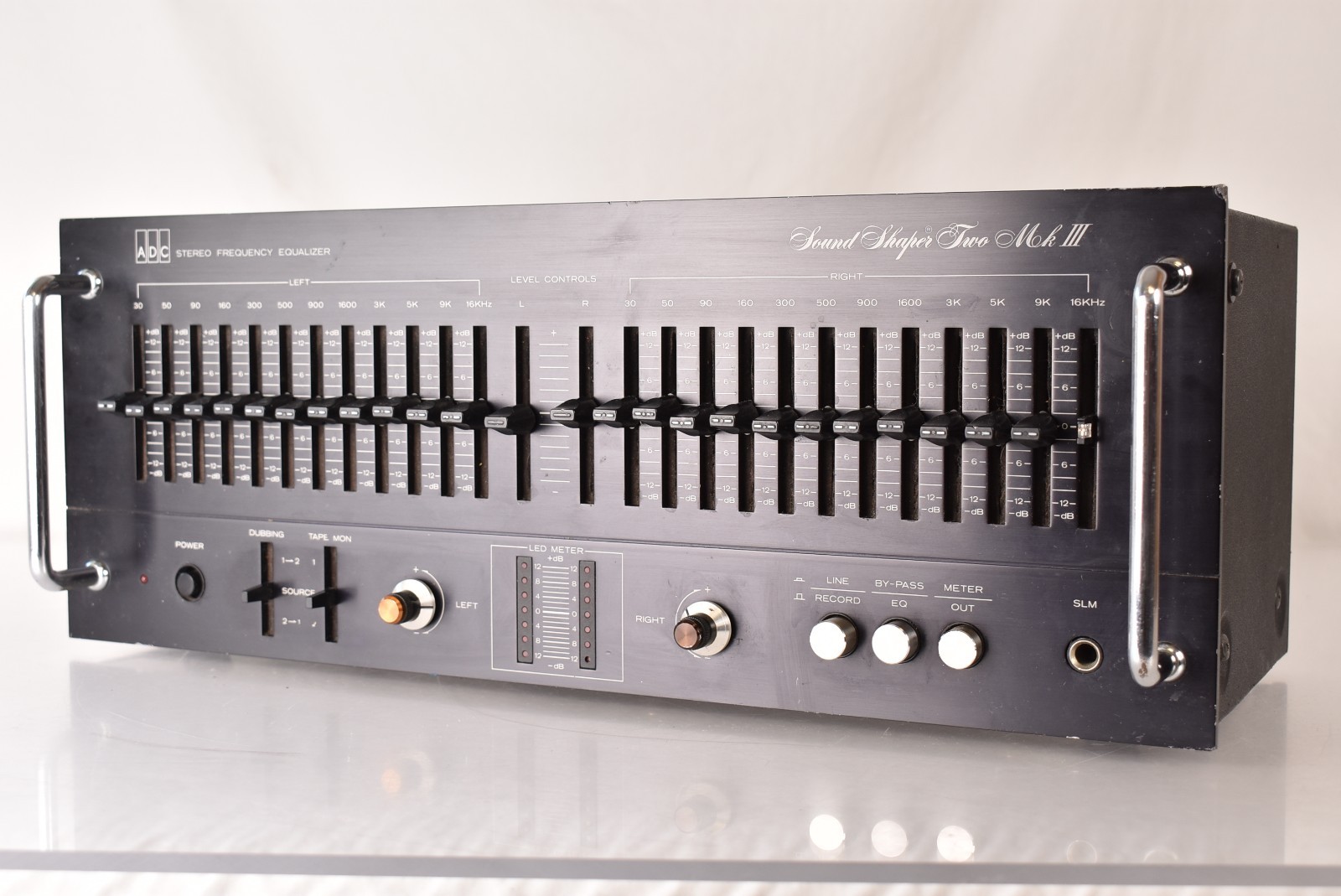
Flipping the power switch on an ADC Sound Shaper Two MKIII feels like unlocking a backdoor in your stereo. Suddenly, the room breathes differently. The bass tightens where it used to bloat. The midrange stops shouting through a pillow. Cymbals shimmer without sizzling. This isn’t magic—it’s precision, built into a slab of brushed black steel with sliders so satisfying to adjust they border on addictive. And that’s the first warning: once you start tweaking, you might not stop. Owners report walking into the room just to nudge a slider, chasing that perfect balance on a familiar track, only to realize 45 minutes have vanished. It’s not just an equalizer. It’s an obsession machine.
Born in the early 1980s, the Shaper Two MKIII landed at a time when audiophiles were finally demanding more than flat response—they wanted control. Not the crude tone controls of old receivers, but surgical, band-by-band authority over frequency response. ADC, or Audio Dynamics Corporation of New Milford, Connecticut, answered with a design that split the difference between pro-audio rigor and high-end home gear. The MKIII wasn’t their first EQ, but it was the one that nailed the formula: 12 fully discrete bands per channel, a clean signal path, and a build quality that still impresses decades later. It wasn’t cheap when new, but it wasn’t trying to be a luxury trinket, either. It was a tool—just one wrapped in a chassis that looked like it could survive a minor earthquake.
The real story isn’t in the specs, though, but in what happens when you plug it in. Unlike some vintage EQs that add their own flavor—veiled mids, fizzy highs, or a slight haze—the Shaper Two MKIII steps aside. It’s transparent when flat, which matters, because no one wants an EQ that colors the sound even when you’re not using it. But when you do engage the sliders, the changes are immediate and accurate. Boost 1 kHz and you don’t get a vague “presence” lift—you get exactly that frequency, and only that frequency, rising with surgical clarity. Cut 250 Hz and the mud clears without thinning the whole lower midrange. That kind of neutrality was rare in consumer gear at the time, more common in studio units twice the price.
Still, it’s not flawless. The temptation to over-EQ is real. One collector on Audiokarma admitted pulling it from their system after months of constant tweaking, confessing it became a crutch—especially with FM radio’s chaotic playlist jumps from pop ballads to thrash metal. The EQ didn’t cause the problem, but it made it worse by inviting endless adjustments. And while the unit itself is robust, time has exposed its weak points: the switches and sliders, though high-quality for the era, develop scratchiness if neglected. A quick dose of contact cleaner usually fixes it, but leave it too long and you’re looking at a full recapping and pot cleaning job, which can add $100–$150 to a restoration budget.
Specifications
| Manufacturer | Audio Dynamics Corporation (ADC) |
| Production Years | 1980–1989 |
| Original Price | $495 (approx. $1,600 today) |
| Input Sensitivity | 1V |
| Output Level | 1V (9V maximum) |
| Gain | ±1dB |
| Frequency Response | 5Hz – 100kHz |
| Total Harmonic Distortion (THD) | 0.02% |
| Intermodulation Distortion (IM) | 0.02% |
| Signal-to-Noise Ratio (S/N) | 85dB |
| Control Range | ±12dB per band |
| Frequency Bands | 30Hz, 50Hz, 90Hz, 160Hz, 300Hz, 500Hz, 900Hz, 1.6kHz, 3kHz, 5kHz, 9kHz, 16kHz |
| Inputs | 1 pair RCA (Main), 2 pairs RCA (Tape In) |
| Outputs | 1 pair RCA (Main), 2 pairs RCA (Tape Out) |
| Number of Channels | 2 (Stereo) |
| Load Impedance | 10kΩ |
| Power Supply | Internal 15V AC transformer |
| Weight | 15 lbs (6.8 kg) |
| Dimensions | 17" W × 5" H × 13" D (43.2 cm × 12.7 cm × 33 cm) |
| Color | Black |
Key Features
12-Band Surgical Precision
Twelve bands weren’t just a number—they were a philosophy. Most consumer EQs of the era settled for 7 or 10 bands, spacing them unevenly and leaving gaps in critical areas like upper bass or lower treble. The Shaper Two MKIII closes those gaps with logarithmically spaced bands that mirror human hearing. The 30Hz and 50Hz sliders let you tame sub-bass resonance without gutting the kick drum. The 900Hz and 1.6kHz bands target the “honk” that plagues many vocal recordings. And the 9kHz and 16kHz controls can add air to cymbals or reduce digital glare from early CDs. Each slider is a 15mm linear potentiometer, built for smooth, repeatable adjustments. They’re not motorized, but they don’t need to be—this is a hands-on device, meant to be touched, not automated.
Studio-Grade Signal Path
Under the hood, the MKIII avoids the cost-cutting tricks that plagued lesser EQs. No IC-based filtering here—each band uses discrete op-amps and passive components, preserving headroom and minimizing crosstalk. The result? An EQ that can handle hot signals without flinching. The 9V maximum output isn’t just theoretical; it means you can drive long cable runs or feed power-hungry preamps without clipping. The 85dB signal-to-noise ratio keeps the noise floor low, so even with deep cuts and aggressive boosts, you won’t hear hiss between tracks. And the 0.02% THD and IM specs aren’t just brochure fluff—they’re consistent across the frequency range, verified by service technicians who still test these units today.
Integrated Tape Monitoring & Build Quality
The rear panel tells a story of thoughtful design. Two sets of tape I/O allow the Shaper Two MKIII to sit neatly in a signal chain, letting you EQ your source before recording to tape or monitor a loop without breaking continuity. The main input and output are straightforward RCA pairs, but the tape switches are tactile and positive—no flimsy toggles here. The front panel, meanwhile, is a study in functional minimalism: black anodized aluminum, recessed sliders, and a centered power indicator. No flashy meters or blinking lights, just clean lines and a chassis thick enough to resist microphonics. Service records show that units from smoke-free environments, even after 40 years, often power up and work flawlessly—testament to ADC’s conservative engineering and quality control.
Historical Context
The early 1980s were a turning point for home audio. High-fidelity systems were becoming more common, but room acoustics and speaker limitations still plagued even the best setups. The rise of the CD brought pristine digital sources, but also exposed flaws in analog playback and room response. Enter the graphic equalizer—not as a novelty, but as a problem solver. Companies like Rane and Drawmer dominated the pro side, but home users needed something more accessible. ADC stepped into that gap with the Shaper series, offering pro-level performance in a form factor that wouldn’t look out of place next to a Marantz receiver or a Technics turntable.
The Shaper Two MKIII wasn’t alone. Competitors like the Sony EQ-700 and the Pioneer EQ-F700 offered similar features, but often with lower build quality or noisier circuits. The MKIII’s closest rival might have been the BSR 1212, but it lacked the ADC’s clean aesthetic and robust construction. What set the Shaper apart was its balance: not quite pro, not quite consumer, but a hybrid that appealed to serious listeners who wanted results without a rack full of gear. It also had a sibling ecosystem—the ADC SA-1 Spectrum Analyzer, designed to pair with the EQ for real-time frequency analysis. Few owners actually used them together, but the fact that ADC offered it speaks to their engineering-first mindset.
By the late ’80s, the EQ craze began to fade. Audiophiles turned toward room correction software and better speakers, and the idea of “fixing” sound after the fact fell out of favor. ADC responded with the SS2-IC, an updated version with improved caps and slightly refined circuitry, but the MKIII remained the sweet spot—fully matured, widely available, and just before the cost-cutting that affected later models.
Collectibility & Value
Today, the Shaper Two MKIII trades in a narrow but passionate market. Units in working condition with clean sliders fetch $200–$300 on eBay, while fully serviced examples with replaced capacitors and cleaned controls can reach $400, especially if they include the original box or manual. Cosmetic condition matters—missing side screws, scratched faceplates, or faded labels knock $50–$100 off the price. The most common failure points are the sliders and switches, which develop scratchiness from dust and oxidation. A full cleaning with DeoxIT can restore smooth operation, but if the pots are worn, replacement is tricky—modern equivalents don’t always fit the panel cutouts.
More serious issues involve the internal power supply. The original 15V AC transformer is robust, but the electrolytic capacitors degrade over time. A full recapping job, including the op-amp power rails, runs $100–$150 at most vintage audio shops. Units that have been recapped often command a premium, especially if the work is documented. One warning: avoid models with a history of overheating. While rare, some units were used in poorly ventilated racks, leading to heat damage on the PCB traces near the power supply. Check for discolored areas or warped boards before buying.
For buyers, the real question isn’t whether the MKIII is worth it—it’s whether you’re ready for the responsibility. This isn’t a “set it and forget it” box. It demands engagement. But if you’re willing to learn your room’s quirks, if you want to hear what your speakers are truly capable of, the Shaper Two MKIII remains one of the most honest tools ever made for the job. It won’t fix a bad system, but it will reveal a good one.
eBay Listings



As an eBay Partner, we earn from qualifying purchases. This helps support our independent vintage technology research.