ADC Sound Shaper Two MKII (1980–1983)
A 12-band equalizer that doesn’t just shape sound—it reveals what your system was hiding, one slider at a time.
Overview
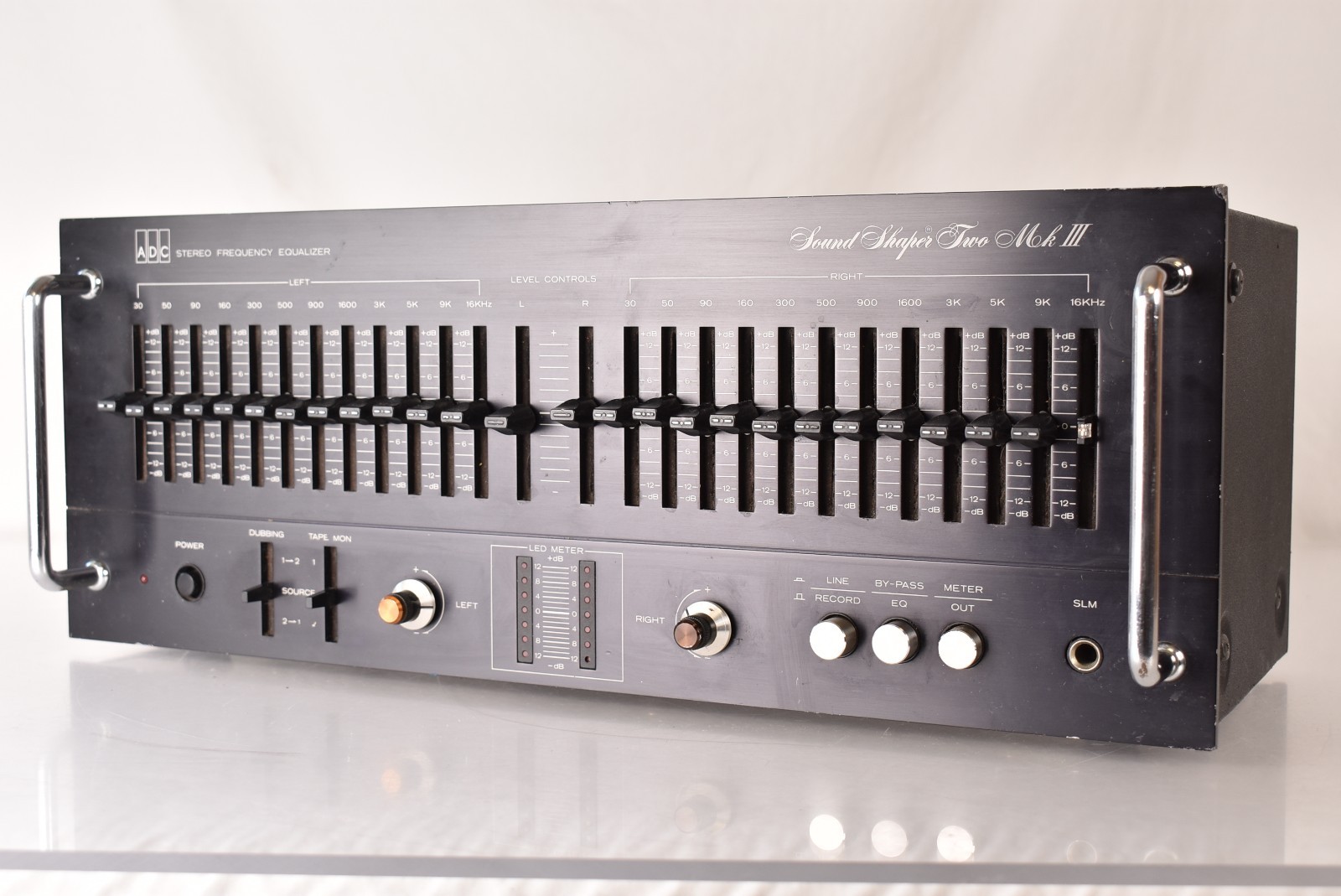
Flipping the power switch on an ADC Sound Shaper Two MKII doesn’t produce fireworks, but the silence afterward tells a story. Not the silence of failure—of course not—but the quiet hum of something built to disappear into the signal path until you need it. And when you do, those 24 chunky sliders, backlit faintly in amber, stand ready like an orchestra tuning up. This isn’t a gadget for the casually curious; it’s for the listener who’s stared down their room’s bass boom, cursed at a bright tweeter, or wondered why their favorite record never quite “sits” right. The Shaper Two MKII was made for that moment—the one where you stop blaming the music and start fixing the chain.
ADC, or Audio Dynamics Corporation out of New Milford, Connecticut, didn’t set out to make flashy gear. They built tools. While other companies chased chrome finishes and blinking lights, ADC focused on measured performance and long-term reliability. The Shaper Two MKII, produced from roughly 1980 to 1983, landed in the sweet spot between their earlier, simpler models and the more advanced MKIII and Two-IC variants. It wasn’t the entry-level EQ—those were the single-digit bands of the SS-110 or SS-33—but it wasn’t the flagship either. It was the workhorse: 12 bands per channel, a clean signal path, and a build quality that still turns heads at hi-fi swaps nearly half a century later.
What makes it special isn’t just the number of bands, but how transparent it is when flat. Unlike some graphic EQs of the era that colored the sound even with all sliders at zero, the Shaper Two MKII steps aside. Its total harmonic distortion is a whisper at 0.02%, and with a signal-to-noise ratio of 85dB, it doesn’t add hum, hiss, or hash to your signal. That transparency is why owners report using it not just for room correction, but as a creative tool—nudging a vocal forward here, taming a resonant floorboard there, all without the sense that the music has been processed. It’s surgical, but not cold.
And then there’s the physical presence. The brushed black faceplate, the precise detents on each slider, the dual LED level meters flanking the center—this is gear that feels like it belongs between a good preamp and power amp. It doesn’t scream “I’m an equalizer!” like some sci-fi console; it just looks like part of a serious system. The tape monitor loop is a thoughtful touch, letting you insert it between components without breaking the tape recording chain—a small thing, but one that shows ADC understood how people actually used their gear.
Specifications
| Manufacturer | Audio Dynamics Corporation (ADC) |
| Production Years | 1980–1983 |
| Original Price | $495 (equivalent to ~$1,700 today) |
| Number of Bands | 12 per channel (24 total) |
| Frequency Range | 5Hz to 100kHz |
| Input Sensitivity | 1V |
| Output Level | 1V (9V maximum) |
| Gain Control Range | ±12dB per band |
| Total Harmonic Distortion (THD) | 0.02% |
| Intermodulation Distortion (IM) | 0.02% |
| Signal-to-Noise Ratio | 85dB |
| Input Impedance | 47kΩ |
| Output Impedance | 600Ω |
| Audio Inputs | 1 pair RCA (Main), 1 pair RCA (Tape In) |
| Audio Outputs | 1 pair RCA (Main), 1 pair RCA (Tape Out) |
| Tape Monitor Function | Yes, switchable |
| Level Meters | Dual LED bar graph (L/R) |
| Power Supply | Internal 120V AC, 60Hz (non-removable) |
| Weight | 15 lbs (6.8 kg) |
| Dimensions | 19" W × 5" H × 12" D (48.3 × 12.7 × 30.5 cm) |
Key Features
The 12-Band Architecture: Precision Without Pretense
Twelve bands per channel was serious business in the early '80s. Most consumer EQs topped out at 5 or 7 bands, while pro gear with 15 or 31 bands often cost twice as much and looked like they belonged in a broadcast truck. ADC split the difference with a carefully spaced curve: bands at 32Hz, 63Hz, 125Hz, 250Hz, 500Hz, 1kHz, 2kHz, 4kHz, 8kHz, 12kHz, 16kHz, and a surprising 20kHz—yes, 20kHz. That top band wasn’t just for show. It let users gently roll off or boost extreme highs, useful for taming worn tapes or bright speakers. The spacing follows a quasi-third-octave layout, giving meaningful overlap between bands without the overkill of a 31-band unit. Each slider has a ±12dB range with smooth, consistent travel. When flat, they sit perfectly aligned, a visual promise of neutrality.
Signal Path Integrity: Where the Magic Hides
The real story isn’t in the sliders—it’s in the circuitry behind them. ADC used high-quality op-amps and discrete components laid out with care, avoiding the cost-cutting shortcuts that plagued some contemporaries. The input and output stages are buffered, preventing loading issues with sensitive preamps or long cable runs. The 85dB signal-to-noise ratio means you can crank up quiet passages without hearing the electronics breathe. And the 0.02% THD and IM specs aren’t just marketing fluff—they’re consistently verified in service manuals and owner measurements. This is one of the few graphic EQs from the era that can sit in a high-end chain without becoming the weakest link. It doesn’t just tolerate high-resolution sources; it respects them.
Build and Interface: Built for the Long Haul
The chassis is a no-nonsense slab of steel, finished in textured black paint that resists scratches and fingerprints. The sliders are Allen-Bradley-style conductive plastic pots—durable, but not immune to wear. Over time, they can develop scratchiness, especially if not exercised regularly. But unlike cheaper EQs with flimsy sliders that wobble or stick, these have a solid, almost industrial feel. The dual LED level meters are a standout feature, offering real-time feedback on output levels—a rarity on consumer EQs. They’re not calibrated to dB, but they’re accurate enough to prevent clipping when boosting multiple bands. The front panel also includes a tape monitor switch, letting users toggle between direct and tape-loop paths. It’s a small thing, but one that speaks to ADC’s attention to real-world use.
Historical Context
The early 1980s were a turning point for home audio. The quadraphonic fad had fizzled, but the rise of high-resolution sources—like the CD, introduced in 1982—meant listeners were hearing more detail than ever. Suddenly, room acoustics, speaker flaws, and recording inconsistencies were harder to ignore. Graphic equalizers, once seen as gimmicks or tools for car audio, started appearing in serious two-channel systems. ADC wasn’t the first to market—companies like Rane, Rane, and Sony had offerings—but they were among the few to treat the graphic EQ as a high-fidelity component rather than an effects box.
The Shaper Two MKII arrived just as audiophiles were beginning to embrace system tailoring. It competed with the Sony EQ-707, the Fisher 750, and the more expensive dbx 120A, but stood apart with its cleaner spec sheet and understated design. While Sony went for flashy meters and chrome trim, ADC kept it clinical. This wasn’t gear for show—it was for solving problems. And unlike the dbx, which leaned into noise reduction and compression, the Shaper Two MKII stayed pure: no compression, no limiting, just EQ. It was the kind of gear you bought not because it looked cool, but because your system needed it.
ADC’s reputation for quality wasn’t accidental. The company had roots in professional audio and test equipment, and it showed. Their equalizers were built in small batches with tight quality control. Documentation was thorough, serviceability was high, and failure rates were low—so low that many units still work today with little more than a cleaning. The Shaper Two MKII was eventually succeeded by the MKIII and the Two-IC, which added features like switchable filter slopes and remote control, but the MKII remains the most balanced blend of performance, usability, and value.
Collectibility & Value
Today, the ADC Sound Shaper Two MKII trades in a narrow but passionate market. Units in working condition with clean sliders and responsive meters typically sell for $200 to $350, depending on cosmetics and provenance. Those with original boxes, manuals, or service records can fetch closer to $400, especially if verified as recently serviced. Units described as “tested” or “recapped” often command a premium—smart, because while the Shaper Two MKII is reliable, it’s not immortal.
The most common failure points are the sliders and the tape monitor switch. Sliders can become scratchy due to dust, oxidation, or worn resistive tracks. Most respond well to contact cleaner like DeoxIT, but heavily worn units may need replacement—a tedious but doable repair. The tape monitor switch, a mechanical push-button, is another weak spot. Owners report intermittent cutouts, especially in the right channel, as seen in service notes from The Music Room. A quick blast of cleaner often fixes it, but if the switch is worn, replacement parts are scarce.
The internal power supply is non-removable and uses aging electrolytic capacitors. While not a frequent failure point, a failing cap can cause hum or channel dropouts. Recapping the unit—replacing all electrolytics—runs $150 to $250 at a competent tech, but it’s often worth it for long-term ownership. Unlike some vintage gear that’s more valuable untouched, the Shaper Two MKII benefits from maintenance. A freshly serviced unit sounds as good as it did in 1981.
When buying, check each slider for smooth operation and listen for channel imbalance or noise. Verify that the tape monitor loop works cleanly and that the level meters respond to input. Look for dents, missing screws (especially on the side panels), and faded labeling. The original finish is durable, but UV exposure can dull the faceplate over decades. Avoid units described as “untested” unless priced as parts-only—there’s no point saving $50 only to spend $200 on repairs.
For those building a period-correct system or seeking a transparent EQ for modern use, the Shaper Two MKII remains a top contender. It’s not the rarest ADC model—those would be the SS-315 with spectrum analyzer or the elusive Two-IC—but it’s arguably the most practical. It doesn’t try to do everything; it just does one thing exceptionally well.
eBay Listings


As an eBay Partner, we earn from qualifying purchases. This helps support our independent vintage technology research.