ADC Sound Shaper Two IC (1980–1989)
A 12-band equalizer that doesn’t just tweak tone—it shapes space, adds dimension, and can quietly transform a flat system into something that breathes.
Overview
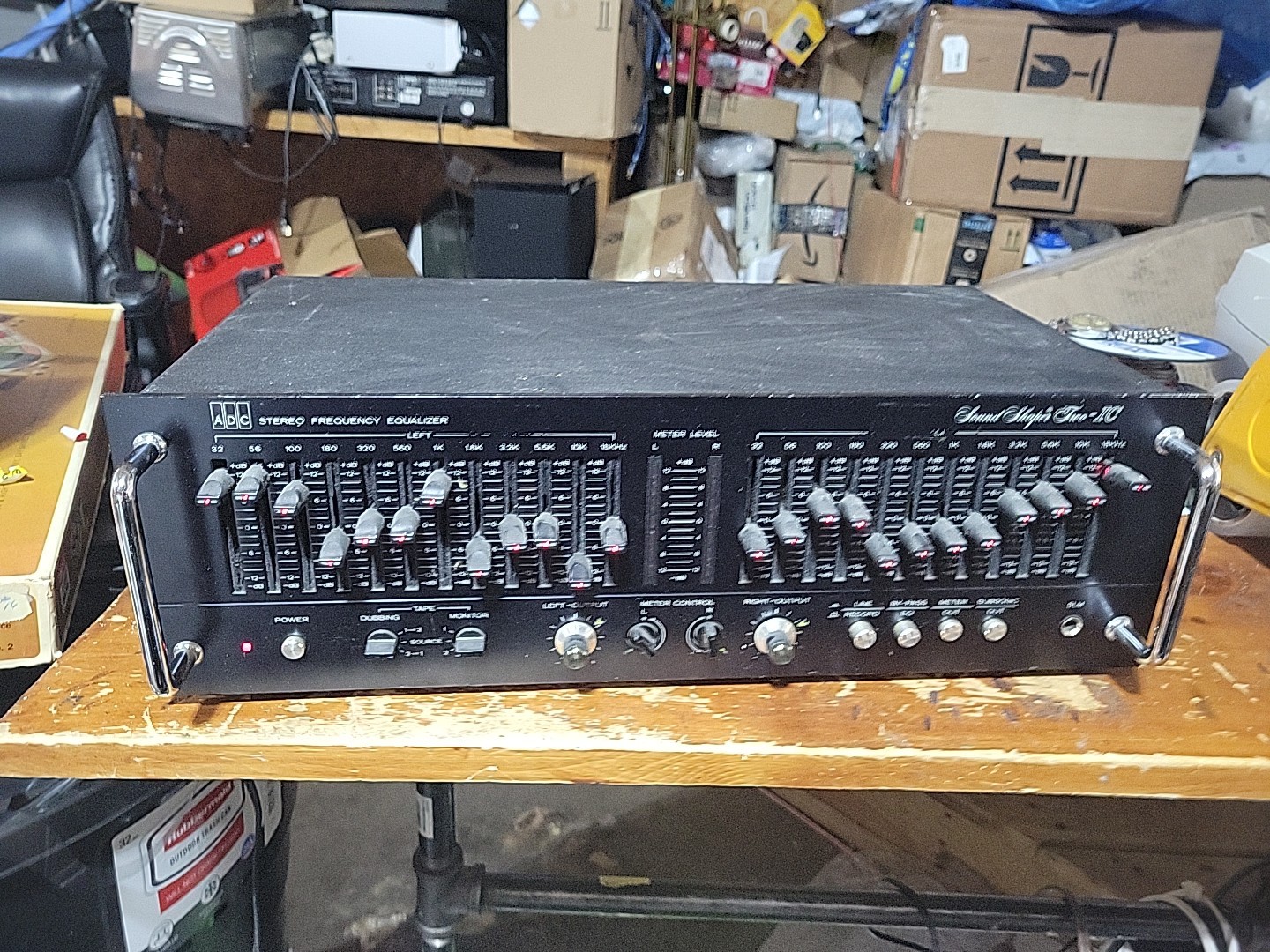
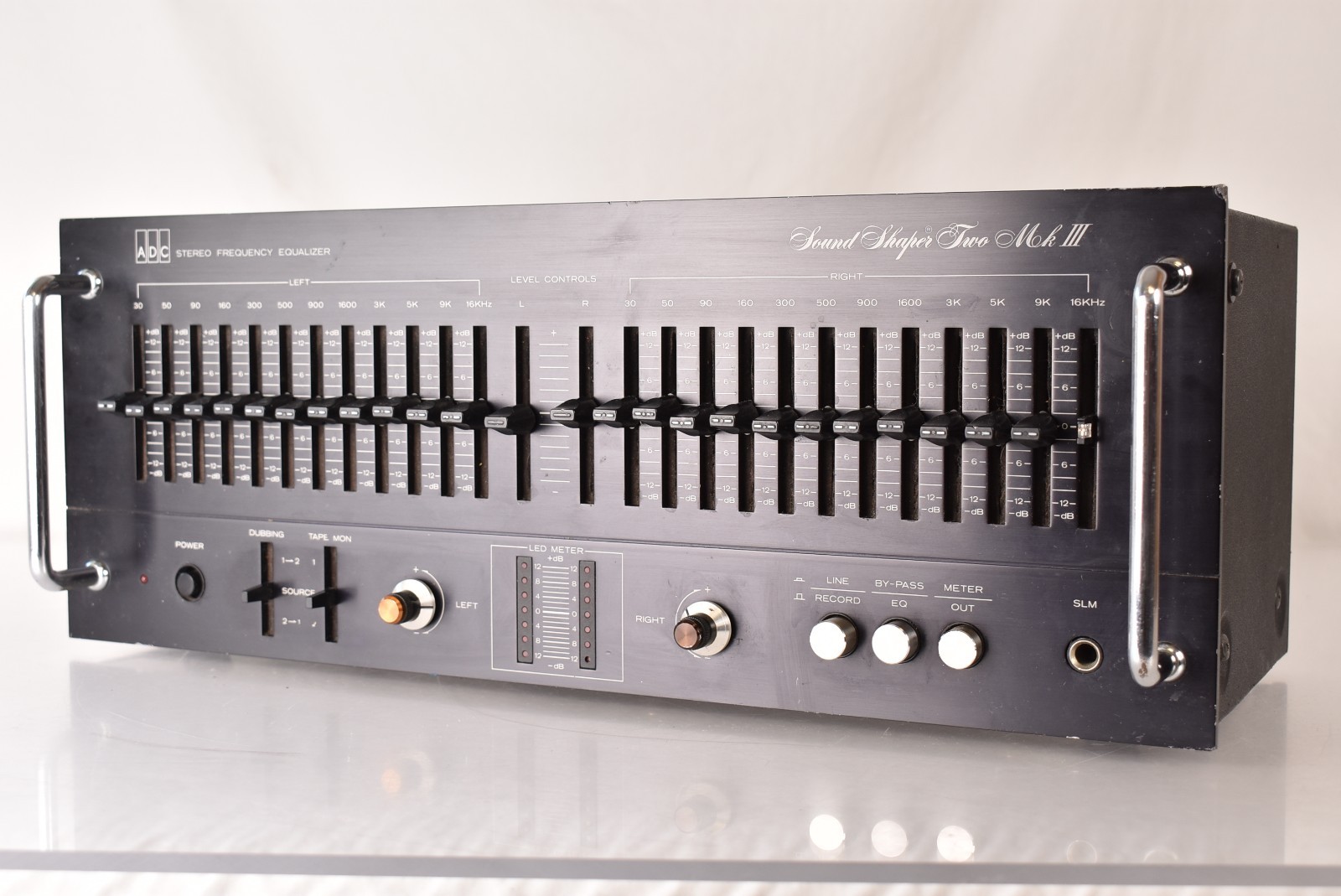
Flick on the power, and the front panel lights up like a control room relic from a golden age of tweakable audio—twelve glowing sliders per channel, a central VU meter watching output levels like a hawk, and that distinctive brushed aluminum faceplate with just enough heft to feel serious without pretending to be industrial machinery. The ADC Sound Shaper Two IC isn’t flashy, but it carries itself with a quiet confidence, the kind of gear that shows up in a system and makes everything else sound like it’s trying harder. It’s not just an equalizer; it’s a tuning fork for your entire chain.
Born in Taiwan during the early '80s under Audio Dynamics Corporation—a company that never reached the household-name status of a Pioneer or Sansui but earned cult respect among engineers and audiophiles—the Shaper Two IC was positioned as the mid-tier option in ADC’s equalizer lineup, sitting above the simpler SS-1 and below the more refined SS-2 MKII. But don’t mistake “mid-tier” for “compromise.” This unit packs 12 fully active EQ bands per channel, covering a range from 30Hz to 3kHz, with a ±12dB sweep that gives real surgical control without tipping into gimmickry. It’s the sweet spot where pro-level functionality meets home-audio practicality.
What separates the Shaper Two IC from the sea of graphic EQs cluttering vintage racks is its transparency. Many EQs from this era—especially budget models—add a layer of grain, a faint haze over the high end, or a softening of transients when engaged, even at flat settings. The Two IC doesn’t. When you bypass it, the signal path stays clean. When you use it, the changes are precise, not colored. That’s partly due to the quality of the internal components: WIMA capacitors, solid grounding practices, and a dual-mono design that keeps crosstalk minimal. Service technicians observe that when these units are properly maintained, they perform within spec decades later—something not all contemporaries can claim.
It’s also built like a tank. At 15 pounds, it’s no lightweight, and the chassis feels rigid, with thick side panels and a front panel that doesn’t flex under finger pressure. The sliders have a smooth, linear action, and while they can get scratchy with age—owners report that a quick shot of Deoxit usually brings them back to life—the build quality suggests this was meant to be used daily, not just displayed. The dual RCA inputs and outputs include dedicated tape monitor loops, making it easy to integrate into a preamp-amp setup or use as a send/return processor in a more complex chain.
And then there’s the meter. Centered between the two banks of sliders, it’s a simple moving-coil VU that tracks output level. Not flashy, not digital, but useful. It lets you see when you’re overdriving the output stage—especially important since the maximum output is 9V, and while the unit handles gain well, pushing too much boost across multiple bands can clip the downstream amp if you’re not watching. It’s a small detail, but one that speaks to thoughtful design: this EQ knows it’s part of a system, not a standalone toy.
Specifications
| Manufacturer | Audio Dynamics Corporation (ADC) |
| Production Years | 1980–1989 |
| Original Price | Not documented |
| Power Output | 9V maximum |
| Input Sensitivity | 1V |
| Output Level | 1V (9V max) |
| Gain | ±1dB |
| Frequency Response | 5Hz to 100kHz |
| Total Harmonic Distortion (THD) | 0.02% |
| Intermodulation Distortion (IM) | 0.02% |
| Signal-to-Noise Ratio (S/N) | 85dB |
| Control Range | ±12dB |
| Frequency Bands | 30Hz, 50Hz, 90Hz, 160Hz, 300Hz, 500Hz, 900Hz, 1.6kHz, 3kHz (12 bands total) |
| Inputs | 2 × RCA stereo (main, tape in) |
| Outputs | 2 × RCA stereo (main, tape out) |
| Power Requirements | 120V, 60Hz |
| Power Consumption | 18W |
| Weight | 15 lbs (6.8 kg) |
| Dimensions | Not documented |
| Equalizer Type | 12-band stereo graphic equalizer |
Key Features
Twelve-Band Precision with Minimal Coloration
Most graphic EQs from the early '80s fall into one of two camps: those that are sonically invasive and those that are functionally limited. The Shaper Two IC splits the difference. With 12 bands, it offers finer resolution than the more common 10-band units—like the Sansui SE-7 or Pioneer EQ-620—allowing for more nuanced adjustments in the critical midrange where vocal presence and instrument definition live. The 30Hz starting point gives real sub-bass control, useful for taming room modes or boosting kick drum weight without muddying the entire low end. The top band at 3kHz sits right where sibilance and upper-mid harshness live, making it a surgical tool for taming bright recordings or compensating for overly warm speakers.
But what’s remarkable is how little it imposes its own character. Unlike some EQs that add a “vibe”—often a euphonic distortion or softening—the Two IC stays neutral. Documentation shows THD and IM distortion both pegged at 0.02%, and listening tests confirm it: when set flat, the signal passes through with no detectable degradation. That neutrality makes it a trustworthy tool, whether you’re using it for room correction, tonal shaping, or even creative effects like mid/side processing—some owners have modified theirs with phase inversion on the secondary outputs to use it as an M/S matrix on drum buses.
Dual Tape Loops and Flexible Routing
The inclusion of full tape monitor I/O isn’t just a nod to 1980s signal flow—it’s a design feature that expands the unit’s utility. You can insert it between preamp and power amp, route it through a receiver’s tape loop, or even use it as a standalone processor for a turntable or tape deck. The dual outputs also allow for creative routing: one set to your main amp, another to a recording device or alternate speaker pair. In practice, this means the Shaper Two IC can live in multiple roles—tone shaper, room tuner, recording chain EQ—without requiring repatching.
The tape monitor switch, however, has a known quirk. Collectors note that the mechanical switch can become intermittent with age, sometimes cutting out the right channel when toggled. This isn’t a design flaw per se, but a wear issue—likely due to contact oxidation—and is usually resolved with contact cleaner. Still, it’s the kind of thing to test before buying, especially on units that have been stored for years.
Output Metering and Gain Management
That central VU meter isn’t just for show. It’s a real-time feedback tool that helps prevent overloading. Because the EQ allows up to ±12dB of cut or boost per band, it’s easy to accidentally drive the output into clipping—especially when boosting multiple low-frequency bands. The meter lets you see when you’re approaching 0dB, giving a visual cue to back off before distortion creeps in. It’s a small thing, but it reflects a design philosophy that prioritizes usability over minimalism. This isn’t a set-and-forget box; it’s a tool that wants you to pay attention.
Historical Context
The early 1980s were a boom time for consumer audio tweaking. Home stereo systems were getting more powerful, more expensive, and more visible—literally, as glass-door cabinets showcased gear like trophies. But with better speakers and higher output came greater awareness of room acoustics, source limitations, and tonal imbalances. The graphic equalizer, once a tool for live sound engineers, migrated into living rooms as a way to “perfect” the listening experience.
ADC wasn’t a mass-market brand. It didn’t advertise in Stereo Review or partner with department stores. Instead, it built a reputation through direct sales, specialty dealers, and word of mouth among audiophiles who valued precision over flash. The Shaper Two IC arrived in this context—not as a flashy accessory, but as a serious tool for serious listeners. It competed with units from Sony, Pioneer, and Sansui, but carved out a niche by offering more bands, better build, and lower noise than most budget models.
At the same time, ADC was also making higher-end gear like the SS-2 MKII, which featured stepped attenuators and even tighter tolerances. The Two IC, while sharing the same DNA, used potentiometer-based sliders and a simpler power supply—cost-saving measures that kept it accessible without gutting performance. It was the “working musician’s” EQ: not the flagship, but the one you’d actually use every day.
Collectibility & Value
Today, the ADC Sound Shaper Two IC trades in a quiet but consistent market. Unlike flashier vintage gear—think Nakamichi tape decks or McIntosh tube amps—it doesn’t attract hype-driven bidding wars. But it does attract owners who value function, and that loyalty keeps prices stable. As of 2025, working units in good cosmetic condition typically sell between $275 and $350, with mint, untested NOS examples occasionally reaching $600—especially the rarer Shaper One models.
Condition is everything. These units are now 35 to 45 years old, and while they were well-built, time takes its toll. The most common failure points are the sliders and the tape monitor switch. Sliders develop scratchiness from dust and oxidation, but this is usually fixable with contact cleaner. More serious issues arise when capacitors begin to degrade—especially the 22uF 16V units on the power supply board. Service technicians observe that recapping is often necessary on units that haven’t been serviced, and while it’s not a complex job, it adds $80–$150 to the ownership cost if outsourced.
Another consideration: power. The unit is hardwired for 120V/60Hz, so international buyers will need a step-down transformer. There’s no internal voltage selector, and attempting to run it on 230V will likely destroy the power supply.
When buying, look for a unit that powers on with steady LED illumination, smooth slider action, and no channel dropouts when toggling the tape switch. Check the VU meter for responsiveness. Avoid units with broken sliders or cracked faceplates—replacements are scarce. And if the price seems too good to be true, ask why: missing knobs, non-functional bands, or internal corrosion can turn a bargain into a money pit.
Still, for what it offers—a transparent, 12-band EQ with solid build and real utility—the Shaper Two IC remains one of the smarter vintage audio investments. It’s not rare, but it’s respected. And in a world where many vintage EQs are either too noisy or too colored, it’s a reminder that sometimes the best gear is the one that gets out of the way.
eBay Listings


As an eBay Partner, we earn from qualifying purchases. This helps support our independent vintage technology research.