ADC Sound Shaper Two (1979–1980s)
Twelve sliders per channel, a clean signal path, and the rare ability to fix your room without ruining your music.
Overview
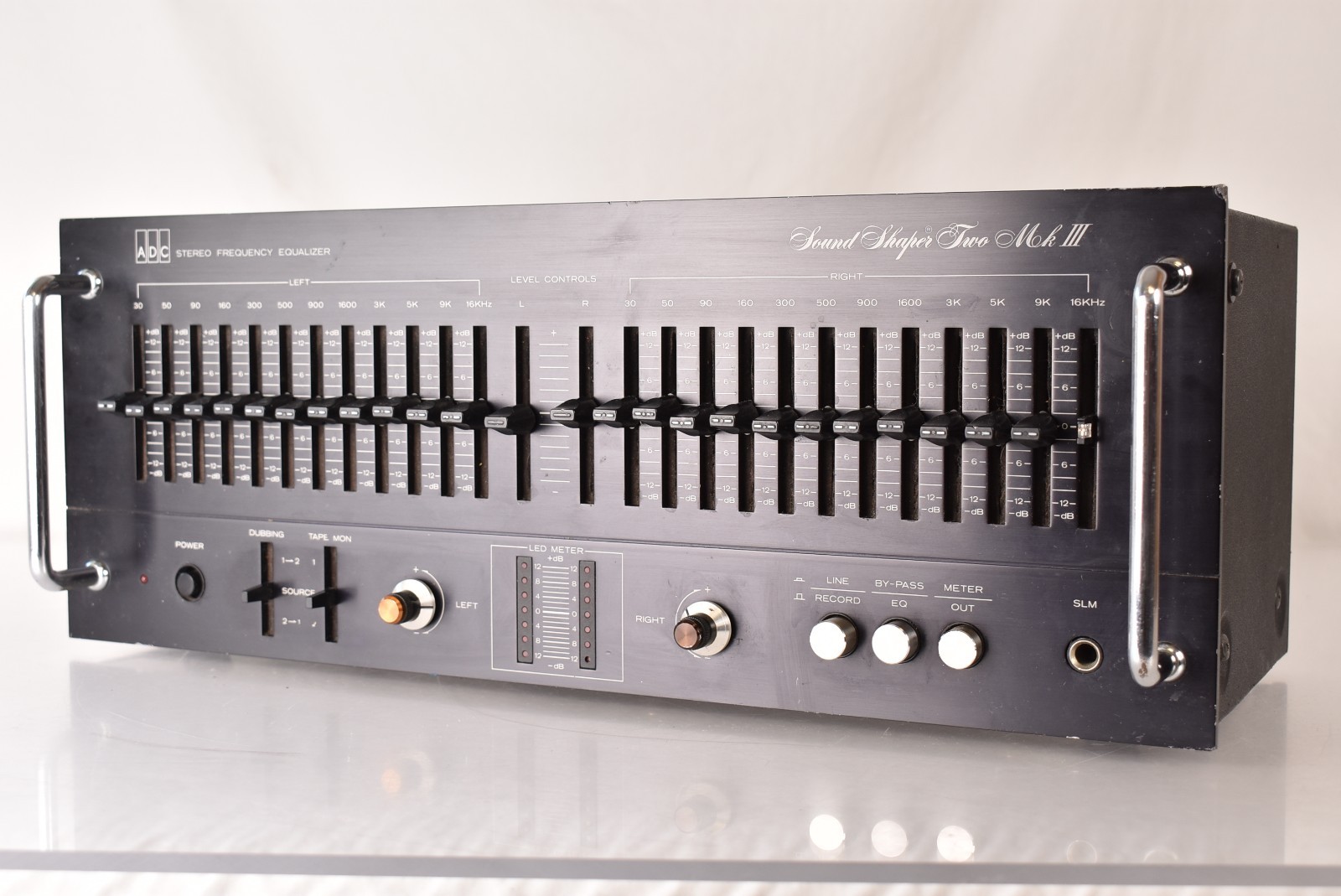
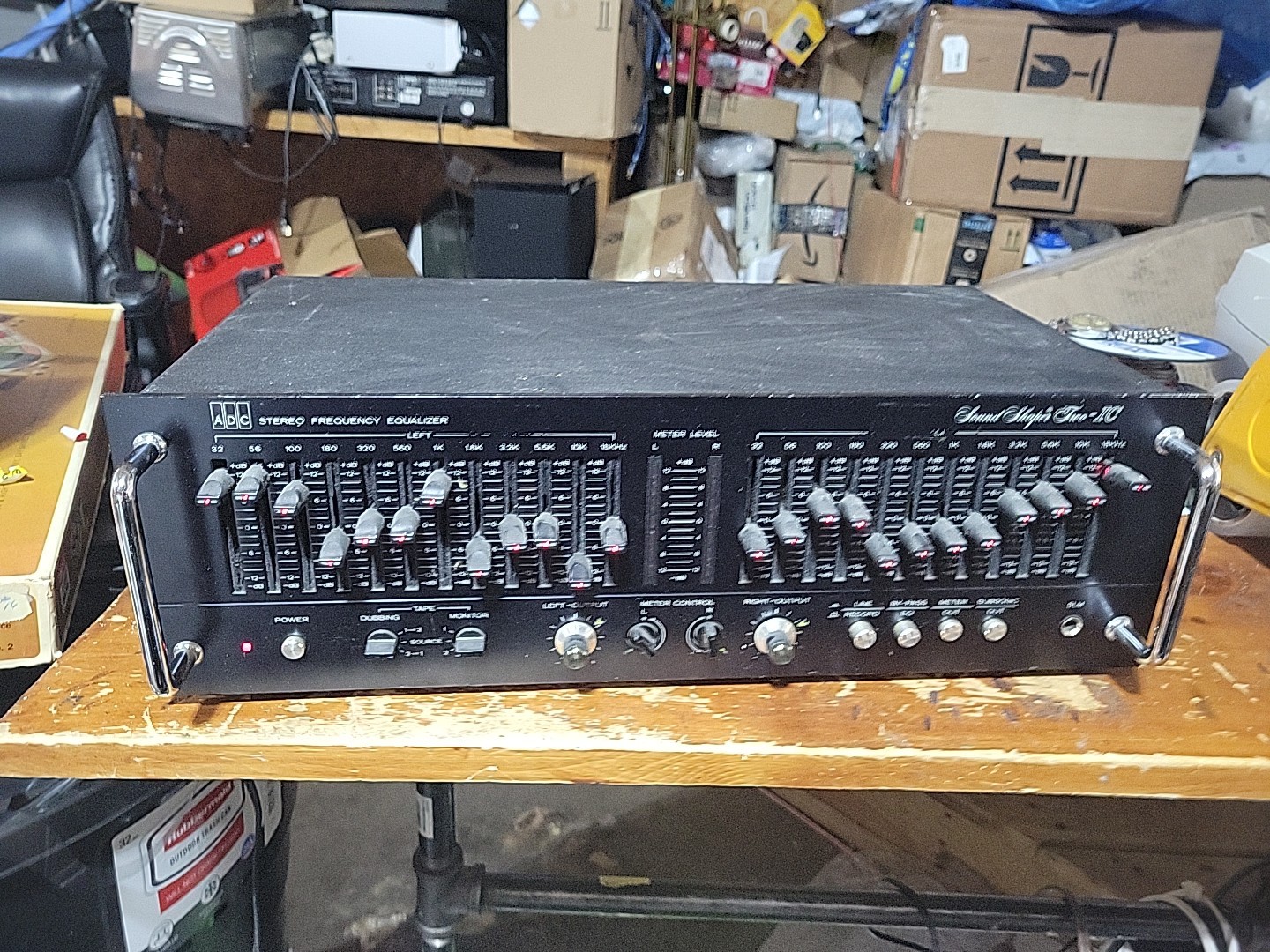
That first flick of the power switch on an ADC Sound Shaper Two doesn’t just light up a pair of VU meters—it unlocks a quiet revelation: you can actually hear your speakers now. Not the room, not the standing waves, not the boom in the corners. The music. This isn’t some colored, hyped-up tone shaper masquerading as correction; it’s surgical, transparent equalization from an era when high-end gear still meant hand-wired point-to-point construction and specs that didn’t lie. The Shaper Two arrived after the modest success of the original Model 1, but it wasn’t just an update—it was a statement. With 12 bands of EQ per channel, front-panel meters, and a microphone input for real-time room analysis (a rarity in consumer gear at the time), ADC wasn’t just chasing audiophiles. They were building tools for people who wanted to *solve* problems, not just tweak tone.
And solve they did. Owners report that the Shaper Two doesn’t just sit in the signal path—it disappears. Unlike many graphic EQs of the era (and even some modern ones), it doesn’t add grain, smear, or a sense of electronic detachment. The frequency response stretches from a plausible 5Hz to a wildly optimistic 100kHz, far beyond what any speaker or LP could deliver, but the intent was clear: keep the passband flat and open, so the EQ only does work when you tell it to. With a signal-to-noise ratio of 85dB and THD measured at just 0.02%, it slips into a high-end chain without announcing itself. That neutrality is its superpower. You don’t buy a Shaper Two because you want a “vintage sound.” You buy it because your room has a null at 80Hz and your floorstanders bark at 2.5kHz, and you’re tired of living with it.
Within the ADC lineup, the Shaper Two was the sweet spot—more refined than the no-frills Model 1, yet without the esoteric complexity of later studio-focused units. It split the difference between home audiophile and semi-pro studio use, a duality reflected in its dual input sensitivity options and the inclusion of a mic preamp for calibration. Later revisions—MKII and MKIII—tweaked cosmetics and sliders, but the core circuit remained largely unchanged. The MKII brought improved sliders and a slightly updated faceplate; the MKIII added cosmetic refinements but no meaningful sonic upgrades. Collectors and technicians agree: if you’re hunting for the definitive home version, the MKII is the one to target. It’s the most commonly found, best documented, and most reliable of the series.
Specifications
| Manufacturer | ADC Sound |
| Production Years | 1979–1980s |
| Original Price | Not available |
| Input Sensitivity | 1V |
| Output Level | 1V (9V max) |
| Gain | ±1dB |
| Frequency Response | 5Hz – 100kHz |
| Signal to Noise Ratio | 85dB |
| Total Harmonic Distortion | 0.02% |
| Intermodulation Distortion | Not available |
| Control Range | ± ? dB (per band) |
| Number of Bands | 12 per channel |
| Filter Type | Paragraphic (quasi-parametric) |
| Meters | VU meters (input/output) |
| Inputs | RCA (line), 1/4" (microphone) |
| Outputs | RCA |
| Weight | 6 kg (13.2 lbs) |
| Dimensions | 416 x 172 x 159 mm (W x H x D) |
| Power Requirements | Not available |
| Construction | Steel chassis, aluminum faceplate, discrete circuitry |
Key Features
Twelve Bands of Surgical Precision
While many graphic EQs settled for 10 bands, the Shaper Two went further with 12 per channel, spacing the frequencies to cover problem areas more effectively—especially in the critical 60Hz to 500Hz range where room modes wreak havoc. The filters are “paragraphic,” meaning they offer a blend of fixed center frequencies with some bandwidth flexibility, giving more control than a standard graphic EQ without the complexity of a full parametric. This makes it unusually effective at notch filtering—dialing out a specific resonance without dragging down adjacent frequencies. For vintage gear, that level of surgical ability is rare. Most EQs from this era either colored the sound or lacked the resolution to do real correction. The Shaper Two does neither. It’s a scalpel, not a paintbrush.
Integrated Metering and Mic Input
The inclusion of dual VU meters isn’t just for show—they’re essential for setting input levels correctly, a critical step when inserting an EQ into a high-gain chain. Overdriving the Shaper Two isn’t common, but it can happen if paired with a hot preamp, and the meters let you back off before clipping. More intriguing is the 1/4" microphone input, a feature almost unheard of in consumer-grade equalizers. This wasn’t just a gimmick; it allowed users to plug in a measurement mic and sweep tones to identify room issues, then adjust the sliders in real time. While ADC didn’t include software or test tones (those came later), the hardware foundation was there for actual acoustic correction. In the early 1980s, that put the Shaper Two ahead of 90% of the market.
Build That Lasts—When Maintained
Open the case and you’re greeted with point-to-point wiring, hefty transformers, and high-quality potentiometers under each slider. This isn’t mass-produced PCB junk. It’s overbuilt, which is why so many still work after 40 years. But time takes its toll. The sliders themselves are the most common failure point—dusty, oxidized, or worn out from decades of adjustment. Owners report that a thorough cleaning with contact cleaner (like Deoxit) often restores smooth operation, but some sliders may need replacement if the resistive strip has degraded. The power supply is generally robust, but like any gear from this era, electrolytic capacitors will eventually dry out. A full recap isn’t always necessary, but it’s a smart move if the unit has been powered off for years.
Historical Context
The late 1970s and early 1980s were a golden age for high-end audio innovation, and ADC Sound emerged in that window with a focus on precision tools rather than lifestyle gear. While brands like Marantz and Sansui were selling receivers with walnut veneers and glowing VU meters, ADC was quietly building gear for people who wanted measurable performance. The Shaper Two arrived when home listening rooms were often untreated, speakers were inefficient, and turntables still introduced significant coloration. Room correction wasn’t a feature—it was a DIY project. ADC saw an opening: deliver studio-grade equalization to the serious listener. Competitors like Rane and Ashly were active in the pro world, but their gear was expensive and industrial. The Shaper Two offered 80% of that functionality in a package that wouldn’t look out of place next to a Rek-O-Kut or a McIntosh preamp.
It also arrived just before the digital revolution made room correction commonplace. By the late 1980s, DSP-based systems would begin to dominate, but they were prohibitively expensive and often sonically compromised. The Shaper Two remained relevant because it worked in the analog domain, where phase shifts and latency weren’t concerns. It didn’t “model” anything—it just adjusted frequency response with minimal side effects. For purists, that mattered. And unlike many graphic EQs of the era (looking at you, Radio Shack), it didn’t degrade the signal when set flat. That transparency gave it staying power even as newer tech emerged.
Collectibility & Value
Today, the ADC Sound Shaper Two occupies a quiet but respected niche. It’s not a flashy showpiece like a gold-plated preamp or a tube monster, but it’s the kind of gear that changes how you hear your system. Prices vary widely based on condition and revision. A fully functional MKII in good cosmetic shape typically trades between $300 and $500 on the used market. Units with original boxes, manuals, or microphone accessories can fetch $600 or more, especially if verified as low-hours from a meticulous owner. The MKIII commands similar prices, though it’s less sought after due to minimal upgrades. The original Model 1 is rarer but often less desirable due to the lack of meters and mic input.
When buying, the biggest red flags are scratchy sliders and intermittent connections. Test every slider—move them slowly and listen for noise. The tape monitor switch (used for A/B comparisons) is another known weak point; some units develop channel dropouts when toggling, often due to dirty contacts. A quick shot of contact cleaner usually fixes it, but if the switch is mechanically worn, replacement parts are scarce. Cosmetic condition is secondary—these were tools, not decor—but dented sliders or cracked faceplates can indicate rough handling. Fully recapped units are worth a premium, especially if documentation is provided. Service technicians observe that while the Shaper Two is reliable, neglected units stored in damp environments often have corroded circuit boards or failing capacitors. A unit that’s been sitting for decades should be powered up gradually with a variac to avoid catastrophic failure.
For those considering restoration, budget $150–$250 for a professional recap and slider refurbishment. DIY is possible but requires patience—there are 24 sliders to clean or replace, and sourcing exact replacements can be tricky. The good news? The circuit is simple by modern standards, and schematics occasionally surface in enthusiast forums. It’s not a restoration nightmare like a multichannel tube amp, but it’s not a plug-and-play vintage purchase either. Treat it like a classic car: it’ll reward care, but it won’t forgive neglect.
eBay Listings


As an eBay Partner, we earn from qualifying purchases. This helps support our independent vintage technology research.