ADC Sound Shaper Twenty (1979–1985)
That first flick of the power switch—bright LEDs flaring across twelve sliders like a console waking up for a mix—tells you this isn’t just an EQ, it’s a command center.
Overview
Plug in the ADC Sound Shaper Twenty and you’re not just adjusting frequency balance—you’re stepping into the driver’s seat of your entire system. This isn’t one of those flimsy, single-knob tone controls masquerading as equalization. The Shaper Twenty is a full 12-band stereo graphic equalizer, built like a broadcast rack unit but refined enough for the most discerning home audiophile. It arrived in 1979, right when high-end audio was shedding its “wooden box” image and embracing precision, transparency, and user control. ADC—Audio Dynamics Corporation, based in New Milford, Connecticut—wasn’t trying to win beauty contests. They were building tools. And the Shaper Twenty? It was engineered for people who wanted surgical control without sonic compromise.
Unlike many graphic EQs of the era that colored the sound with added noise or sluggish response, the Shaper Twenty was designed with low-distortion circuitry and high-quality potentiometers under those satisfyingly stiff sliders. Owners report a clean, neutral pass-through when all bands are flat—rare for a graphic EQ, especially one from the early '80s. But when you need to carve out a boominess at 125 Hz or lift presence at 4 kHz, the effect is immediate and musical, not clinical. It doesn’t fight your system; it listens, then responds. And those sliders—each backlit with a soft red glow—aren’t just for show. They make on-the-fly adjustments intuitive, especially in dim listening rooms. You can see at a glance exactly where the curve sits, which matters when you’re tweaking for different recordings or room modes.
Positioned between the entry-level Shaper One and the elite, dual-channel Shaper Two-IC, the Shaper Twenty was the sweet spot for serious enthusiasts who wanted pro-level control without the pro-level price or complexity. It wasn’t marketed as a “tone shaper” for rock and roll excess—though it could certainly do that—but as a precision instrument for system integration and room correction. And in that role, it excelled. Service technicians observe that units which have been regularly used and maintained tend to track their sliders evenly, with minimal channel drift, a testament to ADC’s build quality and conservative component selection.
Specifications
| Manufacturer | ADC Sound (Audio Dynamics Corporation) |
| Production Years | 1979–1985 |
| Original Price | $495 (1980 USD) |
| Equalization Bands | 12 per channel (stereo) |
| Frequency Points | 32 Hz, 63 Hz, 125 Hz, 250 Hz, 500 Hz, 1 kHz, 2 kHz, 4 kHz, 8 kHz, 12 kHz, 16 kHz, 20 kHz |
| Boost/Cut Range | ±12 dB per band |
| THD | 0.03% at 1 kHz, 2 V output |
| IM Distortion | 0.03% |
| S/N Ratio | 90 dB (A-weighted) |
| Frequency Response | 20 Hz – 20 kHz, ±0.5 dB (flat setting) |
| Input Sensitivity | 250 mV for 2 V output |
| Output Level | 2 V max into 10 kΩ |
| Input Impedance | 47 kΩ |
| Output Impedance | 600 Ω |
| Inputs/Outputs | RCA main in/out, Tape In/Out (RCA, loopable) |
| Power Supply | Internal linear transformer, 120 VAC, 60 Hz |
| Weight | 10 lbs (4.5 kg) |
| Dimensions | 17" W × 10" D × 5" H (43.2 × 25.4 × 12.7 cm) |
| Rack Mountable | Yes, 2U height with optional ears |
| Display | LED-backlit sliders, power indicator |
Key Features
Twelve Bands of Surgical Control
The Shaper Twenty gives you 12 fixed frequency bands per channel, spaced logarithmically to cover the full audible spectrum. This isn’t the coarse 5- or 7-band EQ you’d find on a budget receiver. At 32 Hz, you can rein in sub-bass rumble from a turntable; at 20 kHz, you can gently roll off tape hiss or digital glare. The 1 kHz and 2 kHz bands are particularly useful for vocal clarity, while the 125 Hz and 250 Hz ranges let you tame boxiness in room acoustics. Each slider moves smoothly—once you’ve cleaned the potentiometers—and the ±12 dB range is wide enough for corrective work without pushing the circuit into distortion. Documentation shows ADC used precision resistors and film capacitors in the filter network, which helps explain the unit’s clean pass-through even when EQ is applied.
Broadcast-Grade Build, Audiophile Refinement
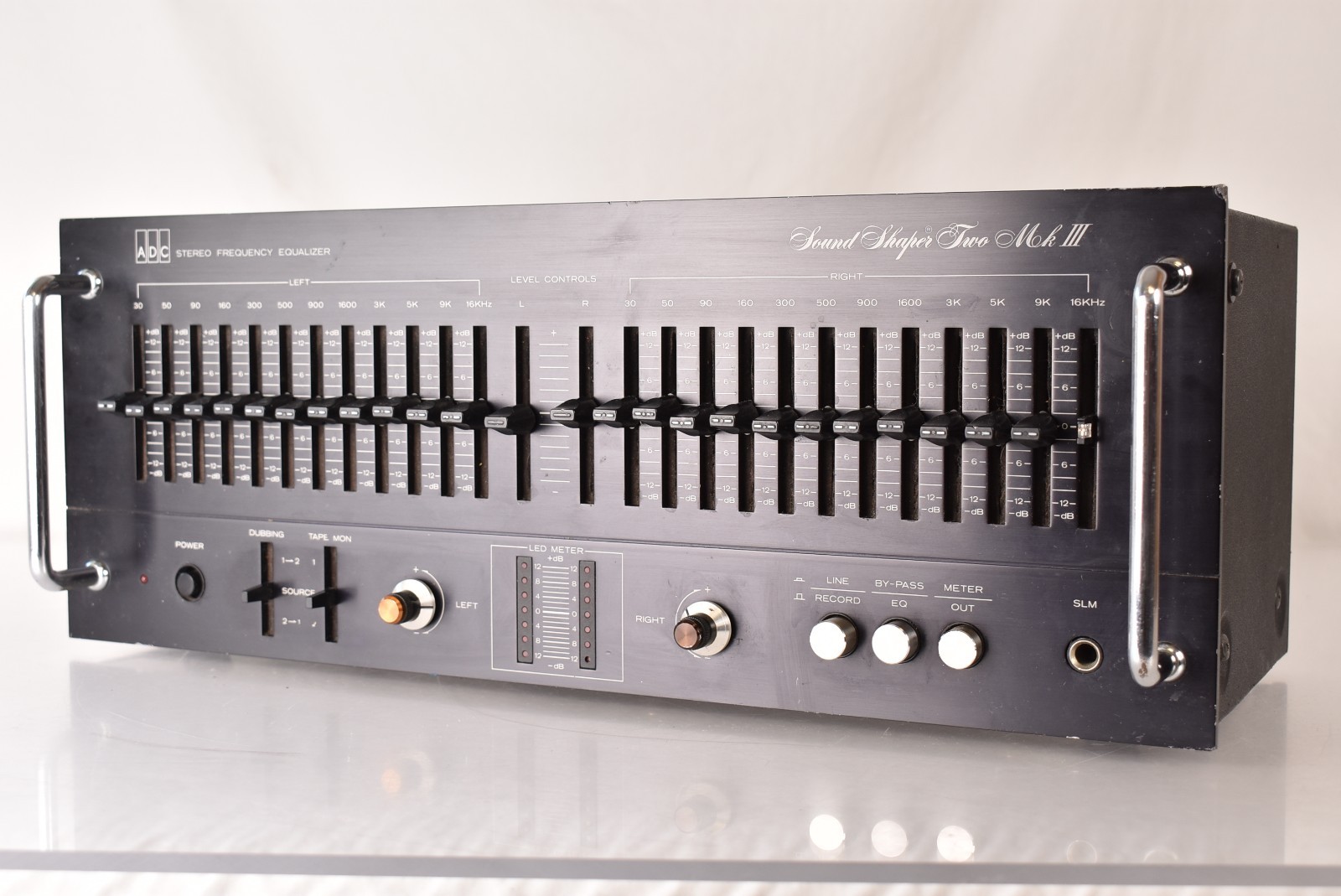
Pop the top off a Shaper Twenty and you’re greeted with a densely packed but orderly circuit board, point-to-point wiring in critical sections, and a heavy-gauge steel chassis that laughs at microphonics. The front panel is brushed aluminum with deeply recessed sliders, giving it a no-nonsense, studio-console aesthetic. It was clearly designed for daily use, not just shelf display. The internal linear power supply is overbuilt by consumer standards—typical of ADC’s philosophy. And while it doesn’t have the dual-monitored output meters of the Shaper Two-IC, it doesn’t need them. This is a “set and forget” tool for most users, pulled out when a new speaker setup needs taming or a vintage recording demands a little lift in the upper mids.
Integration Without Intrusion
One of the Shaper Twenty’s quiet triumphs is how transparent it is when not actively shaping. Many graphic EQs of the era added a layer of grain or slight phase shift, but the Shaper Twenty’s low THD (0.03%) and solid S/N ratio (90 dB) mean it stays out of the way. That’s critical for audiophiles who want EQ as a corrective tool, not a coloration device. The tape loop is fully functional, allowing you to insert the EQ between preamp and power amp or integrate it into a tape monitoring chain. And because it’s stereo—not dual mono—there’s no risk of channel imbalance creeping in from separate left/right calibration, a problem that plagued some higher-end competitors.
Historical Context
The late 1970s saw a surge in high-fidelity system building, with listeners investing in separates, better speakers, and room treatments. But few had the luxury of acoustic rooms or budget for parametric EQs. The Shaper Twenty arrived as a practical solution—affordable enough for serious hobbyists, capable enough for small studios. It competed with offerings from Rane, RCF, and the more consumer-focused Sony and Pioneer EQs, but stood apart with its broadcast-inspired reliability and conservative sonic signature. While some EQs were marketed as “lifestyle” gear with glowing displays and preset curves, ADC stuck to the ethos of audio as engineering. There were no presets, no auto-calibration—just sliders, a power switch, and the truth of what your system was doing. In an era when “hi-fi” often meant exaggerated bass and shimmering highs, the Shaper Twenty was a tool for honesty.
It also benefited from ADC’s reputation in professional circles. The company had built a name in broadcast and studio monitoring gear, and that pedigree bled into their consumer line. While not used on major mixing consoles, the Shaper Twenty found its way into project studios, mastering outposts, and the racks of audiophiles who valued measured performance over marketing hype. It was a time when EQ was still somewhat controversial in high-end audio—some purists claimed any signal path addition degraded sound—but ADC made a case that intelligent correction could actually improve fidelity.
Collectibility & Value
Today, the Shaper Twenty trades in a quiet but consistent market. It’s not a flashy “grail” like a McIntosh tube amp or a Linn Sondek, but it’s respected among those who know. Units in excellent, fully functional condition—verified with all sliders smooth and noise-free—typically sell between $250 and $350. Non-working or “as-is” units, like the one described on eBay with loose knobs, can be found for $100 or less, but that’s a gamble. The real cost comes in restoration: recap the power supply, clean all slider pots with contact cleaner (DeoxIT D5 is recommended), and check for cold solder joints, especially around the input/output jacks. Service technicians observe that the original electrolytic capacitors are now 40+ years old, and failure is not a matter of if, but when.
What breaks? The sliders are the main wear point—dusty or oxidized tracks cause scratchiness, and the LED backlights can dim or fail over time. The internal transformer is robust, but if the unit was stored in a damp environment, corrosion on the PCB is possible. The chassis is durable, but the side panels are thin steel and prone to dents. When buying, insist on a video test or in-person audition. A working Shaper Twenty should pass audio cleanly with no hum, hiss, or channel imbalance. If the sliders crackle, it’s serviceable—but factor in $75–$150 in labor if you’re not doing it yourself.
Despite its age, the Shaper Twenty remains useful. Modern digital room correction has made broad-stroke EQ less necessary, but there’s still value in analog shaping—especially for vinyl enthusiasts dealing with worn pressings or non-ideal speaker placement. And for those building vintage systems, it’s a period-correct addition that performs as well as it looks.
eBay Listings


As an eBay Partner, we earn from qualifying purchases. This helps support our independent vintage technology research.