ADC Sound Shaper Three (1980–1985)
Twelve glowing sliders per channel, a fluorescent display that pulses like a heartbeat, and a pink noise generator that will make your dog flee the room—this is equalization as ritual.
Overview
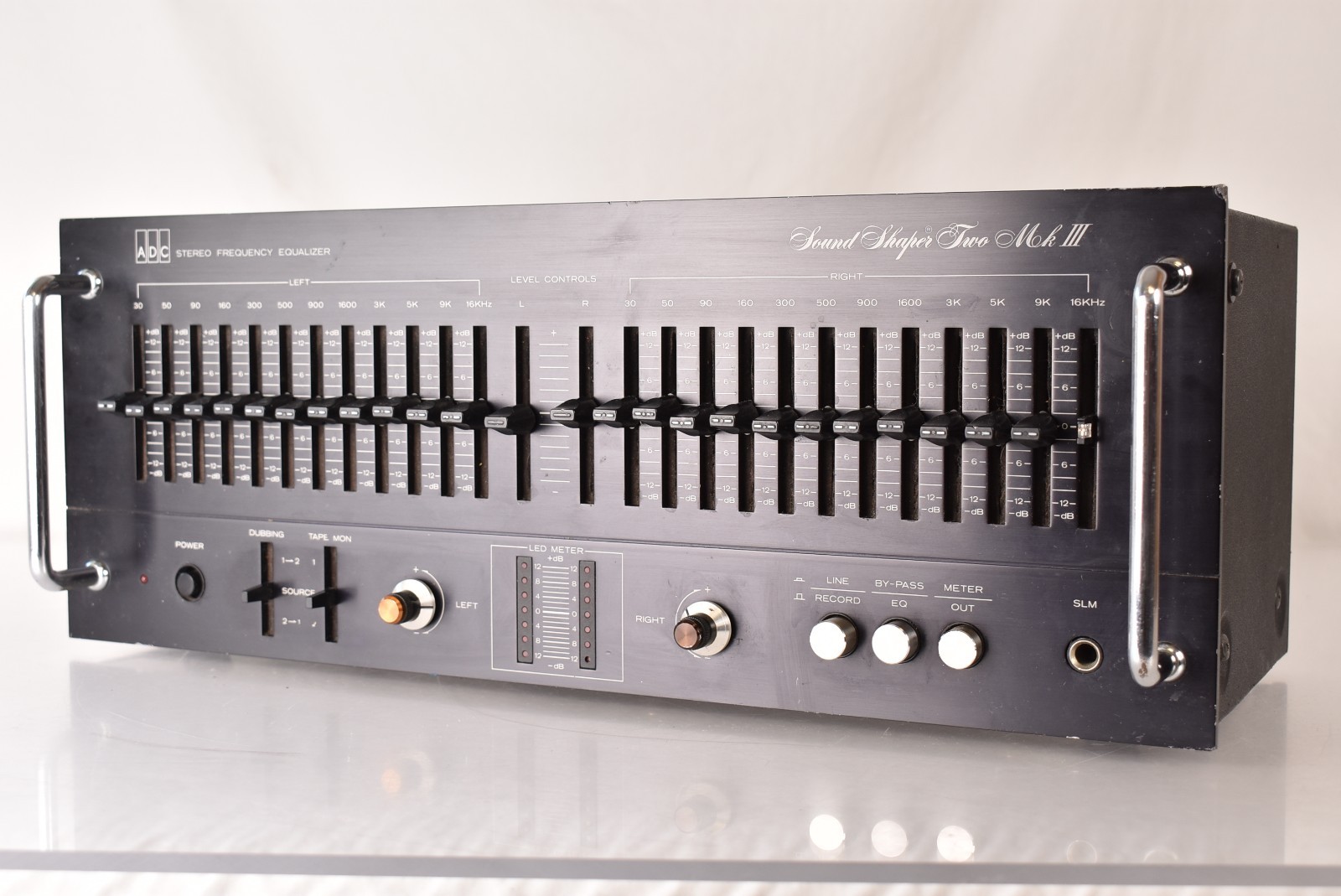
Power it up and the fluorescent bar graph flickers to life with a soft green glow, casting long shadows across the brushed aluminum faceplate. The ADC Sound Shaper Three isn’t subtle—it’s a statement piece, a diagnostic tool, and, when used wisely, a sonic sculptor capable of taming even the most unruly speaker-room combination. Born in the early 1980s, when home audio systems were finally powerful enough to expose acoustic flaws, the Shaper Three arrived as both savior and spectacle. It wasn’t just an equalizer; it was a full-on audio laboratory in a 20-pound chassis, designed to let you see and shape the frequency response of your system with surgical precision.
Unlike the passive tone controls on most preamps of the era, which offered broad strokes at best, the Shaper Three gave you 12 fully parametric bands per channel—each with adjustable center frequency, bandwidth, and gain. That kind of control was unheard of in consumer gear at the time. Most graphic EQs offered fixed frequencies and shallow cut/boost ranges, but the Shaper Three let you zero in on problem areas: a ringing mid-bass resonance at 80 Hz, a harsh 3 kHz peak from a tweeter, or a dip in the upper mids that made vocals sound recessed. With ±15 dB of adjustment and a clean, low-noise signal path, it didn’t just react to flaws—it could correct them without adding coloration of its own.
And then there’s the real-time analyzer. Bundled with an electret condenser microphone and a built-in pink noise generator, the system promised “flat response in any room.” In theory, you’d place the mic at the listening position, fire up the noise, and watch the fluorescent display map your room’s response. Then, you’d tweak the sliders to flatten the curve. In practice? It’s more art than science. The stock microphone—widely criticized by owners—has a lumpy frequency response, rolling off sharply above 10 kHz and below 50 Hz, which means the analyzer often lies to you in the extremes. But get your hands on a better mic (like the RCA clip-on model some technicians recommend), and the system becomes startlingly effective. Still, most experienced users agree: trust your ears first. The analyzer gets you in the ballpark; the final tuning happens in the dark, with your favorite records spinning.
Specifications
| Manufacturer | ADC Sound (Audio Dynamics Corporation) |
| Production Years | 1980–1985 |
| Original Price | $595 (equivalent to ~$2,000 today) |
| Equalization Bands | 12 per channel, paragraphic (parametric-style) |
| Frequency Range | 20 Hz – 20 kHz |
| Adjustable Frequencies | 12 selectable center frequencies per band |
| Gain Range | ±15 dB per band |
| Bandwidth Control | Adjustable Q per band |
| Input Sensitivity | 300 mV for rated output |
| Input Impedance | 47 kΩ |
| Output Impedance | 600 Ω |
| Total Harmonic Distortion | < 0.05% at 1 kHz, 1 V out |
| Signal-to-Noise Ratio | 85 dB (A-weighted) |
| Inputs | RCA (stereo), tape loop |
| Outputs | RCA (stereo), tape loop |
| Pink Noise Generator | Yes, internal, switchable |
| Real-Time Analyzer | Yes, with fluorescent bar graph display |
| Included Accessories | Electret condenser microphone, windscreen, manual |
| Power Requirements | 120 V AC, 60 Hz, 50 W |
| Weight | 20 lbs (9.1 kg) |
| Dimensions | 19" W × 5.5" H × 14" D (48.3 × 14 × 35.6 cm) |
| Model Variants | SS-3 (original), SS-3 IC (integrated circuit version), SS-3 MKII |
Key Features
The Paragraphic EQ Circuit: Precision Without the Inductors
Most high-end parametric EQs of the era relied on inductors to shape frequency response, but the Shaper Three took a different path—using op-amps and precision capacitors in a fully active IC-based design. This eliminated the size, cost, and magnetic interference issues of inductors, but it also meant the sound character was defined by the quality of the internal electronics. The “IC” version, introduced later in the production run, refined this further with updated operational amplifiers and tighter component tolerances. While some audiophiles sniffed at the lack of “analog warmth,” the reality is that the Shaper Three was designed for transparency. It doesn’t add color; it removes problems. When you boost 60 Hz, you’re not getting a “fat” bass tone—you’re correcting a null caused by room modes. And because the circuit maintains low distortion even at extreme settings, you can push the sliders around without fear of muddying the signal.
Fluorescent Display: The Soul of the Machine
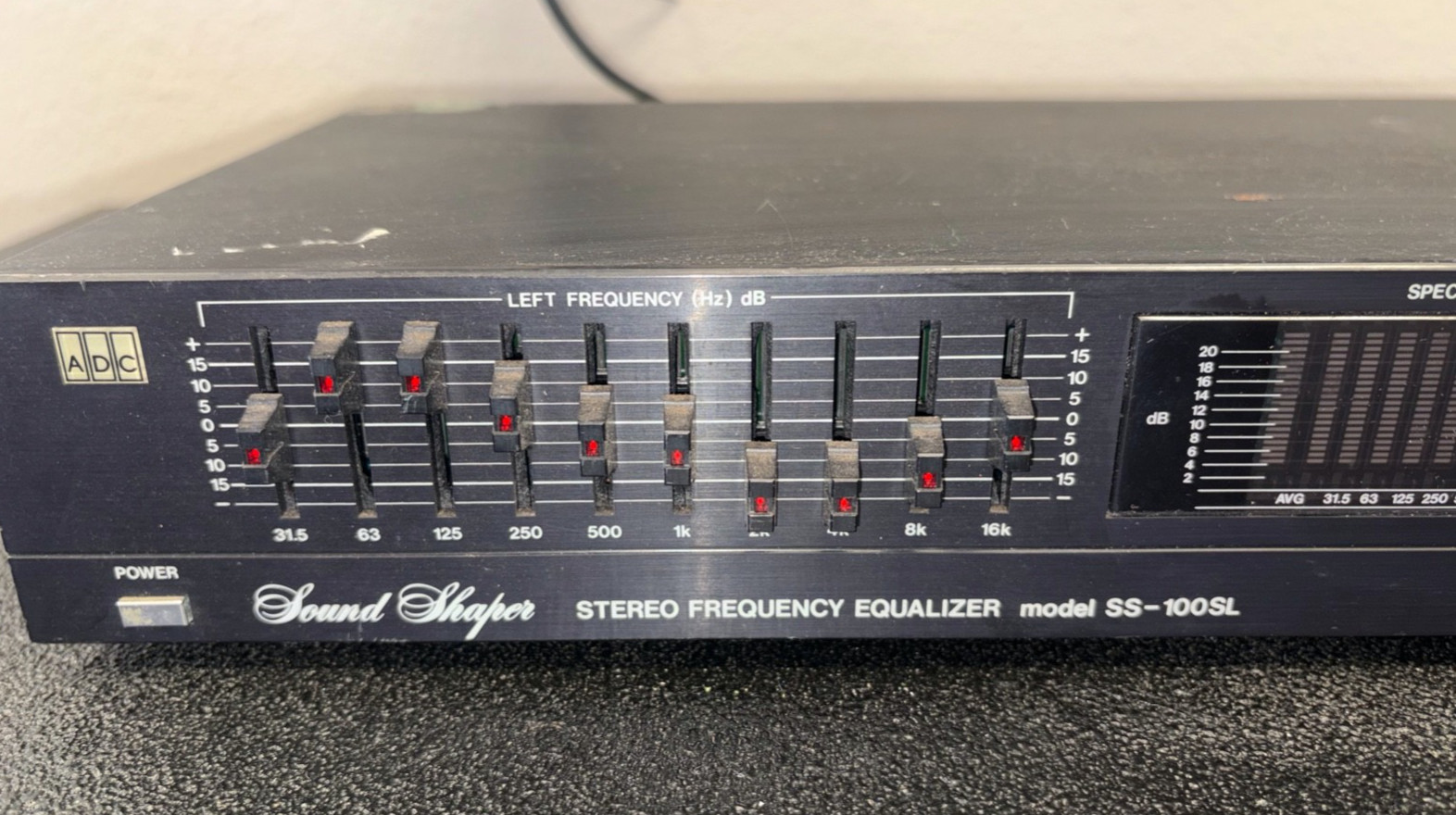
The 12-segment fluorescent bar graph isn’t just for show—it’s the heart of the real-time analyzer. Each vertical bar corresponds to one frequency band, lighting up in real time as the microphone picks up the pink noise response. It’s mesmerizing to watch, especially when you’re making adjustments and seeing the room’s acoustics shift before your eyes. But it’s also fragile. These displays are prone to dimming over time, and replacements are nearly impossible to find. Some service technicians report that high-voltage driver circuits can fail, leaving half the display dark. When it works, it’s magical. When it doesn’t, the unit still functions as a standalone EQ—but you lose the visual feedback that made it special.
Onboard Pink Noise & Mic Input: The Good, the Bad, and the Annoying
The built-in pink noise generator is powerful—so powerful that using it at full volume can set off car alarms down the street. It’s also essential for the analyzer to work, but prolonged exposure is brutal on the ears. The unit includes a level control, but many owners recommend using the noise in short bursts, especially if you’re working in a shared space. The included microphone, while functional, is the weakest link. Multiple user reports and service notes confirm it has a non-flat response, particularly in the highs and lows, which skews readings. Swapping it out for a calibrated measurement mic (like the Radio Shack 33-3013 or a Dayton Audio unit) dramatically improves accuracy. Just remember: the input is designed for electret mics only. Plugging in a dynamic mic can damage the preamp stage—a quirk that has fried more than one curious tinkerer.
Historical Context
The early 1980s were a turning point for home audio. Speakers were getting more efficient, amplifiers more powerful, and listeners more critical. But as systems improved, so did the exposure of room-induced frequency anomalies—boomy bass, dead spots, and reflective peaks. Most manufacturers ignored the problem, but ADC saw an opportunity. Audio Dynamics Corporation had already built a reputation with high-quality MM cartridges and the short-lived Accutrac turntable. With the Shaper Three, they pivoted hard into room correction, targeting audiophiles who wanted laboratory-grade tools without professional prices.
They weren’t alone. Competitors like Rane, Ashly, and Rane offered pro-level EQs, but they cost thousands and looked like rack-mounted gear. The Shaper Three brought that capability into the living room with a consumer-friendly design and a built-in analyzer. It was heavily advertised in catalogs like DAK Industries, where it was sold alongside budget gear—though at nearly $600, it was anything but budget. Still, for the era, it was a bargain compared to pro units. And while some dismissed EQs as “crutches for bad speakers,” ADC positioned the Shaper Three as a tool for perfectionists—people who understood that no speaker performs the same in every room.
By the late 1980s, ADC had been acquired by BSR, the British turntable manufacturer, and the brand faded. The Shaper Three’s legacy, however, lived on in the form of rebranded BSR units and a cult following among vintage audio tinkerers. It was one of the first consumer devices to treat room acoustics as a solvable problem—not just a fact of life.
Collectibility & Value
Today, the ADC Sound Shaper Three is a niche collectible—prized more for its functionality than its resale value. Units in working condition with a full set of accessories (especially the microphone) sell for $250–$400 on the open market, with pristine MKII models occasionally fetching over $500. “For parts” listings start around $50, but beware: these are often missing the mic, have dead displays, or suffer from capacitor leakage on the main boards.
The biggest threat to longevity? Age. The electrolytic capacitors throughout the power supply and signal path are now 40+ years old. Even if the unit powers on, they’re likely dried out and unstable. A full recapping job—replacing all electrolytics and checking resistors—is strongly recommended before regular use. Service technicians observe that the power transformer is also a weak point; when it fails, replacements are hard to source due to custom winding specs. The sliders themselves are another concern. While they’re high-quality Alps faders, decades of dust and oxidation can cause crackling. Cleaning with a fader-specific contact cleaner helps, but some units require slider replacement—a costly and time-consuming process.
Before buying, test the following: power-up behavior (listen for hum or crackling), slider smoothness (no jumps or dropouts), display illumination (all segments should light evenly), and microphone input (plug in a known-good electret mic and check analyzer response). If the unit came from a smoky or humid environment, assume internal corrosion and budget for a full service. And if the fluorescent display is dim or flickering, consider it a project unless you’re prepared to hunt down NOS tubes or retrofit an LED alternative.
eBay Listings


As an eBay Partner, we earn from qualifying purchases. This helps support our independent vintage technology research.