ADC Sound Shaper Thirty (1978–1983)
That first flicker of the fluorescent bar graph dancing to the beat—this is where your room finally starts to breathe.
Overview
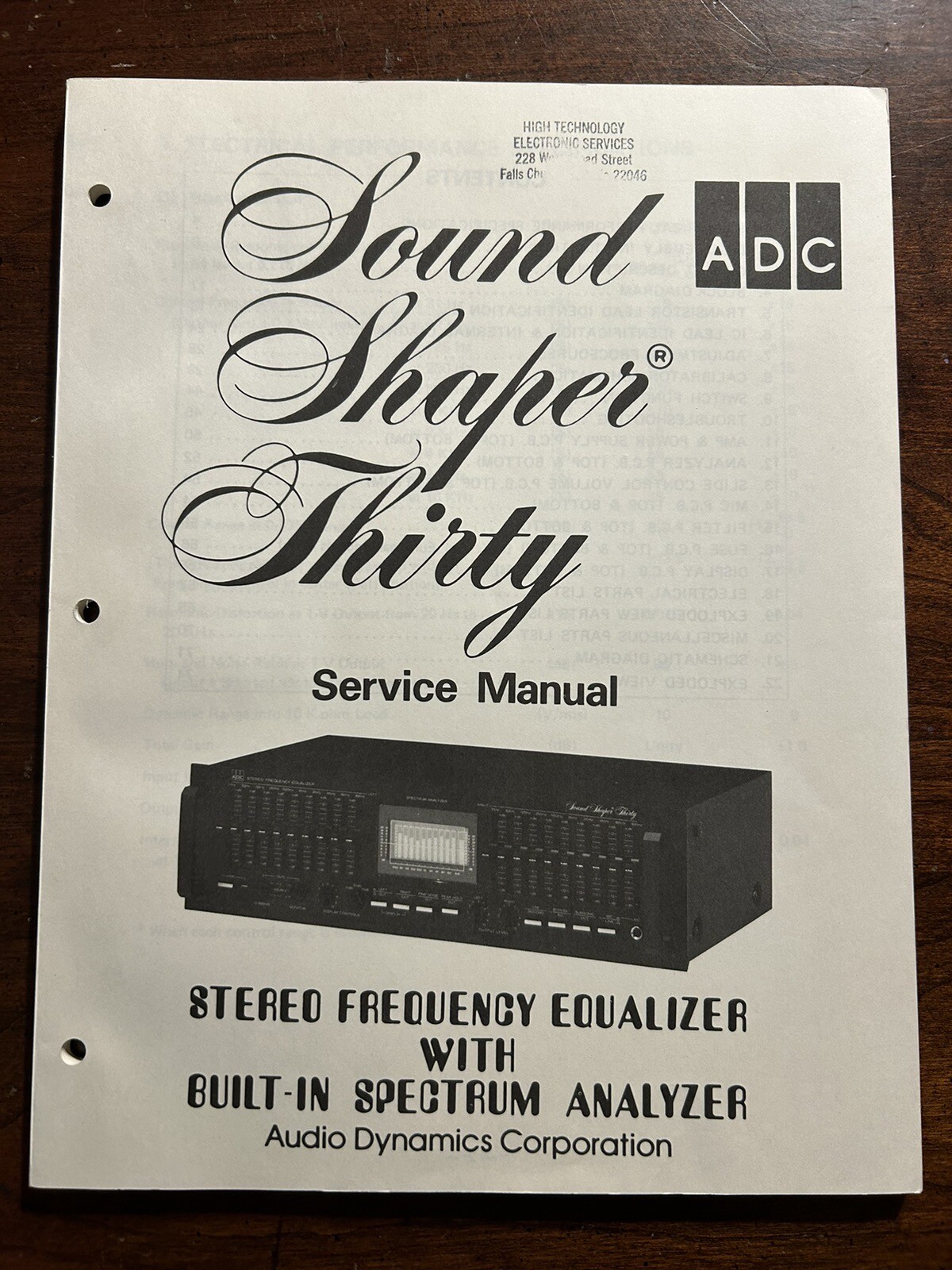
You don’t just listen to the ADC Sound Shaper Thirty—you watch it work. Plug it in, hit play on a dense mix, and within seconds, the fluorescent spectrum analyzer flares to life, ten glowing bars pulsing in real time, each one a window into the hidden shape of your sound. It’s not theater; it’s diagnostic. The Shaper Thirty was built for people who knew their room was fighting them, who’d spent weeks tweaking speaker placement only to find a bass hump at 80 Hz they couldn’t shake. This wasn’t just another graphic EQ with a light show tacked on—it was a tuning fork for your entire system, a rare piece of consumer gear that borrowed lab-grade visualization and made it accessible without dumbing it down.
Released in 1978, the Shaper Thirty (model SS-30) landed at a moment when home audio was getting serious about fidelity. Audiophiles were investing in high-efficiency speakers, tape decks with Dolby B, and preamps with stepped attenuators. But few had tools to actually measure how their gear interacted with their space. Enter ADC Sound, a company that had been quietly building professional-grade test equipment and finally decided to bring some of that precision to the living room. The Shaper Thirty wasn’t their first EQ—the Sound Shaper Two and Three came earlier—but it was the first to pair a full 10-band graphic equalizer with a real-time fluorescent display, making it instantly recognizable on any rack.
It’s not the most powerful EQ you’ll find from the era, nor the most sonically transparent. But what it lacks in subtlety, it makes up for in immediacy. Each slider controls a fixed frequency band—31 Hz, 62 Hz, 125 Hz, 250 Hz, 500 Hz, 1 kHz, 2 kHz, 4 kHz, 8 kHz, 16 kHz—with ±12 dB of cut or boost. That’s standard for a graphic EQ of this class, but the real magic is in the feedback loop between your ears and your eyes. You hear a harshness in the upper mids, you look at the display, and there it is—8 kHz spiking on the right channel. Dial it back a notch, and the glare softens. It’s surgical, but not cold. The circuitry, while solid-state and clean, doesn’t strip the music of its body. There’s a warmth in the midrange that keeps vocals present, and the bass bands, though not thunderous, are precise enough to tame boominess without sucking the life out of kick drums.
And then there’s the build. This thing weighs in at just under 20 pounds, all of it housed in a brushed steel chassis with a thick aluminum faceplate. The sliders are smooth but stiff—no wobble, no creak—and the fluorescent display, while fragile by today’s standards, is mesmerizing when it’s working right. It’s not backlit; it *is* the light. Each bar is a tiny vacuum tube segment, glowing green-blue in the dark, responding fast enough to catch transients but smooth enough to track average levels. It’s the kind of display that makes you leave the EQ on even when you’re not adjusting it, just to watch the music move.
Specifications
| Manufacturer | ADC Sound |
| Production Years | 1978–1983 |
| Model Number | SS-30 |
| Type | Stereo 10-band graphic equalizer with spectrum analyzer |
| Frequency Bands | 31 Hz, 62 Hz, 125 Hz, 250 Hz, 500 Hz, 1 kHz, 2 kHz, 4 kHz, 8 kHz, 16 kHz |
| Boost/Cut Range | ±12 dB per band |
| Display Type | Fluorescent bar graph spectrum analyzer (10-segment, dual-channel) |
| Inputs | 2 x RCA line-level (tape in), 1 x RCA line-level (source), 1 x 1/4" mic/line (front panel) |
| Outputs | 2 x RCA line-level (tape out), 1 x RCA line-level (main out) |
| Signal-to-Noise Ratio | 80 dB (A-weighted) |
| Total Harmonic Distortion | <0.1% at 1 kHz |
| Frequency Response | 20 Hz – 20 kHz (±0.5 dB) |
| Input Impedance | 47 kΩ |
| Output Impedance | 600 Ω |
| Gain | 0 dB (bypass), +6 dB maximum (with boost) |
| Power Requirements | 120 VAC, 60 Hz, 30 W |
| Weight | 19.8 lbs (9 kg) |
| Dimensions | 19" W × 5.5" H × 12" D (48.3 cm × 14 cm × 30.5 cm) |
| Original Price | $349 |
Key Features
The Fluorescent Display: Seeing Is Believing
Most graphic EQs from the late ’70s offered little more than a row of sliders and maybe an LED or two. The Shaper Thirty didn’t just add lights—it added insight. The full-channel fluorescent display isn’t just a gimmick; it’s a functional tool that lets users see frequency imbalances in real time. Unlike slower LED meters, the fluorescent bars have a slight persistence that smooths out transient peaks, giving a more accurate picture of sustained energy. It’s especially useful when dealing with room modes—those low-frequency resonances that can make a subwoofer sound like a washing machine. With the display active and a pink noise source (often fed via the mic input or an external generator), you can sweep the room and see exactly where the bass is piling up. It’s not a full-room calibration suite, but for 1978, it was borderline revolutionary.
Front-Panel Flexibility
The inclusion of a 1/4" input on the front panel is more thoughtful than it first appears. At a time when most high-end gear kept all connections in the back, ADC understood that users would want to plug in a microphone or portable source for quick tests. That mic input, while basic, opens up the unit for live tuning—say, running a vocal through the EQ to hear how the midrange adjustments affect intelligibility. It also supports dubbing functions, with dedicated tape in/out jacks that let you insert the EQ into a tape loop for real-time recording adjustments. This wasn’t just a tone shaper; it was a workflow tool for tinkerers who wanted to fine-tune their cassette dubs or balance a mix before laying it down.
Slider Quality and Longevity
The sliders themselves are long-throw, conductive plastic potentiometers, the kind that were standard in pro gear but rare in consumer units. They’re durable, but they’re not immortal. Decades of dust and oxidation have left many units with scratchy sliders, especially in the mid and high bands. Cleaning helps, but it’s a temporary fix—eventually, the resistive tracks wear out. Some owners report success with replacement sliders from industrial suppliers, but the fit isn’t always perfect. The good news? The circuit board layout is relatively simple, and service technicians observe that the power supply and display driver boards are generally robust if the unit has been kept in a dry environment.
Historical Context
The late 1970s saw a surge in “high control” audio gear—devices that gave listeners more power over their sound than ever before. Graphic EQs were part of that wave, but most were either too basic (5-band, no display) or too expensive (professional rack units from companies like API or Drawmer). ADC Sound carved out a niche by offering lab-inspired features at a price point that serious hobbyists could justify. The Shaper Thirty sat just below the flagship Shaper Thirty-Three (SS-33), which added a built-in pink noise generator and slightly refined circuitry. But the SS-30 was the sweet spot—affordable enough for most audiophiles, yet advanced enough to feel like a real tool.
It competed directly with offerings from Sony, Technics, and Pioneer, all of which released graphic EQs around the same time. But few matched ADC’s focus on visualization. Sony’s TA-EQ50, for example, had a 10-band EQ but only a basic LED meter. The Shure FP-33, a pro unit, had better specs but no display at all. ADC’s decision to prioritize the visual feedback loop set the Shaper Thirty apart. It wasn’t just for tweaking—it was for learning. Users started to understand how their rooms colored the sound, how speaker placement affected frequency response, and how small cuts could do more than massive boosts. That educational aspect gave the unit staying power beyond its era.
Collectibility & Value
Today, the ADC Sound Shaper Thirty trades in a narrow but passionate market. Units in working condition with a fully functional display typically sell between $250 and $400, depending on cosmetic condition. Those with missing slider caps—especially on the low end, like the 31 Hz and 62 Hz sliders—can drop to $180–$220, though functionality isn’t affected. The real premium goes to units with bright, even fluorescent displays and clean sliders. Any flickering, dimming, or dead segments can slash value by half, since replacement displays are nearly impossible to source.
The most common failure points are the fluorescent display tubes and the slider potentiometers. The tubes degrade over time, especially if the unit was left on for long periods. Some owners report success with gentle warming or tapping to revive weak segments, but it’s a sign of impending failure. The power supply, while simple, can develop capacitor leakage after 40+ years, so a recapped unit is worth the premium. Dust inside the case is almost universal, and while it doesn’t affect performance, it can contribute to contact noise in the sliders.
Before buying, check that all ten bars respond to signal input and that the sliders move smoothly without crackling. Test both channels independently if possible—some units develop imbalances due to aging components in one side. Also, verify that the tape loop functions correctly; broken switches in the signal path can render the unit useless in a chain. Despite these quirks, the Shaper Thirty has a loyal following. It’s not a “set and forget” EQ, but for those who enjoy the ritual of tuning, it’s still one of the most engaging tools ever made for the analog living room.
eBay Listings

As an eBay Partner, we earn from qualifying purchases. This helps support our independent vintage technology research.