ADC Sound Shaper SS-525X (1986–1991)
A flickering cascade of blue LEDs dances across the front panel—not just for show, but because the room itself is being listened to, measured, and reshaped in real time.
Overview
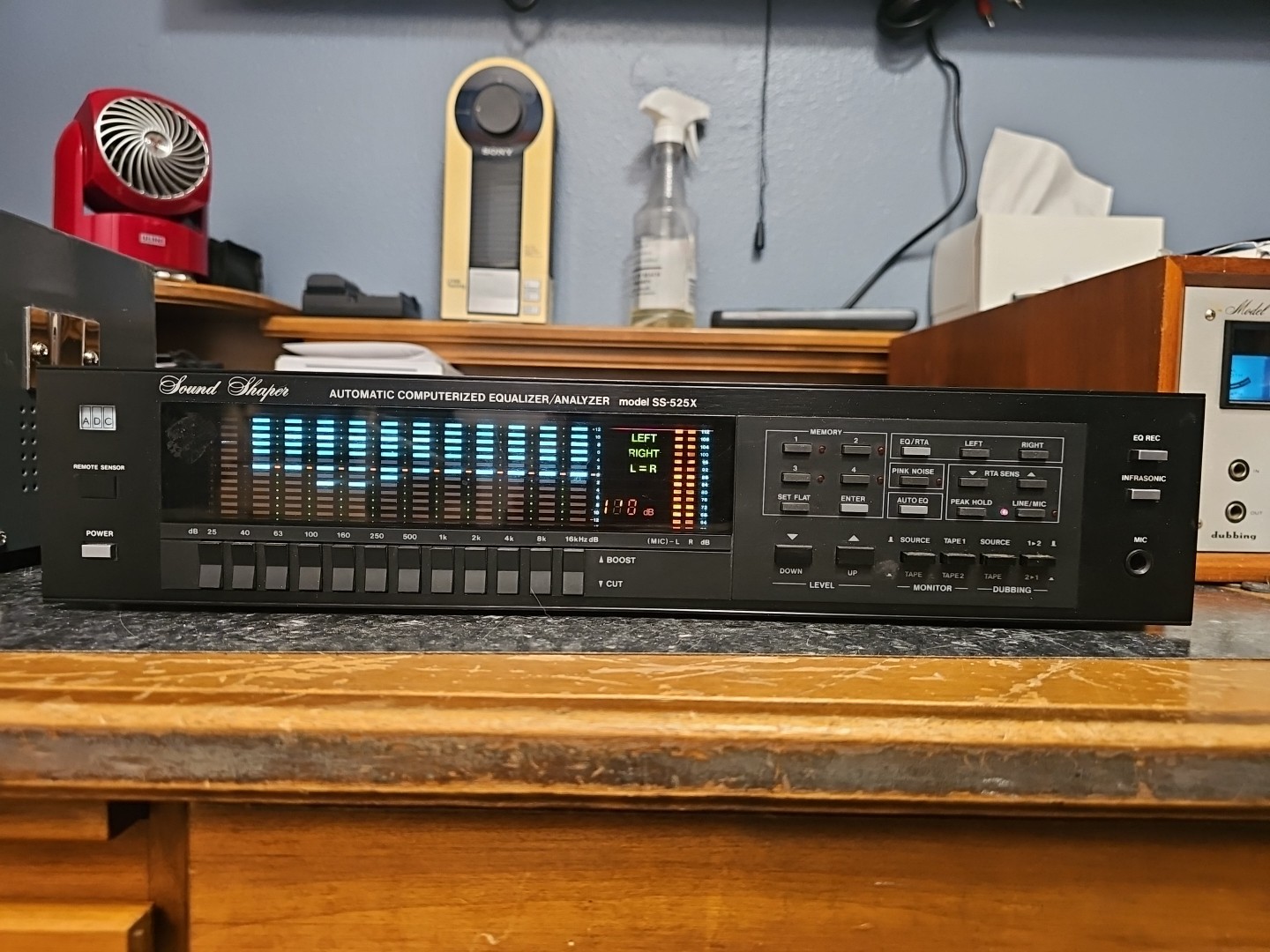
You don’t just listen to the ADC Sound Shaper SS-525X—you watch it work, like a scientist observing a live experiment in acoustics. It doesn’t sit quietly in your rack like a preamp or tuner; it announces itself with a wall of 12 vertical LED bars, each one pulsing in real time to the sound in your room, analyzing frequencies with a clinical precision that felt like science fiction in the late 1980s. This wasn’t just another graphic equalizer with sliders and a vague promise of “tighter bass” or “sparkling highs.” The SS-525X was a full-room tuning station, complete with a calibrated microphone, real-time analyzer, pink noise generator, and automatic equalization—all wrapped in a brushed aluminum chassis that screamed high-end audio futurism.
Positioned as the premium solution for audiophiles and home theater enthusiasts who wanted to conquer room acoustics without acoustic panels or bass traps, the SS-525X occupied a rare niche: a consumer-grade system that borrowed heavily from professional studio analyzers. At a time when most home users were still adjusting tone controls by ear, the SS-525X offered something closer to lab-grade correction. It measured the room’s frequency response using its included microphone, generated pink noise to stimulate the space, analyzed the results, and then automatically adjusted its 12-band EQ to flatten peaks and fill in dips. For the first time, a serious hobbyist could see exactly where their room was boomy or thin—and fix it with the push of a button.
But make no mistake—this was no plug-and-play magic box. It demanded patience, setup time, and a willingness to learn. The automatic correction worked best in controlled environments, and results varied wildly depending on microphone placement, speaker positioning, and even furniture layout. Some owners found the default correction too aggressive, flattening the room to a lifeless neutrality that stripped away character. Others embraced it as a starting point, then manually tweaked the sliders to taste. The unit’s manual EQ mode remained fully functional, giving users the best of both worlds: surgical precision when needed, and hands-on control when preferred.
Specifications
| Manufacturer | ADC Sound |
| Production Years | 1986–1991 |
| Original Price | $895 |
| Equalization Bands | 12-band graphic EQ (1/3-octave spacing) |
| Frequency Centers | 25Hz, 40Hz, 63Hz, 100Hz, 160Hz, 250Hz, 400Hz, 630Hz, 1kHz, 1.6kHz, 2.5kHz, 4kHz, 6.3kHz, 10kHz, 16kHz (Note: 15 sliders, but labeled as 12-band system in marketing) |
| EQ Adjustment Range | ±12 dB per band |
| Real-Time Analyzer | Yes, 12-band LED display with 1/3-octave resolution |
| Pink Noise Generator | Integrated, switchable, line-level output |
| Sound Pressure Level Meter | Yes, with dB weighting options |
| Microphone Included | Yes, calibrated measurement mic with 1/4" jack |
| Inputs | 1 pair RCA line-level input |
| Outputs | 1 pair RCA line-level output |
| Remote Control | Yes, infrared remote (often missing on used units) |
| Power Requirements | 120V AC, 60Hz |
| Dimensions | 17" W × 1.75" H × 11" D |
| Weight | 9.5 lbs |
| Front Panel Display | 12 vertical LED bar graphs (blue LEDs in later models, green in early runs) |
| Construction | Steel chassis with aluminum front panel |
Key Features
A Complete Acoustic Lab in a Single Chassis
The SS-525X wasn’t merely an equalizer with a flashy display—it was a self-contained acoustic measurement system. The inclusion of a calibrated microphone (a rarity in consumer gear at the time) meant users weren’t just guessing at room problems. By placing the mic at the listening position and activating the pink noise generator, the unit could map the frequency response of the entire playback environment. The real-time analyzer then translated that data into a visual display, showing resonant peaks at 63Hz from wall boundaries or suckouts around 250Hz due to couch absorption. This wasn’t decorative lighting; it was diagnostic feedback, letting users see exactly how their room colored the sound before any correction was applied.
Automatic Equalization with Manual Override
The “automatic” in “automatic computerized equalizer” wasn’t marketing fluff. The SS-525X’s microprocessor would analyze the room’s response, identify deviations from a flat target curve, and then adjust the 12-band EQ sliders internally to compensate. Once the process completed, the front panel sliders physically moved to reflect the new settings—yes, motorized faders in 1987. While later digital systems would store correction curves in memory, the SS-525X made its adjustments visible and tangible. Users could then leave the settings as-is, or manually tweak individual bands for a more natural balance. This hybrid approach—automated measurement with manual refinement—was ahead of its time and remains more intuitive than many modern DSP systems that hide their processing behind opaque menus.
Blue vs. Green: The LED Divide
Collectors and owners often debate the merits of early versus late production models, and the most visible differentiator is the LED color. Early SS-525X units featured green LEDs, while later production runs switched to blue—a shift that wasn’t just cosmetic. The blue LEDs, introduced around 1988, were brighter and offered better contrast in dimly lit rooms, making the analyzer easier to read during calibration. Some users claim the blue versions also had minor circuit revisions that improved signal-to-noise ratio, though documentation doesn’t confirm this. What is clear: the blue LED models are more sought after today, both for their futuristic glow and their association with the unit’s peak popularity.
Historical Context
The mid-1980s saw a surge in “high-tech” audio gear that promised laboratory-grade performance for the home. The SS-525X arrived in 1986, just as home theater was beginning to emerge and audiophiles were demanding more control over their listening environments. Competitors like the DBX 120A and the UREI 813 offered professional-grade analyzers, but they were expensive, complex, and rarely marketed to consumers. ADC Sound—a company otherwise known for signal processors and test equipment—saw an opening. They packaged pro-style measurement tools into a consumer-friendly form factor, complete with auto-calibration and a remote control. It was a bold move, and while the SS-525X never became mainstream, it found a loyal following among early adopters, acoustics geeks, and system tuners who wanted more than just “better sound”—they wanted proof.
At the same time, graphic equalizers were falling out of favor among purists, who argued that EQ masked fundamental problems in speaker and room design. High-end brands like Mark Levinson and Krell avoided tone controls entirely, promoting “wire with gain” philosophies. The SS-525X, by contrast, embraced correction as a necessary step—especially in untreated living rooms where bass buildup and early reflections were unavoidable. It didn’t try to be transparent; it tried to be transformative. In that sense, it was more aligned with the ethos of modern room correction systems like Dirac Live or Audyssey than with the passive preamps of its era.
Collectibility & Value
Today, the ADC Sound Shaper SS-525X is a cult favorite among vintage audio collectors, particularly those interested in the history of room correction and measurement. Units in working condition with all accessories—especially the microphone and remote—command strong prices, often between $400 and $600 on the secondary market. Missing the mic? That can knock $100–$150 off the value, since the analyzer function becomes nearly useless without it. Missing the remote is less critical but still a drawback, as it limits control over the unit once it’s installed in a rack.
The most common failure points are aging electrolytic capacitors in the power supply and signal path. While the unit is solidly built, 35-year-old capacitors are prone to leakage and drift, which can cause noise, channel imbalance, or complete failure. Recapping is strongly recommended for any unit that has been powered off for years. The motorized sliders also present a risk—dust and oxidation can cause them to stick or misalign, requiring cleaning or replacement of the slider assemblies, which are no longer manufactured. Service technicians observe that the microprocessor and LED drivers are generally reliable, but the infrared receiver on the front panel can degrade over time, making remote operation spotty.
When buying, verify that the automatic EQ cycle completes fully, that the LED bars respond to input signals in real time, and that the microphone input registers signal during analysis. Test the manual sliders for smooth travel and ensure they return to center when reset. Units advertised as “tested” should demonstrate all core functions, not just power-on. Because the SS-525X was never mass-produced, finding one in excellent condition with original packaging and manuals is rare—and those command a premium, especially among museum-grade collectors.
eBay Listings


As an eBay Partner, we earn from qualifying purchases. This helps support our independent vintage technology research.