ADC Sound Shaper SS-520 ()
Twelve bands of surgical EQ, a brain full of 1980s microprocessor magic, and a microphone that turns your room into a lab — if you can find one that still works.
Overview
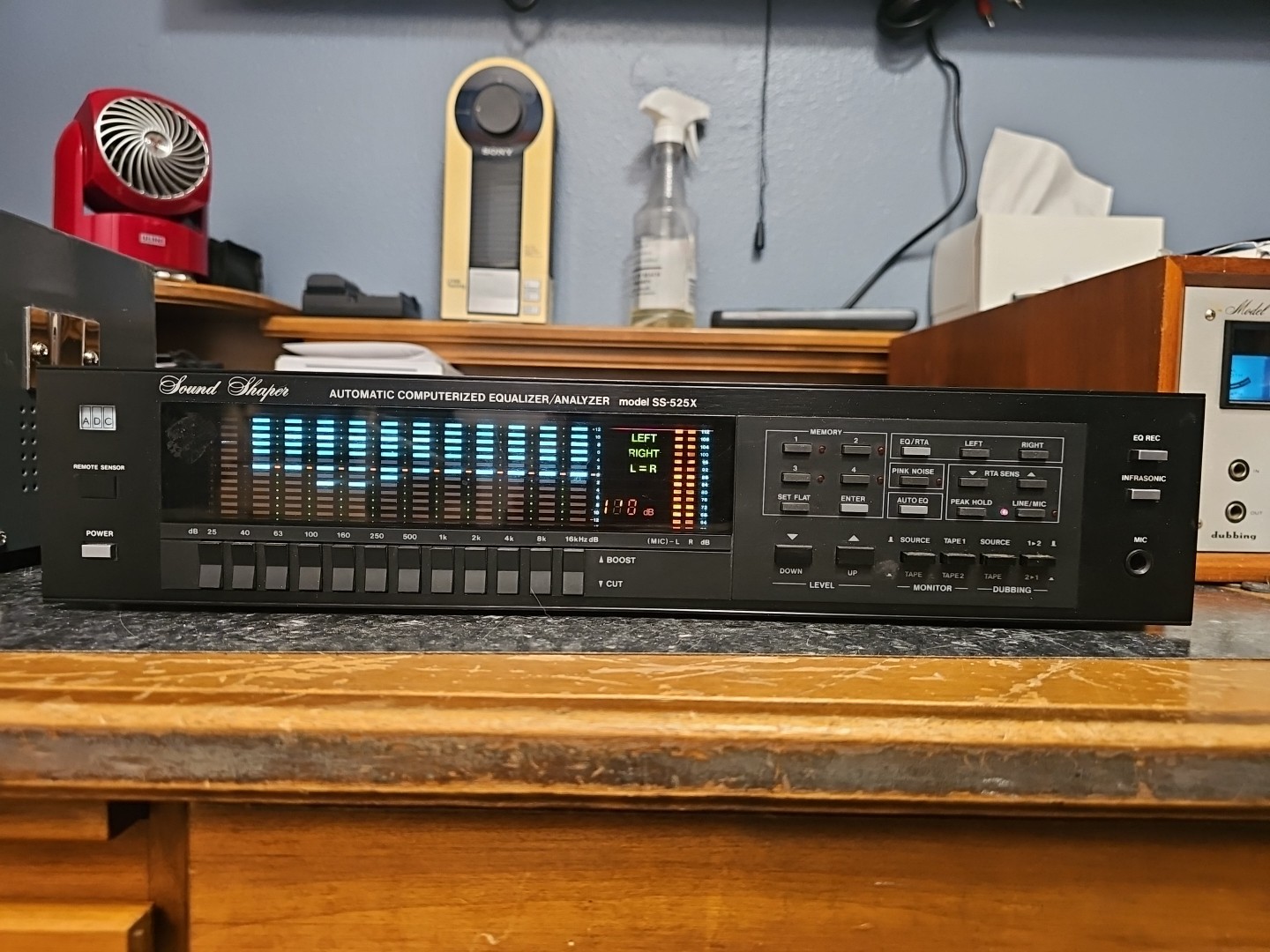
Fire up the SS-520 and the first thing you notice isn’t the sound — it’s the lights. Rows of green and red LEDs climb up the front panel like a fever chart for your speakers, each one pulsing in real time to the rhythm of your music or the relentless drone of pink noise. This isn’t just an equalizer; it’s a diagnostic machine, a sonic X-ray for your listening room, and a time capsule of late-’80s audio engineering hubris. The SS-520 sits at the top end of ADC’s “Sound Shaper” line, a step beyond the basic graphic EQs that cluttered component shelves in the early ’80s. It’s not content with just letting you boost the bass — it wants to fix your bass, diagnose your midrange, and lecture you about room modes with a calibrated microphone and a flickering fluorescent display.
It’s also a machine that assumes you care deeply about flat frequency response — a philosophy that sounds almost quaint today, when most listeners chase colored sound, spatial tricks, or DSP-powered room correction. But back when the SS-520 was new, this was high-tech. The idea that you could plug in a little electret mic, hit “Analyze,” and have the unit automatically adjust your EQ to flatten your system’s response was borderline revolutionary for home audio. It wasn’t perfect — owners report the calibration mic had a narrow, uneven response, and the automatic mode often overcorrected — but it was *there*, blinking at you like a robot therapist for your stereo.
Under the hood, it’s a hybrid beast: analog filters for the EQ section, digital control via a microprocessor, and a real-time analyzer that samples the incoming signal and maps it across 12 bands from 31.5 Hz to 16 kHz. The build quality is solid, typical of ADC’s mid-tier gear — metal chassis, chunky sliders, and a layout that’s functional if not elegant. It doesn’t scream “luxury,” but it doesn’t feel cheap, either. You get RCA inputs and outputs, a headphone jack, and a dedicated mic input on the front panel, which is where the magic — and the heartbreak — begins. Because without that matched microphone, the analyzer is just a light show.
Specifications
| Manufacturer | ADC Sound (Audio Dynamics Corporation) |
| Production Years | Mid to late 1980s |
| Original Price | Not listed in research |
| Number of Bands | 12 |
| Frequency Bands | 31.5 Hz, 63 Hz, 125 Hz, 250 Hz, 500 Hz, 1 kHz, 2 kHz, 4 kHz, 8 kHz, 12 kHz, 16 kHz |
| EQ Range | ±15 dB per band |
| Equalizer Type | Analog graphic equalizer with digital microprocessor control |
| Real-Time Analyzer | Yes, 12-channel fluorescent display |
| Pink Noise Generator | Yes, internal |
| Sound Pressure Level Meter | Yes |
| Microphone Input | Dedicated front-panel input for electret condenser microphone |
| Inputs | Stereo RCA line-level input |
| Outputs | Stereo RCA line-level output, front-panel headphone jack |
| Headphone Output | Yes, 1/4" jack |
| Power Supply | Internal power transformer |
| Weight | Not listed in research |
| Dimensions | Not listed in research |
| Country of Origin | Japan |
Key Features
The Microprocessor Brain and the Myth of “Automatic” EQ
The SS-520’s standout feature is its “automatic” equalization mode, a feature that sounds more impressive than it performs. The microprocessor takes input from the calibrated microphone, runs a real-time analysis of the room’s frequency response using the built-in pink noise generator, then adjusts the 12 sliders to attempt a flat curve. In theory, this should save hours of manual tweaking. In practice, it often creates a lumpy, overcorrected mess. The stock microphone — a proprietary electret condenser — is widely criticized for its poor frequency response, especially at the extremes. One owner described it as “an upside-down smile,” with significant roll-off below 50 Hz and above 10 kHz. That means the analyzer doesn’t “see” the real bass or treble energy in the room, leading to incorrect compensation. Savvy users quickly learned to ignore the auto mode and use the analyzer as a reference tool instead, adjusting by ear while watching the display for guidance.
Twelve Bands of Analog Muscle
Forget the digital smarts — the real value of the SS-520 is its analog EQ section. Twelve bands give you surgical control over your system’s tonal balance, far more than the 10-band units that were common at the time. The ±15 dB range is aggressive, capable of both subtle refinement and dramatic reshaping. Unlike some budget EQs of the era, the SS-520 doesn’t add noticeable hiss or coloration when bypassed. Owners report it “sounds clean,” with a transparency that suggests decent op-amps and careful circuit layout. The sliders are smooth and precise, though like all vintage pots and faders, they’re prone to crackle if not exercised regularly. A quick shot of Deoxit usually brings them back to life, but neglect can lead to channel imbalance or intermittent dropouts.
The Calibrated Mic: Holy Grail or Hype?
The included microphone is both the SS-520’s superpower and its Achilles’ heel. It’s not just any mic — it’s a calibrated unit designed to work specifically with ADC’s analyzer circuitry. Lose it, and you lose the ability to run automatic EQ or accurate measurements. Generic electret mics *can* work, but they need to be matched to the input sensitivity, and the unit’s manual warns against using dynamic mics, which can damage the preamp. Replacement mics are rare, often selling for $50–$100 on their own. Some users have successfully substituted modern measurement mics like the Dayton Audio EMM-6 or even repurposed RCA clip-ons, but calibration remains a guesswork process. For collectors, a complete set with the original mic and foam windscreen can double the unit’s value.
Historical Context
The SS-520 arrived in the mid-1980s, when home audio was caught between analog warmth and digital ambition. Graphic equalizers had moved from pro studios to living rooms, thanks to brands like Sony, Pioneer, and ADC making them affordable. ADC, originally known for phonograph cartridges and the short-lived Accutrac turntable, pivoted hard into signal processing. Their early EQs, like the SS-315, were simple 10-band units. But by the mid-’80s, they were chasing the high end, adding microprocessors, real-time analyzers, and automation. The SS-520 was part of that push — a “computerized” equalizer that promised audiophiles a scientific approach to sound. It competed with offerings from Sony (the EQS-700 series), Yamaha (the AFX-1), and KLH, but few matched its combination of analyzer, noise generator, and automatic EQ in one box. Still, the market was skeptical. Many audiophiles dismissed room correction as unnecessary, preferring to tweak speaker placement or accept their system’s natural coloration. ADC’s later acquisition by BSR, a British budget audio brand, signaled the end of its premium aspirations — the same technology soon appeared in cheaper, stripped-down BSR-branded units without the analyzer or mic.
Collectibility & Value
Today, the SS-520 is a niche collectible — not a must-have like a Revox tape deck or a Nakamichi receiver, but a prized tool for vintage audio tinkerers and measurement geeks. Complete units with the original microphone sell for $250–$400 on eBay, while “for parts” models without the mic go for $80–$150. Condition is critical: the power transformer is a known failure point, with reports of burned windings and no available replacements. If the unit powers on but the display is dim or flickering, it could indicate failing capacitors in the power supply or the fluorescent display driver — a common issue that requires recapping. The microprocessor itself is generally reliable, but the ribbon cables connecting the front panel can degrade, leading to dead sliders or erratic analyzer behavior. Before buying, test the sliders for smoothness, check for LED burnout, and verify that the headphone output works. If the mic is included, test the analyzer mode with a known signal. And never, ever plug in a dynamic microphone — the input is designed for low-current electret mics, and a mismatch can fry the preamp.
Restoration is doable but not trivial. Service manuals are scarce, and ADC never released schematics to the public. However, the circuit layout is straightforward enough that experienced techs can trace faults. The biggest hurdle is sourcing the original microphone — without it, the unit becomes a very expensive 12-band EQ. For that reason, collectors prioritize completeness. The SS-520 isn’t a daily driver for most, but for those rebuilding a period-correct 1980s system or diving into analog room correction, it’s a fascinating piece of audio history — equal parts useful tool, blinking art installation, and cautionary tale about automation before its time.
eBay Listings



As an eBay Partner, we earn from qualifying purchases. This helps support our independent vintage technology research.