ADC Sound Shaper SS-425X (1980–1989)
A slow-dancing wall of light that also happens to sculpt sound—one of the few equalizers you’d display like art.
Overview
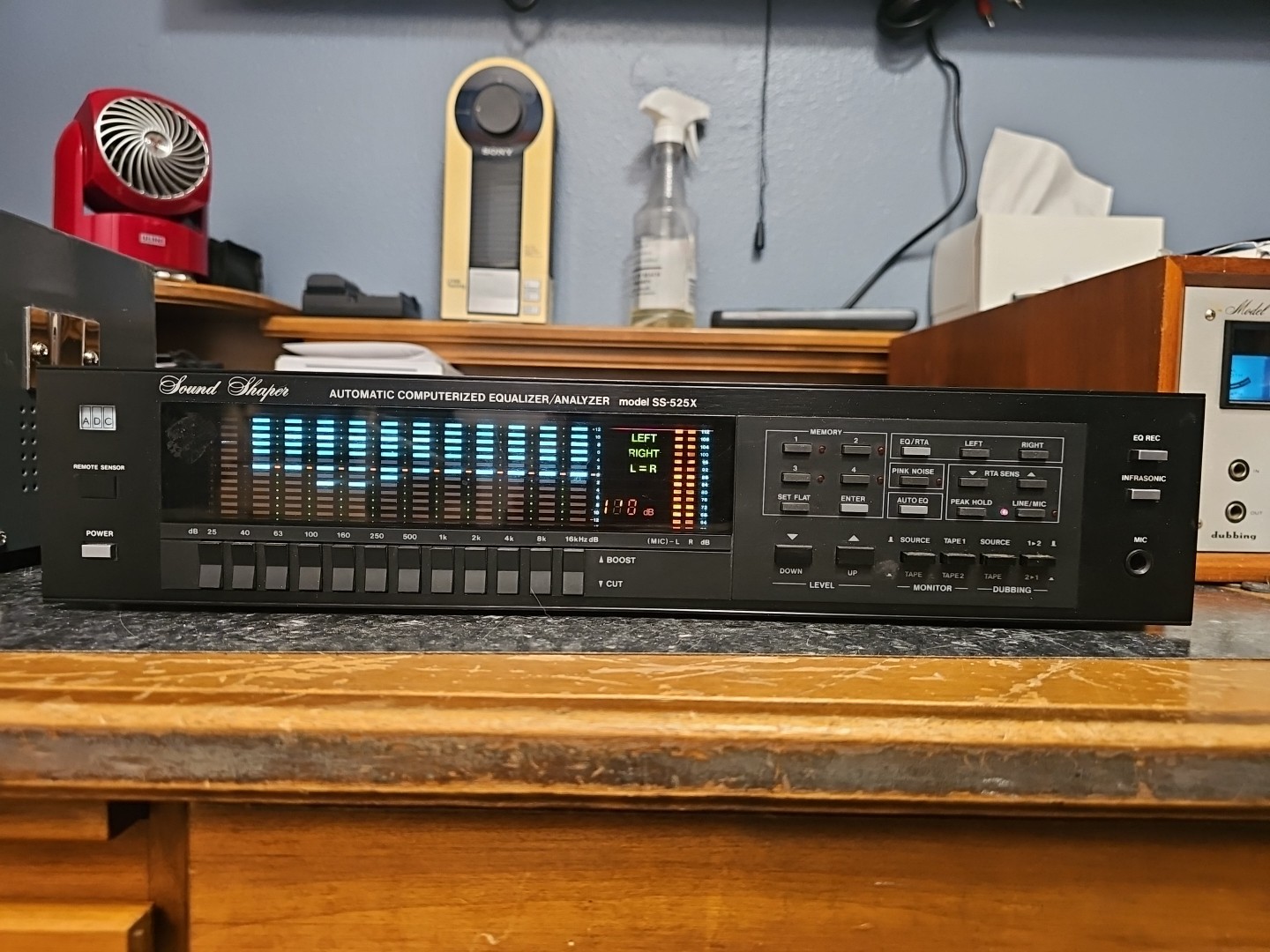
You don’t just hear the ADC Sound Shaper SS-425X—you watch it breathe. Its twin 12-band spectrum analyzers pulse in real time, each column of LEDs rising and falling like liquid fire, turning your listening session into a private light show. Built in Japan during the golden age of high-end consumer audio, the SS-425X wasn’t just another graphic EQ; it was a statement. A conversation piece. A piece of performance art that doubled as a precision audio tool. While most equalizers from the era sat quietly in racks, this one demanded attention, its glossy black faceplate and symmetrical twin displays glowing like something lifted from a sci-fi control panel. It’s no surprise owners report using it less for surgical tone correction and more for the hypnotic joy of watching music take physical form.
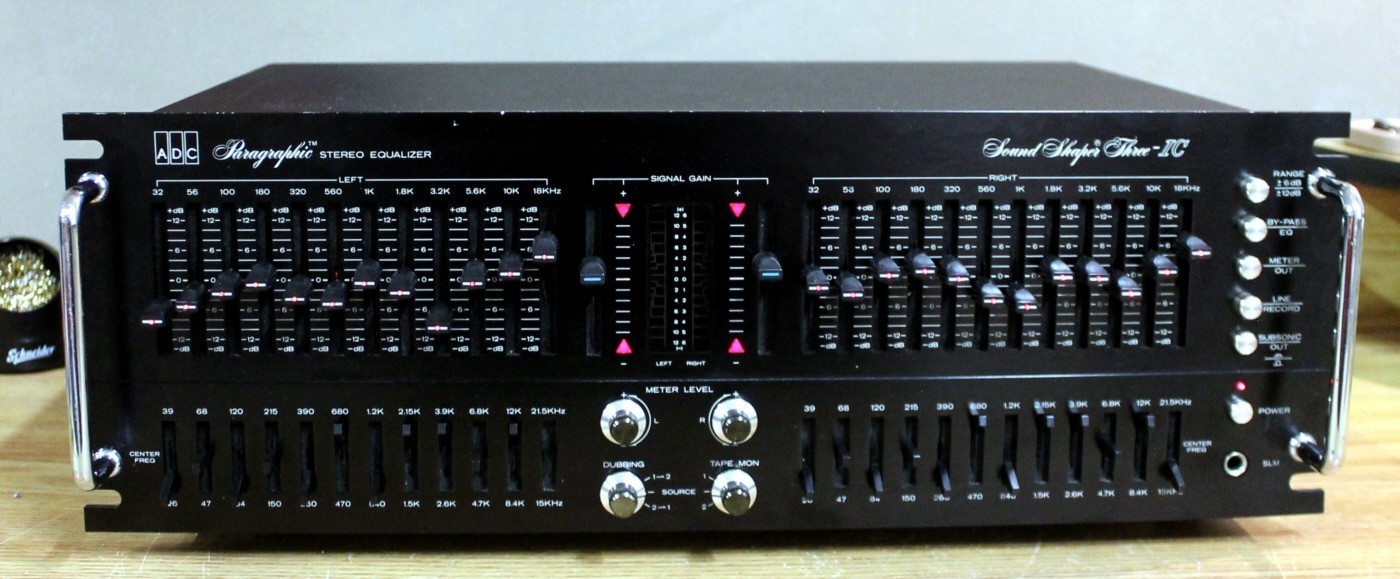
Functionally, it’s a stereo 12-band graphic equalizer with analog circuitry and digital memory—a rare combo in the early '80s. That memory feature, backed by internal batteries, lets it store custom EQ curves, a luxury when most competitors reset to flat every time you powered down. It’s not a processor in the modern sense—no presets, no remote, no digital effects—but the ability to recall your preferred tonal shaping without manual fiddling was a subtle convenience that elevated it above simpler units. The frequency bands are spaced logarithmically across the audible spectrum, from 32Hz to 16kHz, allowing nuanced adjustments that feel musical rather than clinical. Used with care, it can smooth out a bright speaker, warm up a lean system, or just nudge your favorite records into a more pleasing balance. But let’s be honest: most people bought it for the lights.
And those lights? They’re not an afterthought. The spectrum analyzers are full-range, responding dynamically to the input signal with a smooth, slightly damped motion that avoids the frantic strobing of cheaper VU meters. They’re accurate enough to give you a rough idea of frequency distribution, but their real value is aesthetic—they transform the act of listening into a visual experience. In a dim room, with the SS-425X pulsing gently on your rack, music becomes something you feel in your chest and see in your periphery, like a campfire you can tune to FM.
Specifications
| Manufacturer | ADC Sound |
| Production Years | 1980–1989 |
| Original Price | $199.00 (USD) |
| Number of Bands | 12 per channel (stereo) |
| Frequency Response | 32Hz to 16kHz |
| Adjustment Range | ±12dB per band |
| Memory | Yes, battery-backed |
| Battery Type | Internal, replaceable (typically 9V) |
| Audio Inputs | Stereo RCA (unbalanced) |
| Audio Outputs | Stereo RCA (unbalanced) |
| Signal-to-Noise Ratio | Not specified in available documentation |
| THD | Not specified in available documentation |
| Power Supply | AC adapter (external, model not specified) |
| Dimensions | Approx. 17" W × 5" H × 12" D (typical for rackable Japanese audio gear of era) |
| Weight | Approx. 10 lbs (4.5 kg) |
| Color | Black |
| Display Type | Dual 12-segment LED spectrum analyzers |
| Mounting | Rack-mountable (with optional brackets or custom panel) |
Key Features
The Light Show That Listens
The SS-425X’s most defining feature isn’t in the signal path—it’s in the display. Those dual LED arrays aren’t just decorative; they’re responsive, calibrated, and synchronized to the stereo input. Unlike the single-center displays on many competitors, the SS-425X gives you independent left and right readouts, making it easy to spot imbalances or simply enjoy the stereo image unfold. The LEDs have a warm, slightly amber glow—softer than modern blue or green arrays—and their response curve is tuned to feel organic, not jumpy. You can actually use them to identify dominant frequencies in a mix: a thumping bassline lights up the bottom three bars, cymbals make the top two flicker, and vocals bloom in the midrange. It’s not a professional analyzer, but it’s close enough to be useful and beautiful enough to justify its place on a shelf.
Analog Tone, Digital Recall
Under the hood, the SS-425X uses analog filter circuits for each band, which means the sound remains warm and continuous, avoiding the quantization and aliasing that plagued early digital EQs. The ±12dB range per band is generous but not extreme—enough to correct room issues or tailor system response without pushing into distortion. The real innovation is the memory function. When powered off, the unit retains your EQ settings via an internal battery, a feature that was still uncommon in mid-tier gear at the time. Service technicians observe that when these batteries eventually die (or leak), the memory is lost, and in some cases, corrosion can damage the board underneath. Replacing the battery with a fresh 9V and cleaning the contacts is a routine maintenance step for long-term ownership, but it’s a small price for the convenience of not resetting your curve every time you switch on the system.
Build and Interface
The chassis is typical of high-end Japanese audio from the era: thick steel, solid knobs, and a faceplate that feels like it could survive a minor earthquake. The sliders are smooth but slightly stiff—deliberate, not sloppy—and they stay put once adjusted. There’s no remote control, no digital interface, no menu diving. Everything is front-panel, tactile, immediate. The RCA jacks are mounted on the rear and feel secure, though owners report that the included AC adapter is often missing today, and replacements can be tricky to source with the correct voltage and polarity. The unit was designed to sit on a shelf or be rack-mounted, though it lacks built-in ears—most users add a third-party rack panel or simply display it proudly on open shelving where the lights can be seen.
Historical Context
The early 1980s were a boom time for home audio as consumers embraced the shift from stereo consoles to component systems. Brands like Sony, Pioneer, and Kenwood were pushing the limits of compact design, but niche players like ADC Sound carved out a space with bold, feature-rich gear that leaned into the spectacle of high fidelity. The SS-425X arrived when graphic equalizers were transitioning from professional studios to living rooms, often as tools to compensate for less-than-ideal speaker placement or room acoustics. Competitors like the Pioneer EQ-6300 or the Sony TA-EQ70 offered similar functionality, but few matched the SS-425X’s visual drama. While some audiophiles dismissed EQs as tone-killing gimmicks, others embraced them as a way to personalize their sound—especially as cassette decks and early CD players began to expose the brightness or thinness of certain recordings.
ADC Sound, while not as widely known as Denon or Yamaha, built a cult following among enthusiasts who valued both performance and presentation. The SS-425X sat near the top of their lineup, above simpler models like the SS-300SL but below the flagship SS-525X, which added automatic room correction and more bands. It was part of a broader trend of “computerized” audio gear—marketing speak for anything with memory or digital control—which gave products a futuristic sheen. The SS-425X didn’t compute in the modern sense, but the ability to store settings made it feel like it was one step ahead of its time.
Collectibility & Value
Today, the SS-425X is a sought-after piece for vintage audio collectors, not for its sonic transparency—though it performs admirably—but for its iconic look. Units in working condition with both displays fully functional typically sell between $400 and $700, with prices spiking for mint examples that still have their original packaging or accessories. Non-working units, especially those with dead or flickering LEDs, can be found for $150–$250, but restoration can be costly. The most common failure points are the internal battery (which can leak and damage the PCB), the power jack (prone to cold solder joints), and the LED arrays themselves, where individual segments may burn out over decades of use. Replacing a full display requires careful desoldering and matching of LED specs, a job best left to experienced technicians.
When buying, always verify that all 24 LED bars respond to input and that the sliders move smoothly without crackling. Check for corrosion around the battery compartment and ask whether the unit powers on consistently. Many sellers claim “tested and working,” but intermittent issues are common in gear this old. The original AC adapter is often missing, so factor in the cost of a compatible replacement with the correct voltage (typically 12V DC) and center-negative polarity. For long-term ownership, replacing the internal battery with a fresh one and cleaning the contacts is a must—do it sooner rather than later to avoid board damage.
Despite its age, the SS-425X integrates well into modern systems. It’s unbalanced RCA only, so it won’t compete with today’s balanced studio gear, but it pairs beautifully with vintage receivers, tube preamps, or even modern turntables with line-level outputs. It’s not a transparent processor—no graphic EQ truly is—but it imparts a subtle warmth that many find pleasing, especially on digital sources that can sound too clinical.
eBay Listings


As an eBay Partner, we earn from qualifying purchases. This helps support our independent vintage technology research.